
 •
Rating:
•
Rating:
THE REVIEW
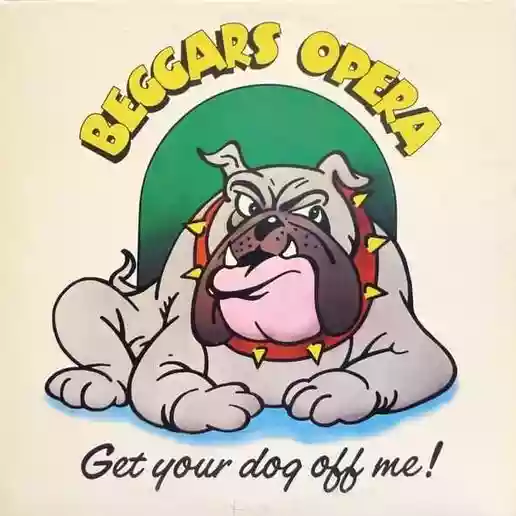
When this album was released back in 1974, there was a fair amount of disappointment among fans of this Glasgow band and the progressive genre in general. The cover art and the title alone didn’t bode well, especially after the spectacular covers and evocative names that graced their first three records.
With this fourth release, Beggars Opera further abandon their original progressive instincts, but don’t continue in the vibrant pop folk rock style they displayed on their second and third albums. Instead, they veer toward a pot pourri of hard rock, folk blues, pop rock, rock’n’roll… an eclecticism that, in their case, makes their music lose its identity more than making it lively and accessible.
The general downgrade is also due to the new singer, who has breath and grit but lacks the passionate operatic qualities of his predecessor—a true baritone with a tremendously powerful and easily recognizable, if at times undisciplined, voice. Guitarist Ricky Gardiner also lets go; at first he sounded like Blackmore and later delivered ultra-melodic Stratocaster parts and orchestrations that had undeniable impact. Here, instead, he plays as hard as he can and loses much of his personality.
The same goes for his bandmate Alan Park, an extremely skilled keyboardist who, after having virtuoso outbursts on the organ in the debut album, had adapted to a less flashy but still incisive role in the following two albums. Here, he steps back even further, and his talents are generously displayed only in the cover of “Classical Gas,” the famous instrumental by American guitarist Mason Williams, performed here with an abundance of harpsichord, mellotron, minimoog, and grand piano. All well done, but rather unremarkable.
There are nonetheless two or three good tracks (but nothing essential)—notably “Open Letter,” a fiery electric blues ballad, then the short and touching instrumental “Requiem” which somehow carries a scent of Scotland, their homeland. I’ll also include “Turn Your Money Green,” which is a fairly lyrical and intense hard rock number.
As for the rest: the title track that opens the album is a folk rock piece with a fine acoustic guitar intro; “Freestyle Ladies” and “Sweet Blossom Woman” are rock’n’roll tracks with nothing particularly outstanding; “Morning Day” is a skippable pop rock tune; “La Di-Da” is an American-style sing along, pleasant but completely impersonal; “Working Man” is a sturdy rock blues with a nice Hammond sound.
The CD edition includes two bonus tracks: “Two Timing Woman” is a basic and forgettable hard rock song, and “Lady of Hell Fire” is much the same.
With this record, Beggars Opera thus lose their sound—their hallmark as a Scottish progressive band tinged with good local folk and fueled by a couple of fine guitar and organ soloists. The event proves fatal for them, condemning them to a further career with limited prospects and precarious releases.
For die-hard progressive music fans, I strongly recommend their delightful 1970 debut, “Act One”; for the less fervent, their second album from 1971, “Waters of Change”—progressive for only about 20 percent, perhaps, but nevertheless solid and seductive.
Loading comments slowly
Summary by Bot
This review evaluates Beggars Opera’s album 'Get Your Dog off Me!'. The reviewer offers a fair rating and points out key strengths and weaknesses in the music. There is a focus on the album’s place in the band’s discography. Readers are given insight into whether the album is worth exploring. The review leans toward a balanced, middle-of-the-road assessment.Tracklist
01 Get your Dog off Me! (03:40)
02 Freestyle Lasdies (04:20)
03 Open Letter (04:32)
04 Morning Day (04:32)
05 Requiem (02:18)
06 Classical Gaz (04:28)
07 Sweet Blossom Woman (04:08)
08 Turn your Money Green (04:08)
09 La-di-da (02:53)
10 Working Man (04:33)
11 Two Timing Woman (03:44)
12 Lady Of Hell Fire (03:43)
Beggars Opera
Beggars Opera are a Scottish progressive rock band formed in Glasgow in 1969, best known for their early-’70s Vertigo LPs Act One, Waters of Change, and Pathfinder. The lineup featured guitarist Ricky Gardiner, keyboardist Alan Park, singer Martin Griffiths, and mellotron player Virginia Scott.03 Reviews
