 •
Rating:
•
Rating:
THE REVIEW
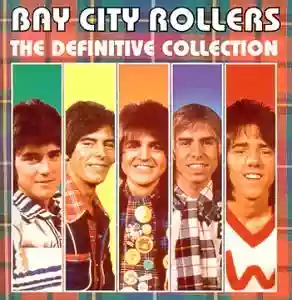
Today I would like to talk to you about the Bay City Rollers.
A name that to most may seem completely unknown, but which in the mid-70s represented a commercial and media phenomenon in England during the intermediary period between the end of glam and the rise of punk, very close to that of the early Beatles and Ziggy Stardust.
As a fan of glam rock and seventies bubblegum, I approached their journey and I must say that the story of this Scottish band is one of those that really deserves a few words; if nothing else, it is indicative of how the mechanisms of the music industry (and show business in general) have always been a treacherous and attractive lure capable of creating authentic idols only to ruthlessly discard them at the first change of wind, leaving those kind smiles and clean faces, chosen specifically for the posters in girls' bedrooms, at the mercy of personal tragedies and a descent into hell without respite.
Despite some devoted followers, even on the web the Bay City Rollers are almost ignored, with the exception of some nostalgic forties... yet exactly 20 years ago, in the year of grace 1975, this group scored a long series of singles in the British top ten, even breaking into the U.S.A. with what would become their most famous song, "Saturday Night".
The Bay City Rollers began to emerge, just in their twenties, in the first half of 1974 after a few unsuccessful singles: the decline of T.Rex and the abdication of Ziggy Stardust had created an image void in the stumbling glam scene that the too sophisticated Roxy Music and the too hard Slade could not fill.
Within 7 months, these Rollers emerged out of nowhere with a fresh, "good boy" image, absolutely flashy and kitsch outfits, in the best tradition of the fashion of the time, and a bubblegum pop with a strong inclination to win over the (mostly female) under 18 audience, with harmless and sugary lyrics... practically, a cleaned-up version of the Sweet.
Within a year, the band was on the covers of all music magazines and others, serious and lighthearted, with singles at no.1 on the charts, hysteria at concerts and massive success in the States... the "rollermania" was raging, even leading to the proposal of a television show all for them.
In '76 the first cracks appeared, despite other hits, with some suspicions of sessionmen being used to play on the records, and in the early months of '77, returning from a tour in Australia, it was the end: punk and new wave were at their peak, the platforms and teenage pop of the BCR (although some members of the band complained of being forced by the managers to compose "nauseating" melodic songs) became immediately past, ridiculous, pointless... from outcasts of British showbiz and idols of girls, the Rollers began an endless, painful ordeal to tell.
I've read about failed trips to Japan, several suicide attempts, scams by their managers (it seems that despite selling over 10 million records, the Rollers saw very little of their royalties), arrests for drugs and manslaughter, and increasingly squalid ventures until the recent arrest of the drummer, found with 6,000 images of pedophile pornography downloaded from the internet.
The sad story of this band forgotten by (almost) everyone after having touched glory for a few minutes is exemplary and lends itself to a long series of interpretations, also connected to the boy band phenomenon of recent years: in any case, as Rupert Pupkin said, better to be "king for a night" than a schmuck for life.
Loading comments slowly
Summary by Bot
The Bay City Rollers were a major 1970s British pop phenomenon with success driven by catchy bubblegum tunes and teen fan mania. Their clean-cut image and hits like "Saturday Night" made them idols before punk music eclipsed their style and popularity. Despite commercial success, they suffered exploitation, personal tragedies, and scandals in later years. Their story reflects the darker side of the music industry and transient fame.Tracklist Lyrics Videos
02 Keep on Dancing (single version) (02:10)
03 Remember (Sha La La La) (single version) (02:35)
05 Summer Love Sensation (03:18)
11 Rock and Roll Love Letter (02:59)
13 Yesterday's Hero (single version) (03:47)
14 Rock 'n Roller (03:38)
15 Dedication (single version) (03:58)
18 The Way I Feel Tonight (03:56)
19 Turn on the Radio (single version) (03:49)
20 Wouldn't You Like It (03:22)
Bay City Rollers
Scottish pop group that achieved major teen-idol success in the mid-1970s with hits such as "Saturday Night".01 Reviews
