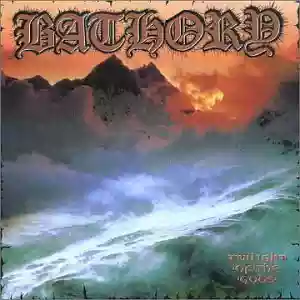
 •
Rating:
•
Rating:
THE REVIEW
There are people capable of creating, with very little, true masterpieces: this is the case of Quorthon, who in his long career wrote some of the best viking/epic albums, but certainly with this "Twilight Of The Gods" he reached the highest point of viking in general, yes...I am firmly convinced, for two fundamental reasons:
1) "Twilight Of The Gods" contains some of the most beautiful songs in epic viking
2) "Twilight Of The Gods" contains the most beautiful songs by Bathory
It's 1991, and Bathory has been around for a few years now, it's well known that the band is not composed of musical geniuses (technically speaking), but what most puzzles the group's fans is: "Which path will Quorthon decide to take? Will we return to the cacophonous black of the early albums?? Will Death Blood And Fire continue?"... well, the answer is simple, that genius Quorthon does what he does best...ignore everyone and everything and compose what he feels...and guess what??? A true masterpiece composed of 7 viking pearls is born, pearls that go by the name of "Twilight Of The Gods", a majestic 14-minute suite full of emotion: the song opens with a long introduction played entirely muted, to which, in a fantastic melodic interweaving, electric and acoustic guitars join, weaving a heavy and dark melody accompanied by a splendid text. The theatricality of the singer's voice and the great choirs in the background make the song truly exquisite and not at all heavy to listen to. Then we move on to "Through Blood By Thunder," a song that lays the foundations for the great post-production Bathorian style, starting with a quite calm initial arpeggio, followed by a very cadenced base based on a square and powerful rhythm accompanied by an especially ungraceful singing that makes it all very particular. After this pearl, we move on to "Blood And Iron," a great classic of the group's production, which opens with a beautiful and very sad acoustic guitar arpeggio, then transforming into a more complex song compared to the previous one: the guitars become more aggressive, and the drum tempos are much more varied and complex. Quorthon's monotonal voice is this time a bit of a weak point of the song, which is slightly marred. Nevertheless, the general level of the song is excellent. 10 minutes of pure epicness. "Under The Rune" instead shows us a vocalist in great shape, offering us a truly excellent performance with the construction of excellent vocal lines accompanied by fantastically epic choruses. The melodic base is simple, almost elementary, but not at all ugly...the main melody turns out to be one of the best on the album, where light musicality and aggressiveness are perfectly balanced. "To Enter Your Mountain" is the song that attracted me the least, not because it's ugly (on the contrary, compared to modern viking, it is something unreachable), but because it relies too much on the base of "Twilight Of The Gods" and a truly terrible singing that it is overshadowed by so much beauty (I regret saying it). "Bond Of Blood" resumes the path taken with the previous song, but is much richer in ideas and accompanied by better singing; the electric guitar lines are beautiful and dominate the song's duration. The last "Hammerheart" is one of the most beautiful songs I have ever heard: nothing special from a technical/instrumental point of view, to be clear, but the emotional charge that this Viking choir releases is something unparalleled; the theatricality and emotionality that Quorthon's voice releases in this piece is something unique and fantastic. The main melody is excellent, absolutely devoid of guitars and all classic instruments such as bass and drums (the latter only appearing with cymbals in the dreamy chorus).
Ultimately, this is surely one of the most beautiful albums I have ever listened to, and it is undoubtedly the best viking product ever conceived; the production of the album, quite dirty, makes it all the more fantastic and pleasant.
Loading comments slowly
Summary by Bot
The review praises Bathory's 1991 album Twilight Of The Gods as the pinnacle of Viking metal and one of the best Viking albums ever made. Quorthon's unique creative vision shines through in all seven tracks. Despite some technical imperfections, the songs balance emotion and melody expertly. Highlights include the majestic title track and the emotionally charged 'Hammerheart.' The album's raw production adds to its captivating atmosphere.Tracklist Lyrics Videos
Bathory
Bathory was a Swedish extreme metal project led by Thomas “Quorthon” Forsberg, widely credited as a key early architect of black metal and an origin point for Viking/epic metal. The project began with raw, satanic-leaning black/thrash records and later shifted toward epic, Norse-myth inspired works such as Hammerheart and Twilight of the Gods. Forsberg died in 2004.26 Reviews
Other reviews
By fjelltronen
Quorthon shouts to march under the runes, to die under the runes in the next track, and he does so with a fervor and passion that leave one trembling, astonished.
A timeless work that does not suffer from changing trends, that does not care for coteries and labels, that celebrates the cult of the North with vigor and simplicity as befits the men of the North.
