
 •
Rating:
•
Rating:
THE REVIEW
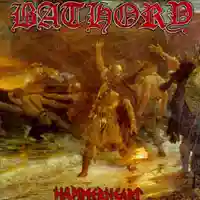
The turning year for Quorthorn, leader of Bathory, is 1990: after being the creator of a malevolent, perverse, and extremely violent thrash, with particularly satanic lyrics, which will take the name of Black Metal, our Thomas undergoes an ideological and musical shift: he realizes that Satanism only serves to bring Christianity to mind, and so he decides to distance himself from it as well; his goal, the battle against the Christian religion, is then carried on in another way, through pagan lyrics inspired by Norse mythology: "Hammerheart" can therefore be seen as a concept album centered on the customs and traditions of the ancient Vikings.
There are also novelties from a musical perspective: abandoning the cacophony of the previous three and a half albums (in fact, the previous 'Blood Fire Death' is musically a black with many epic parts), this work embraces epic and solemn tones, very close to American epic metal, full of choirs and melancholic melodies. From this emerges "viking metal."
A delicate guitar arpeggio opens "Shores In Flames", a composition that stretches to 11 minutes, developing into a majestic metal symphony centered on the Viking raids of the 11th century. From this track alone, one can understand the stylistic coordinates that will guide the work: the compositions are very simple and repetitive, always formed by a linear structure, and lacking any technical evolution; above all stands Quorthorn's bard-like Nordic voice, ungraceful and, in a sense, very "punk" in attitude, yet simultaneously more evocative than ever. After the long and heavy "Valhalla", we move to "Baptised In Fire And Ice", the heaviest track of all, boasting an anthemic and majestic riff and a truly uncompromising rhythm. Both this and the following track, "Father To Son", with its sunny and very melodic chorus, are centered on the theme of passing on traditions: in both songs, the narrator's father is the central figure, pleading with the son to carry on the traditions and never change ideas and values. "Song To All Up High" is a brief acoustic ballad, a strong pagan ovation towards Odin, followed by "Home Of Once Brave", the album's most minimal and rhythmic track, centered, like the following, on the theme of the glorious past: Quorthorn describes the natural beauties of his land (mountains, fierce wind, snowstorms, endless forests) calling them "the home of once brave people," whose descendants have forgotten their glorious past and have been deceived by Christian beliefs.
Finally, we reach the masterpiece within the masterpiece, the stunning "One Rode To Asa Bay", the quintessential Viking track, a song brimming with melancholy and epicness in every second... the anger and hatred towards Christianity, a religion imposed by force, and the cause of the loss of all Viking traditions and the Viking identity itself, is almost palpable.
This song concludes one of the greatest albums that Nordic metal has passed down to us, a testament to how heathen pride is still rooted in many people.
RATING = 9.5
Loading comments slowly
Summary by Bot
Hammerheart marks a pivotal shift for Bathory and Quorthorn, departing from satanic black metal to embrace Viking-inspired pagan themes. The album features epic, majestic soundscapes with simple yet evocative compositions. Tracks like 'One Rode To Asa Bay' capture the melancholy and pride of Viking heritage. Widely regarded as a foundational work in Viking metal, Hammerheart stands out for its lyrical depth and musical solemnity.Tracklist Lyrics Videos
Bathory
Bathory was a Swedish extreme metal project led by Thomas “Quorthon” Forsberg, widely credited as a key early architect of black metal and an origin point for Viking/epic metal. The project began with raw, satanic-leaning black/thrash records and later shifted toward epic, Norse-myth inspired works such as Hammerheart and Twilight of the Gods. Forsberg died in 2004.26 Reviews
Other reviews
By emanuele1
The album thus concludes, leaving the world a true masterpiece of music, unrepeatable and unmissable, which will lay the foundation for all future Viking albums.
11 minutes of pure Viking will overwhelm you, transporting you to the icy lands of Northern Europe.
By fjelltronen
The ideal soundtrack for a book of Icelandic sagas, the immortal 'Hammerheart.'
Quorthon’s guitar sounds like a bagpipe among rocky slopes, sketching fiery yet romantic harmonies.
