 •
Rating:
•
Rating:
THE REVIEW
Every musical genre has its heroes. And Ace Borje Thomas Forsberg, known as Quorton, is undoubtedly a hero of metal. All the more worthy of respect as his artistic life unfolded away from the spotlight, in solitude, inside his small garage, among detergents and car parts, a bleak setting where truly significant pages of the history of a handmade genre such as black metal were written.
It's easy to create a myth, especially if we're talking about someone deceased (let's remember that Quorton's existence in this world was abruptly interrupted in 2004, at only 38 years old, due to a sudden cardiac arrest), yet it is impossible not to recognize the merits of a musician who, besides having produced albums of undeniable value (I count at least five masterpieces), was able to stay ahead of his time, transforming his extremist impulses into acts of pure avant-garde (still speaking of metal), continuously changing his essence with absolute consistency in his way of being elusive, outside of trends, in the perspective of an artistic maturation that is first and foremost the maturation of a man and an individual.
Rivers of words could be spent, and never in vain, on an entity like Bathory, which with the first three albums represented the most evil and morbid incarnation of a way to conceive and make extreme music, and with the subsequent ones was able to emancipate itself from the stylistic clichés it had created, to evolve into a more meditative and atmospheric form, in years when metal was pushing the limits of the extreme forward with the birth of death metal and especially grindcore.
"Blood Fire Death", the band's fourth release, came out in 1988 and represents the turning point where the two forms meet: the formal pinnacle of sonic intransigence of the early works, and the starting point for the sublime sounds deftly developed and explored in the masterpieces of maturity “Hammerheart” and “Twilight of the Gods”.
The change, although sudden, is not a bolt from the blue, and finds its origin, albeit in an embryonic stage, in the previous (another, yet another masterpiece) “Under the Sign of the Black Mark”, and more precisely in a track bearing the features of “Enter the Eternal Fire”, which in its almost seven minutes expanded the breakneck thrash metal of its beginnings into the measured pace of an epic ride with undeniable “melodic taste”, if it is permissible to speak of melody.
It is precisely from here that the journey begins to craft a work that, while retaining the muscular and uncompromising sound of the past, wears an armor finally professional, proceeding with greater order, while simultaneously showing the first signs of the impending emancipation from that proto-black metal so ahead of its time that it will still have to be metabolized, conceptualized and picked up by the generation of musicians belonging to the following decade.
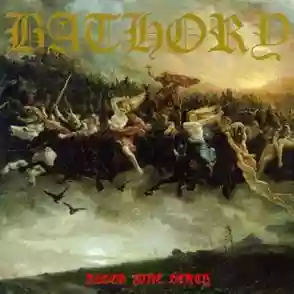
Quorton was already looking beyond, already ahead of his disciples. Just look at how the album takes its first steps. The hiss of the wind, the neighing of horses, the muffled stamping of hooves, evocative symphonic settings as a backdrop: “Odens Ride Over Nordland” is an atmospheric introduction that unexpectedly envelopes the listener, catapulting them into the fantastic and legendary skies depicted on the elegant cover. The acoustic guitar and extraordinarily clear vocals that open the monumental “A Fine Day to Die” do the rest: it is clear from the outset the intent to definitively abandon the satanic themes that had characterized the previous trials to fully embrace the discussion of myths and legends of the ancient North, another major novelty, perhaps the fundamental novelty of the album. Because the Swedish artist is truly the first to tread a path that will win such success among the practitioners of the trade to give birth to a new genre, the viking metal (a label I have never particularly liked).
The radicality of a choice that breaks with a consolidated tradition in the extreme metal of those years remains, which, in line with rock about twenty years earlier, loved to celebrate the Devil as a symbol of transgression, soon degenerating into a carnival and puerile masquerade, ridiculed from many quarters (a fashion still in vogue in the third millennium, and who knows how much Quorton is laughing today, observing inverted crosses and mascaraed novices up there on the Valhalla of rock's damned, drinking beer with Jimi Hendrix and Jim Morrison).
The thematic choice is therefore the winning move of this album which, beyond the undeniable beauty of its pieces, retains the forms and movements of 80s thrash metal: a thrash obviously disfigured by the rawness of those equipped with poor and rudimentary equipment and lacking fine technique (but endowed with passion, creativity, and so much, so much heart!).
There is still much black metal: there is the shrill, ungracious and terrifying bark of Quorton, who continues to showcase his non-singer qualities, as there are no shortage of moments of claustrophobic and mystical speed where the drums pound wildly dragging a hypnotic guitar that reiterates digging abysses within the subconscious of the listener (see the final part of “Holocaust”). Not only: the sharp riffs animated by a rushing epic exuberance and the clinking cymbals that mark legendary mid-tempos are elements that we will often find in the works of the glorious Norwegian school of the '90s. And then the atmosphere that pervades all eight pieces, built with sumptuous keyboard sounds, inspired interventions of acoustic guitar, and a measured use of clean vocals.
The already mentioned “A Fine Day to Die”, which begins as a dark twilight ballad, quickly transforms into a metallic monster that over its eight and a half minutes has the merit of surveying Quorton's new artistic vision, suspended between violence and pathos (see the acoustic interlude that breaks in the middle of the track, a crack of light in the darkness, a sudden melodic opening where the keyboards and the neighing of the horses that opened the piece return to echo).
The tracks that follow are old-style whiplashes, where little is conceded to melody, but which nonetheless record a lesser eagerness to smash everything, and a significant technical improvement in handling the different instruments (remember that, despite Bathory's internal booklet photo enjoying appearing as a proud trio of Vikings armed to the teeth and intent on delivering great sword blows in the foggy vegetation of a Scandinavian forest, all music is as always composed and played by Quorton alone). Among these pieces, which I would dare to define as assassin-like, I mention the superb “For All Those Who Died” and “Dies Irae”, which will certainly set standards in the years to come: the first for its riffing that, albeit almost Sabbath-like, remains dirty, full of pathos and ruthless in its progress; the second for the restart after the sizzling guitar break, which tones down towards a rotten and decadent metal, as the best black-metal tradition will know to embrace and codify.
But there is no doubt that the most extravagant praises must be spent on the majestic title track, which in its engaging ten minutes both anticipates what would later be the next evolution of the band and paves the way to new musical worlds. In this proud ride, there is everything: power, melody, epicness, so much so that it seems to resurrect, in a more elegant and considered form, the glories of the Venom-like “At War with Satan”. What fantastic visions, what infinite worlds this little man sitting on his small chair, hoarse and clumsily playing the guitar from his small basement full of bric-a-brac, where the equipment hardly found a place, is capable of evoking.
This is called art, and Quorton, regardless of everything, represents one of the most genuine and inspired expressions of the metal scene ever: an authentic “songwriter of the Extreme”, Quorton managed to ride the Edge of music, tame terrible demons, to surpass the Edge itself, transcend genres, trace new paths, and remain himself.
A feat granted only to a few chosen ones.
Loading comments slowly
Summary by Bot
Bathory's 1988 album Blood Fire Death marks a crucial turning point in extreme metal, blending black metal's raw intensity with emerging Viking metal epicness. It showcases Quorton's visionary artistry and technical growth, moving from satanic themes to Norse myths. This album combines brutal riffs, atmospheric keys, and a new melodic approach, setting standards for future metal genres. The review praises its enduring influence and artistic innovation, highlighting it as a masterpiece in metal history.Tracklist Lyrics Videos
Bathory
Bathory was a Swedish extreme metal project led by Thomas “Quorthon” Forsberg, widely credited as a key early architect of black metal and an origin point for Viking/epic metal. The project began with raw, satanic-leaning black/thrash records and later shifted toward epic, Norse-myth inspired works such as Hammerheart and Twilight of the Gods. Forsberg died in 2004.26 Reviews
Other reviews
By BathoryAria
Uh-oh! We've been informed that this review also appears (in whole or partially) on truemetal.it and we have been asked to remove it.
