
 •
Rating:
•
Rating:
THE REVIEW
“Aspirational”, a term poorly translated as “aspirazionale” or “motivazionale”, refers to those products that consumers long to possess in order to improve their image or lifestyle. In simple terms: craving what one cannot afford, a sport widely practiced these days. This film feels like the cinematic manifestation of director Bart Layton’s aspirations, who seems to desperately wish he could be the new Michael Mann, only to end up crashing miserably into the guardrail.
The true protagonist of Crime 1010 is undoubtedly nocturnal Los Angeles, filmed with undeniable elegance: incandescent ribbons of yellow and red headlights, buildings suspended in silence, urban unease pulsating beneath the surface. The echo of Collateral is apparent, but above all, the shadow of Heat looms large, a film where the city dominates and human beings are almost mere transient accessories.
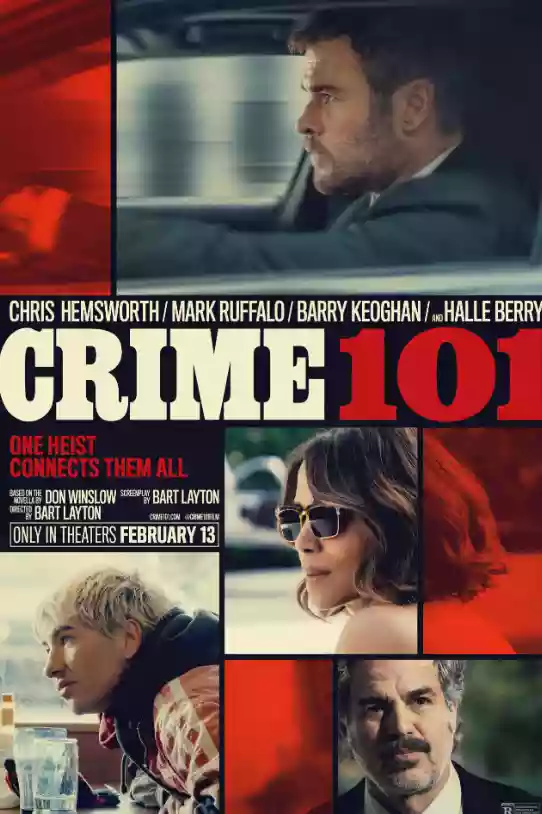
Too bad Bart Layton is not Michael Mann, and here aspirations remain just that: aspirations. The most successful character is Mike (Chris Hemsworth), a silent, methodical, disciplined thief, defined more by routine than by any real personality. He is a professional “non-violent” burglar, working with the colorful Money (Nick Nolte)—whose name says it all. Their heists are planned along Highway 101 to ensure fast getaways, but the plot kicks off when Mike refuses to participate in the jewelry heist that Money instead assigns to the younger and more unstable Ormon (Barry Keoghan).
Meanwhile, Detective Lou (Mark Ruffalo) develops a theory about the 101 thief that, as contractually required by cliché, is met with mockery and paternalism from his superiors. Ruffalo, for his part, seems unaware of which film he’s acting in, while his marital crisis—stuck to the narrative like a forgotten post-it note—serves only as yet another frayed thread of an already teetering screenplay.
Subplots and various distractions pile up around the story: a crooked jeweler who justifies a pointless detour to a lie detector; a love interest for Mike so artificial it’s more irritating than believable; and above all, Sharon (Halle Berry), a successful, wealthy, and frustrated insurance executive, narratively doomed to interrupt the film at regular intervals to remind us of her moral indignation at the "patriarcato". More than a character, she’s a walking reminder. And if the film had really wanted to tackle sexism and ageism with even a modicum of honesty, perhaps they could have chosen someone who actually appeared the age the script claims to problematize.
All these narrative threads, already shaky, stumble towards a finale that manages to be both frantic and absurd. Lou slips into corruption with no consequences, Sharon is awarded for her ideological zeal, while Mike, surviving for years thanks to discipline, suddenly discovers the romance of a woman he’s known for about as long as it takes to order a coffee.
This is one of those films that could have worked, and that’s exactly what makes it more irritating. Beneath the surface, you can glimpse a better, leaner, fiercer, more precise version, but it is slowly strangled by a screenplay lacking the necessary courage, bent to contemporary conventions as predictable as they are sterilizing. Instead of becoming the new Heat, it remains an exercise in frustrated aspiration. Sign of the audience's tepid reception: the film, released in theaters in February 2026, is already available on Prime.
Loading comments slowly
Summary by Bot
The review assesses Bart Layton’s 'Crime 101,' highlighting its gritty atmosphere and suspenseful moments. While the direction is strong, the film doesn't fully deliver, resulting in a lukewarm rating. The reviewer implies the experience is engaging but ultimately average. Fans of the genre may find it worthwhile, though expectations should be managed.
Bart Layton
Bart Layton is a British film director and documentarian known for blending documentary and dramatization, notably in The Imposter (2012) and American Animals (2018). He later directed the heist thriller Crime 101 (2026).02 Reviews
