 •
Rating:
•
Rating:
THE REVIEW
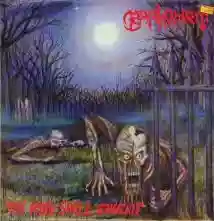
The Baphomet are one of the oldest, most important, and most overlooked bands in the entire American Death metal scene; whether it's because their career ended quite early or because fate was against them, the fact remains that these guys from Buffalo (the same city as Deicide) have had no luck.
On the other hand, the web makes it clear: they have practically left no trace. Listening to “The Dead Shall Inherit” makes one realize how ruthless the mechanisms of the music business are and how unjust the “refined” taste of death metal fans can be. I'm not exaggerating when I say that a listen to this work, after being preliminarily informed of its date (1992), can literally diminish the early works of Deicide, Morbid Angel, and Malevolent Creation; don't think that I hate these groups to death (although for the first two it is somewhat true), I simply mean to say that this is a band that does not deserve to be overshadowed by the big names, and that, in terms of sound and technique, they could very well replace them.
It is absolutely unfair that Baphomet are thus obliterated and Morbid Angel is on everyone's lips even after the release of an album like “Gateways To Annihilation,” but that's another story. The LP, consisting of ten songs, still partially reflects the influences of the most violent Thrash of the late eighties (Sepultura, Testament, etc.), but these are ultimately marginal: the ingredients for a Death CD are all there, more violent and dark than ever.
The drumming, first of all, is very varied and ranges from the usual blast beats to passages that are not excessively flamboyant but of undeniable charm: double bass rolls, accelerations, and slowdowns are nothing but the mainstays on which a complex structure is built, capable of enhancing technical prowess and maintaining a strong impact. Even the guitar parts are never boring; in fact, they are varied enough to keep the listener alert but not to the point of forfeiting power: on the contrary, they are capable of developing a significant wall of sound, often indulging in riffs with Thrashy nuances.
Note the absence of solos, an element generally used to give a breather and showcase the guitarist's skills; to be fair, they are not missed as the sound gains in compactness without falling into monotony or clichés. The bassist offers an excellent performance, delighting the listener's ears with some finely crafted interludes. Lastly, a good performance also from the singer, who has quite a low growling, albeit a little repetitive. Excellent production, filtered just right to render the sound full-bodied but not chaotic. All the songs, as already mentioned, are well-conceived and always include a good range of tempos and riffs that show a certain attention in the writing phase: moreover, although this CD is not a so-called “concept album,” they manage to generate a mood in their own way (even if it is solely based on violence). In short, “The Dead Shall Inherit” is one of those albums that best define Death metal; powerful, extremely heavy, and not obvious, a CD that wins the comparison with many other contemporary works that have enjoyed greater success with the public and critics.
The score could very well be the highest, but given the presence of less convincing tracks like “Through Deviant Eyes” or “Leave The Flesh” (which, if we want to, are closer to the style of the bands mentioned at the start), it drops to the one immediately below: still, it remains very good.
Loading comments slowly
Summary by Bot
Baphomet's 1992 album 'The Dead Shall Inherit' is a powerful and underrated death metal work from Buffalo. Despite being overshadowed by bigger names, the album showcases technical prowess, varied drumming, and a distinctive heavy sound. Influences of thrash metal are present but secondary to its core death metal strength. The album is an unjustly overlooked classic with strong production and songwriting.Tracklist Videos
Baphomet
American death metal band from Buffalo, New York, noted for the 1992 album The Dead Shall Inherit; also known as Banished.01 Reviews
