
 •
Rating:
•
Rating:
THE REVIEW
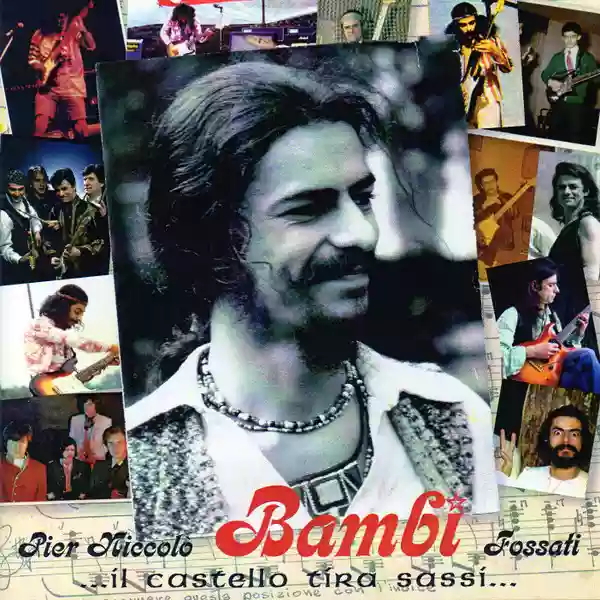
If the name Pier Nicolò Fossati doesn’t ring a bell, it’s only because Italian rock has a short memory. But just pull out the Garybaldi records and, above all, Nuda (1972) to set things straight: one of the wildest, most lysergic, and out-of-control albums ever released in these parts. And at the center of it all was him, “Bambi” Fossati. Somebody who took Jimi Hendrix, filtered him through Genoa, the port, the sweat of smoky clubs, and a uniquely Italian anarchic attitude, and brought out a sound that wasn’t imitation but transformation. It’s no coincidence that even today, Nuda is cited as a cult gem of Italian prog, even by those who can’t stand prog at all.
“…Il Castello Tira Sassi…” comes much later, and inevitably it’s something else. Not the album of consecration, but of memory. Only, thankfully, it is not embalmed. It’s a crooked album, assembled from recordings spanning different years, and that’s exactly why it works: it doesn’t narrate a single phase—it tells the story of a way of inhabiting music. Inside you find Fossati at his most direct and rough (“Reprimenda mores”), the one who starts slow and then upends everything (“Qualcosa non va”), the narrative, almost cinematic one (“Trattoria Celeste”), and the darker, more expansive one (“In una stanza”), where all his psychedelic soul resurfaces. And then there’s the less celebrated but just as important side: the one that plays with jazz, funk, and cross-contamination, without ever losing its identity. It’s not a stylistic exercise—it’s pure curiosity. When today’s Garybaldi, led by Maurizio Cassinelli, make their entrance, the circle closes. “Madre di cose perdute” is not just a great track: it’s a bridge between what was and what remains.
And maybe that’s precisely the point of this album. Not so much to celebrate Fossati, but to remind us that there once was a way of playing that was free, dirty, untamed. A way that today seems almost vanished.
And yet, every now and then, it surfaces from some forgotten tape to remind you that yes, we, too, had our own little sacred monsters here.
Loading comments slowly
Summary by Bot
The review examines P.N. Fossati's album 'Il Castello Tira Sassi,' praising its creativity and unique approach. The strengths of the album are highlighted, while minor criticisms are briefly touched upon. The reviewer recommends the work, rating it 4 out of 5. It's positioned as notable within the Italian scene. Overall, an engaging listen recommended for music enthusiasts.
"Bambi" P.N. Fossati
Italian guitarist best known as the driving force behind Garybaldi, with a fierce psychedelic/prog style. Revered for the cult album Nuda (1972) and later work like …Il Castello Tira Sassi….01 Reviews
