
 •
Rating:
•
Rating:
THE REVIEW
"I Know A Place, high in the mountains, in Switzerland, where there are lakes, and trees and woodland paths... and music!... beautiful music everywhere".
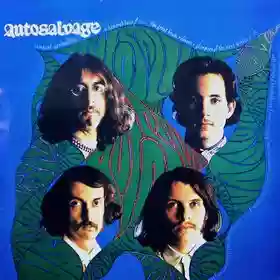
We are welcomed with this hallucinatory phrase by the first and last album of the New Yorkers Autosalvage, a group initially discovered by Frank Zappa who gave them their name before they were signed by RCA, featuring a sound imbued with all the typical characteristics of the psychedelia of that '68, of which they are a legitimate and bastard child, as well as a balanced meeting point: corrosive acidity, vocal grace, rhythmic skill, and innate structural fantasy.
In the opening track, their personal masterpiece stands out, the eponymous title track, exploding ecstatically between Californian-style choruses and the perpetual fuzz-tone of the guitar by leader Rick Turner, whose status is affirmed especially in terms of arrangement; by relying on the dulcimer, he manages to deviate and make a structure otherwise at risk of falling indistinctly into the lysergic cauldron of the late sixties, but which actually takes on spatial connotations worthy of Pink Floyd's "The Piper At The Gates Of Dawn".
It is a sensational track that constantly changes skin in five minutes without ever even slightly touching the pomposity of prog-rock but remains as light as a hit by the Mamas & The Papas, yet infinitely more imaginative; under its heavy acid mood, pop, boogie, and blues-rock succeed each other with extreme and inspired technical skill.
Then, inevitably, the album declines, yet always maintains an excellent level.
Although the extraordinary skills of musicians like drummer Darius Davenport, varied and impeccable, and bassist/pianist Skip Boone (brother of Steve Boone of their friends, the Lovin' Spoonful, mentioned here not by chance) remain indisputable, most of the songs that follow are pieces that, despite being performed impeccably and with a strong personal imprint, fall into the groove of more classic West Coast music.
Needless to say, the main references are the monumental Byrds ("Rampant Generalities" and "A Hundred Days") and Jefferson Airplane ("Glimpses Of The Next World's World"), the former for the vocal harmonies and the latter for the acid-intensifying inclination. This does not mean that the Grateful Dead-style mini-jam blues in "Good Morning Blues", the Creedence-like boogie of "Our Life As We Lived It", and the lysergic journey of "Parahighways" don't make the brain tingle and the legs unconsciously shake.
But let's not forget, the four semi-mustachioed long-haired guys come from the Big Apple, which in '68 mainly means Velvet Underground. It is not uncommon to notice in their offering a slightly noisier attitude than the bands from the opposite coast, from the overused fuzz and distortions (far less frenzied than those of the four Warholian guys), to a guitar style that intentionally combines sickly strumming and "annoying" blunders (the original, swirling "The Great Brain Robbery" which takes the second place on the podium), to some banjo and oboe digressions that at times give the sound a slightly baroque and medieval connotation ("Land Of Their Dreams" and "Ancestral Wants").
"Autosalvage" is a breakout debut, composed with a skill and awareness of their unusual potential for a debut.
This sort of East Coast Jefferson Airplane, tainted by the cosmic blows of Syd Barrett and the abrasive scratches of Jimi Hendrix, stands the test of time better than Slick and company, leaving us with an unsatisfied and bitter question about what they could still have become.
What a pity!
Loading comments slowly
Summary by Bot
Autosalvage's self-titled 1968 album stands out as a brilliant psychedelic rock debut. Led by Rick Turner’s inventive guitar and arrangements, it blends acid rock with West Coast harmonies. Though the album dips after a standout opener, it maintains strong musicianship and showcases a unique NYC noisy edge. The review laments the band’s unrealized future potential.Tracklist Videos
