
 •
Rating:
•
Rating:
THE REVIEW
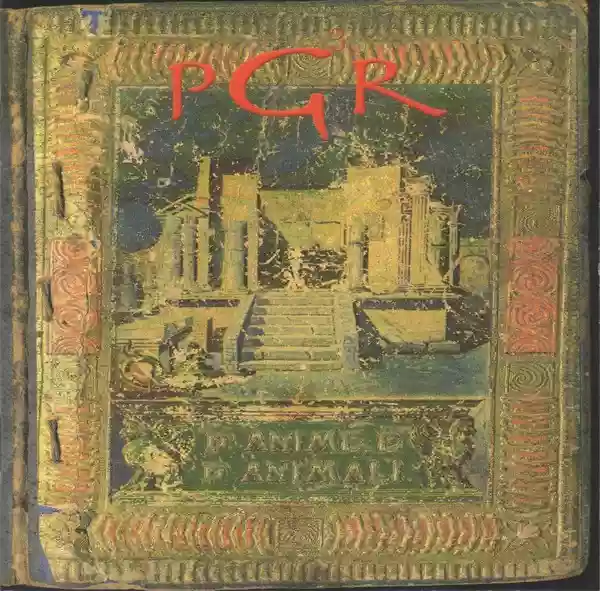
There are albums that are important beyond their artistic value. There are albums to listen to for their historical significance. There are albums worth discussing even if, in the end, you don’t like them. There are albums that mark the end of an era. One of these is “D’Anime e d’animali” by PGR. PGR is the latest creation from the Ferretti family tree, which starts with CCCP, continues with CSI, and concludes (wearily) its adventure with this last creation lacking the harmonious guitars of Zamboni (who accompanied Ferretti from the start), and after the debut (more interesting than the album I’m reviewing) also the skillful keyboards of Magnelli and the sweet voice of Ginevra Di Marco. An inattentive first listen to the CD risks providing much comfort. Ferretti’s magnetic and chanting voice is there, and the sound inherited from CSI seems to be there as well. At a second, slightly less distracted listen, the first doubts arise. Perhaps it sounds too much like CSI, which is almost a paradox considering that the three works of this fundamental band are nonetheless the result of continuous evolution and research. But the feeling is that an easily predictable musical path (for them) was taken. There is nothing that is truly bad (except maybe PGGGR), but the fact that ultimately Zamboni's absence isn’t felt seems more like a flaw than a virtue. Then comes the third listen, less distracted, paying attention to the lyrics and also reading Ferretti's accompanying notes. And everything becomes clear. We are faced with an old friend, we are pleased to see him again. We care about him. But he has changed, we probably won’t see each other again, we won’t find ourselves on the same path anymore. The lyrics and comments are a snapshot of the beginning of Ferretti’s path (still not fully completed) from punk-communist to Ratzingerian Catholic and sympathizer of Giorgia Meloni. He declares himself an orphan of the left, and so far there's no problem. However, one glimpses the path (at times incomprehensible) from the lyrics of “Casi difficili” where we are faced with the classic anti-bien-pensant discourse that currently finds much favor on the Salvini-Meloni shores. In the commentary notes of Cavalli e Cavalle, there are other clues, in his attack on secular fundamentalism (although he defines the Catholic one as ridiculous) and in identifying Islamic extremism as the danger to European existence (although he defines its value as slight). Other clues in “Orfani e Vedove” where his disaffection for the “line” that was the subtitle of CCCP emerges. Although echoes of bucolic praise were present in the splendid “Linea Gotica”, here we find an even stronger turn towards the idyll of the countryside and above all of traditions, roots, and the "good values of the past." Very self-referential texts, twisted around themselves and only at times inspired. “A pure heart and a straight cock are worth more than a weak thought” or “at least let screwing be healthy, the human animal act.” In “Divenire” he still claims a sort of right to become something other than what he has represented (although we remember “make me a megaphone and I will burn it”). Despite all this, some pearls still emerge. The first song “Alla Pietra,” which evokes the instinctive beauty of a concert experienced with the group that brings back to an idyllic albeit illusory atmosphere. Or again, the delicate description of the sexual act where spirituality and animal instinct harmoniously unite in “Tu e io.” But above all, the spectacular “S’ostina” with the most inspired lyrics of the work in which all the strength of a circular yet emotionally charged vision of the world emerges. An album that is an important snapshot for those who loved CCCP and CSI despite its evident weaknesses. The true end of an era. Nonetheless, and always grateful, we leave Ferretti to his current path. This may be his goodbye.
Loading comments slowly
Summary by Bot
PGR’s album D’anime e d’animali is a significant farewell marking the end of an era for Ferretti and his evolving musical journey. While the music lacks the harmony of past collaborations, the album stands as a historical snapshot with deeply personal and political lyrics. It highlights Ferretti’s ideological shift from punk roots to conservative sympathies, dividing listeners. Though musically predictable, some poetic moments remain. Fans of CCCP and CSI will find value despite the album’s flaws.
PGR
PGR (Per Grazia Ricevuta) is an Italian band associated with Giovanni Lindo Ferretti, emerging from the lineage of CCCP and CSI; their work is discussed as a continuation and, for some, a closing chapter of that trajectory.01 Reviews
