
 •
Rating:
•
Rating:
THE REVIEW
Ash: ash, dissolution, death.
Ra: sun, energy, life.
The life-death opposition; the eternal, clear, irreconcilable dualism between light and dark, between warmth and cold, between matter and void, translated into music in the experience of an unparalleled band. Expression of a rigorously and inevitably dichotomous, Manichaean universe, divided between opposing entities in perpetual conflict, torn by the relentless drive of adverse impulses. Celebration of infinite time, of eternal continuity, of the "flow" without beginning and end. Atemporal narration of a journey of no return, getting lost among elusive ancestral suggestions and the perception of a non-concrete, non-measurable, non-Euclidean space; it is the abnormal, shapeless, and boundless space of the psyche, an indescribable entity populated by creatures produced by the subconscious. Finally, apotheosis of "meaning," of emotion, of the original, primitive, and essential "evocative" function of musical matter.
This (and only this?) is the debut album of Ash Ra Tempel, but to "verbalize," to reduce to words the Experience of those who, at least once, have had the inexpressible fortune of listening to those disconcerting forty-five minutes is a "crime," a lack of respect for which I apologize in advance. Because applying rational criteria (or simply, awkwardly attempting to do so) to something like this is an improper operation, perhaps even senseless, and yet necessary to try to convey what this album can transmit, with unchanged expressive vehemence, even after forty years. Knowing full well, however, that very little is what "human," in the strict sense, can actually be heard.
It is 1971. And it is not just any year, especially for the nascent Kraut-Rock: it is the year of "Tago-Mago" by Can, the year of "Tanz Der Lemminge" by Amon Duul II, the year of "Affenstunde," debut of Popol Vuh, the year finally (and above all, I would say) of "Alpha Centauri" by Tangerine Dream. A crucial year, therefore, for the evolution of new Teutonic sounds, and an important year precisely for the release of the album in question, recorded as a trio by a band that had already been noted for some time in the alternative Berlin of those years: it was 1967 when Manuel Gottsching, literally struck by the listening to Hendrix after studying classical guitar for years, joined his schoolmate Hartmut Henke in the short-lived and forgotten Bomb Proofs project. They will change their name several times, they will also be called Steeple Chase Blues Band, before an inevitable "educational journey" to London (it is 1970) that will convince the two, still essentially "amateur" musicians, to dedicate themselves full-time to a new, complex, and very personal musical project. In the contagious frenzy of those days, they shared the same recording studios with Agitation Free and Tangerine Dream, and convinced the latter’s drummer, Klaus Schulze, to join them. Not coincidentally choosing the classic "trio" formula, following the model of Experience and Cream, their declared inspirations.
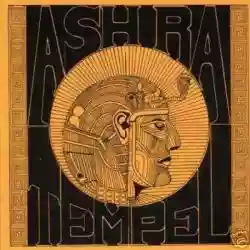
And it is March of that fateful 1971 when the three (who for a few months have been calling themselves Ash Ra Tempel) enter the studio to record, for the Ohr label, what will become the archetype, the highest stylistic reference of the new "kosmische musik", disconcerting and suggestive right from the extraordinary (and now well-known) cover image (by Bernhard Bendig), depicting the (double) entrance gate to the temple of Ra, supreme god of the Egyptian polytheistic system, and personification of the musical aesthetics of the group: Ra is often depicted, in traditional iconography, by his sole eye - which the Egyptians identified with the light of the sun, and the serpent (believed to be a female cobra) protruding from his crown is a symbol of power, of deadly defense against enemies; it is above all the emblem of the vital energy that animates the cosmos and prevents its fall into chaos. The themes of death, decay, and dissolution are instead evoked by a luminous quotation, present among the cover notes, of part of "Howl," the visionary poem by Allen Ginsberg in which the beat poet identified in the United States and the industrial society, ideally represented by the god Moloch (to whom, according to Leviticus, it was customary to sacrifice children) the monster responsible for the disease, dementia, and end of the best intellects of his generation.
Antithetical dualism, it was initially said, and the architecture chosen to account for this oppositional tension is its clearest confirmation: two long compositions per side, for what will become the "canon" recognized for any future "cosmic" ambitions, and tracks that from the title reveal their substantial characteristics.
"Amboss" ("anvil") unfolds in the forms of a slow but assertive crescendo that, from the markedly dreamy and meditative opening, leads to a sudden, violent, traumatic explosion of sounds comparable to a sandstorm in the full desert: rough and gritty acid jam with psychedelic undertones, it has been said and written, but the definition seems far too simplistic and reductive. Gottsching's guitar (not yet nineteen, imagine) "screams," contorts terribly, vomiting piercing and inarticulate blues-tinged phrases with brutal aggressiveness, Schulze shapes a frenetic drum "continuum" that leaves no respite, Henke explores, from the neck of his Gibson Bass, unusual and illogical paths of atonality. The spectral, monstrous executional ease of the guitarist is enriched, as the story unfolds, with Arabesque scale modules, freely inspired by the execution practice of the "maqam" of the Near East. Sand in the eyes, nothing else, and the listener is mercilessly plunged into the tortuous and cacophonous itineraries that lead to the closure, a slow agony among reverberated and anguishing spasms.
"Traummaschine" ("dream machine") is the exact counterpoint of "Amboss," its ideal and symmetrical reversal: what is heard in the first seven-eight minutes is a worthy anticipation of "Zeit" by Tangerine Dream, austere keyboard solemnity among dreamy and chilling atmospheres, a sense of eternal, tomb-like, intangible suspension. Then the guitar begins to imperceptibly awaken, to palpitate, to emit whispers carved in the depths of silence, like drops at an increasing frequency, until, amidst the exaltation of tribal dances, a percussion backdrop takes shape, tasked with accompanying the increasingly strong, increasingly sustained "voice" of the soloist. The "looped" structure of the piece imposes a partial return to the initial sound context, this time, however, made more incisive by the presence of bass and guitar, now an integral part of the overall "atmosphere" on par with electronics (jointly managed by Gottsching and Schulze), before the closure reserved for two overlapping guitar layers, among notes distilled with wisdom until the definitive, conclusive, total "extinction".
Simply out-of-category album. Many of you have already experienced it, but to the uninitiated, I highly recommend handling the product with extreme caution: it is not a terrestrial object.
Loading comments slowly
Summary by Bot
Ash Ra Tempel’s 1971 debut album stands as a seminal work in Krautrock and kosmische musik. Its two long, contrasting tracks embody a profound dualism, blending psychedelic jams with austere, atmospheric soundscapes. The album captures an otherworldly experience that transcends typical musical boundaries. Praised for its innovative instrumentation and emotive power, it remains influential after over four decades.Tracklist Videos
Ash Ra Tempel
Ash Ra Tempel were a German krautrock/kosmische musik group formed in Berlin, best known for long-form psychedelic and electronic-leaning suites and for the guitar work of Manuel Göttsching. Early lineups included Klaus Schulze (drums/electronics) and Hartmut Enke (bass).11 Reviews
Other reviews
By Festwca
"They strip your skin off, they short-circuit your brain."
"DO NOT LISTEN TO IT ALONE if you care about your sanity!"
By Cervovolante
Music that floats suspended in a timeless and mystical dimension.
‘Traummaschine’ was cosmic and meditative, it opened your brain like a can and connected you to the time machine.
By kubik
Big freak. Big gaudio. Big coitus astralis.
Transcendental und trascentalende. Scentelumine et luminescente.
