 •
Rating:
•
Rating:
THE REVIEW
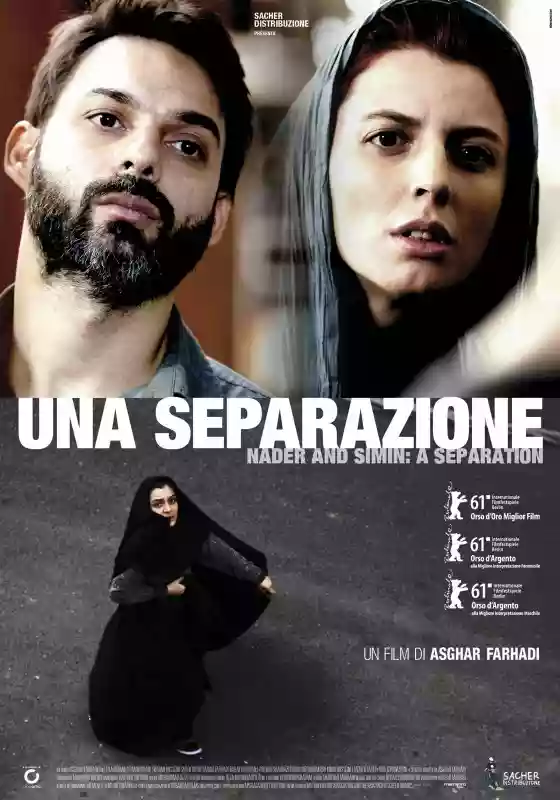
One of the gems of this spectacular cinematic year comes from Iran and it is "A Separation" by Asghar Farhadi, winner of the Golden Bear at the Berlin Film Festival.
A woman wants to move abroad with her daughter, but her husband does not agree: he is taking care of his father who has Alzheimer's. The man then hires a caregiver, very religious, unaware that she is pregnant. The woman leaves the sick man alone for a few minutes, causing an uproar. After an argument with the man, the caregiver loses the child. A murder charge is filed. The story evolves and complicates, plunging into total uncertainty, with each character stuck in their version of events, misunderstood and separated from others by a wall of incommunicability.
The domestic drama is a pretext to begin a reflection on Iranian society, especially the urbanized part of Tehran. The separation of the title involves the spouses but coincides with the separation of the country in general, divided in political key (progressives and conservatives), social (rich and poor), sexual (the scandal of the wife taking initiatives without consulting her husband), and cultural (the rational man and the instinctive one). And, a very delicate subject, religion: in Iran, swearing on the Quran is practically like taking a lie detector test.
In Farhadi's films, there seems to be a mysterious, unshown key moment lurking: the disappearance of the girl in About Elly, the caregiver crossing the street while chasing the old sick man in A Separation. Such a "triggering" moment tends to highlight the hidden frictions among the characters and their contradictions. In About Elly, the group is more anguished by the social reputation of the friend than by her disappearance. In "A Separation," the caregiver is more concerned about her husband's opinion than her own health.
The film is intensely realistic: handheld camera, direct dialogues, few gray environments (always interiors: the apartment, the hospital, the court). A very talkative film that grips the viewer as if it were a thriller. Because we are the jury of the trial: yet the vision of how events actually occur is denied to us. We change our minds every moment, because every "step" towards the resolution always remains a step on a minefield. The truth is never objective. Is the same blame, ultimately, really real? No one is truly guilty or innocent. And we, strong in our beliefs, remain disoriented, disarmed, powerless.
Panahi (Offside, This Is Not a Film); Kiarostami (Close-Up, Certified Copy); Farhadi (About Elly, A Separation). Iran strikes for the growing strength of its cinema, appreciated only recently but flourishing even before Khomeini's Islamic revolution. And it aims today to establish itself as one of the best in the world. We hope the regime has noticed.
Loading comments slowly
Summary by Bot
A Separation by Asghar Farhadi is a compelling Iranian film that uses a domestic drama to delve into broader societal and cultural conflicts. The story revolves around a couple's separation against the backdrop of personal and societal struggles, highlighting issues of truth, justice, and communication. The film's intense realism and ambiguous moral landscape keep viewers captivated and reflective. It marks Iran's cinema as a growing force on the global stage.
Asghar Farhadi
Asghar Farhadi is an Iranian film director and screenwriter known for social-realist, dialogue-driven dramas such as Una Separazione (A Separation) and Il passato (The Past). A Separation won major international awards including the Berlin Golden Bear and the Academy Award for Best Foreign Language Film.02 Reviews
