
 •
Rating:
•
Rating: THE REVIEW
This is quite an amusing story. We find ourselves in 1969, two years after friends Dave Stewart and Steve Hillage, having happily met Mont Campbell at the City of London School and recruited Clive Brooks through an ad in Melody Maker, formed a band called Uriel. The life of this project was short, and just a year later, Steve left intending to focus on his university studies, leaving the three companions to secure a contract, this time under the name Egg, which soon came from Decca.
And so begins our tale. The Egg, shortly after, are also contacted by the unknown Zackariya Enterprises, which offers them to record a session of purely psychedelic material in a single afternoon in exchange for a reasonable sum of money (for the time, that is). Our heroes accept the challenge and on this occasion recall Steve to play with them, but complications are lurking: the contract signed with Decca is exclusive, so the guys decide to use pseudonyms and change the group's name to bypass the obstacle. The choice falls on Arzachel, a lunar crater discovered by Mont on an astrological poster hung in his bathroom, and thus it happens that drummer Basil Dowling (Clive), guitarist and vocalist Simeon Sasparella (Steve), bassist Njerogi Gategaka (Mont), and keyboardist Sam Lee-Uff (Dave) find themselves engaged in playing enough material for the making of an album in less than eight hours.
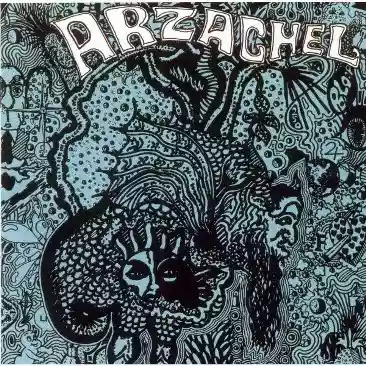
Despite many instrumental diversions being completely improvised and in the pieces recorded as the time limit approached the musicians were much more focused on the hands of the clock sadistically placed in front of them rather than on what they were actually doing, the self-titled album that emerged from this endeavor is unanimously recognized as one of the pinnacles of English psychedelia. Dave, engaged almost exclusively with the Hammond organ, wraps all the compositions with his dark and deep tones, starting from the vocal duets now rhythmic and lively ("Garden of Earthly Delights"), now litaneous and evocative ("Azathoth") between Steve and Mont, then moving to instrumental performances aimed at highlighting the melodic capabilities of his instrument ("Queen St. Gang"), and finally blending with Steve's guitar and his bluesy sounds ("Leg").
The B-side of the album features long and intricate tracks, and if "Clean Innocent Fun" once again shows us the bond achieved between Dave's Hammond and Steve's bluesy guitar, it is with "Metempsychosis" that the lysergic journeys produced by this album begin to reach "interstellar" levels, catapulting us into acid and disconcerting realities, which, thanks to the unceasing work of Clive and Mont, at times become hypnotic and suggestive, at least until the instruments, completely gone mad, evoke the chaos from which it all began.
Although Steve will later state that this work was done "just for a laugh," we are nonetheless glad that these guys, who would later make history with the Canterbury Sound and beyond, joking and laughing, generated such a gem of late psychedelic space rock in an era when they hadn’t even reached their twenties.
Loading comments slowly
Summary by Bot
Arzachel's self-titled 1969 album was recorded in a single afternoon under pseudonyms to bypass contractual issues. Despite the rushed session, the album stands as a high point of English psychedelia, showcasing vibrant Hammond organ, bluesy guitar, and inventive improvisations. Members later became influential in the Canterbury Sound. The album captures a unique blend of playful spontaneity and musical mastery.Tracklist Videos
Arzachel
Arzachel was a British psychedelic/space rock project recorded in 1969 by Uriel members Steve Hillage, Dave Stewart, Mont Campbell, and Clive Brooks. Due to contractual constraints, they used pseudonyms and cut a self-titled album in a single session, now regarded as a cult cornerstone tied to the Canterbury scene.02 Reviews
