
 •
Rating:
•
Rating: THE REVIEW
"I could compare my music to a white light that contains all colors." (Arvo Pärt) It is precisely so: the music of Arvo Pärt, a composer born in Estonia in 1935, is a white music, immersed in silence. This is its charm: the profound sense of pauses, the slow breath between one sound and the next. The emptiness gains supreme importance, and that moment when a sound slowly disappears to make room for the next becomes a moment of magical transformation. Pärt himself says: "I have discovered that a single note, played with grace, is sufficient. This single note, or silent beat, or moment of silence, comforts me. I work with very few elements - one voice, two voices. I compose using a simple triad, and the three notes of the triad are like bells, and hence the name "tintinnabuli". It is in this zone that I move when I am seeking an answer - in my life, in my music, in my work, in my darkest moments. I have the feeling that everything outside of this has no meaning... I remain here alone... with silence."
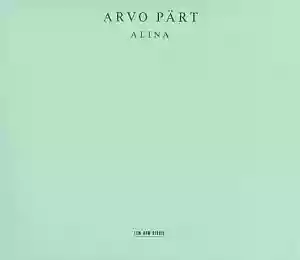
The style called "tintinnabuli" and invented by Arvo Pärt, made its first appearance in a short piano piece called "Für Alina" (1976) and subsequently in "Spiegel im Spiegel" (1978) for violin and piano and for cello and piano. These two pieces, alternated and then repeated again, are the musical content of the CD ALINA. Always the same two pieces that chase each other, changing color in an imperceptible but continuous way. A strange choice. Yet, one could spend hours following these slow transformations... just as one could spend hours watching the waves of the sea chasing each other or the clouds moved by the wind. The entire recording is based on a simple triad executed slowly and infinitely: only three notes of the B minor chord, while the melody unfolds freely on the same scale. Three sounds that never cease to cradle us and to amaze us with their sweetness.
It seems that Arvo Pärt is not afraid of boredom and is not afraid to bore, and perhaps for this very reason he never becomes boring... at least as long as we manage to get caught in the white web. If this happens, we even forget that the simple melody is performed by a violin and a cello, which at times join a piano and at times leave it alone in this sound universe. The performers are perfectly in tune and seem to know how to enter the core of the sounds with courage and delicacy. They are the talented violinist Vladimir Spivakov, pianists Sergey Bezrodny and Alexander Malter, and cellist Dietmar Schwalke.
An album not to be missed if you love music in its purest state.
Loading comments slowly
Summary by Bot
The review praises Arvo Pärt’s Alina for its profound use of silence and minimalism through his tintinnabuli style. It highlights the subtle transformations in the repeated pieces and the emotional impact of simplicity. The performers are commended for their delicate and courageous interpretation. Overall, the album is recommended for lovers of pure and contemplative music.Tracklist Videos
Arvo Pärt
Arvo Pärt (born 1935, Paide, Estonia) is a composer renowned for the tintinnabuli style—music of triads, silence and radical simplicity. After early experiments with serialism and dodecaphony (studying under Heino Eller at the Tallinn Conservatory and engaging with the Darmstadt school), he turned to Gregorian chant and Baroque models. Tintinnabuli emerged with Für Alina (1976) and deepened with Spiegel im Spiegel (1978). ECM releases helped bring works like Tabula Rasa, Fratres, Passio and Te Deum to international attention.03 Reviews
