
 •
Rating:
•
Rating:
THE REVIEW
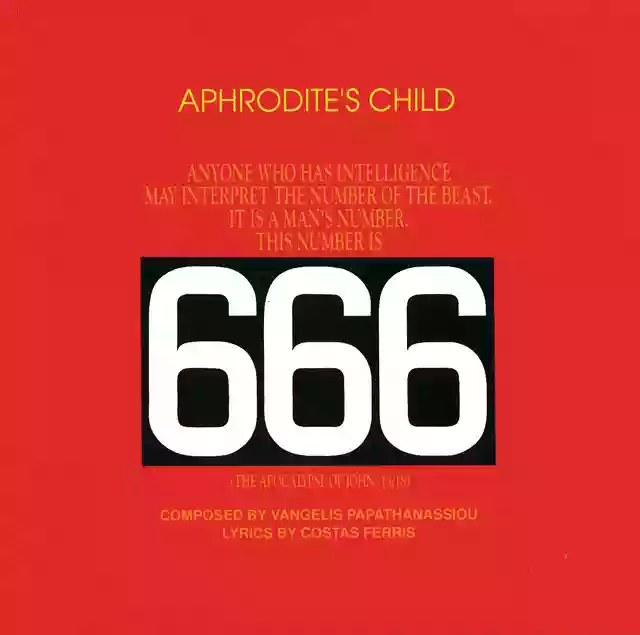
“We've got the System, to fuck the System”—this is the mantra that opens this (forgotten) progressive rock album. Aphrodite’s Child was a Greek band active between the late '60s and early '70s. Throughout their brief career, the lineup consisted of the multi-instrumentalist Vangelis (who would later become renowned as a soundtrack composer, notably for Blade Runner), singer and bassist Demis Roussos (who also became known in later years as a solo singer), drummer Loukas Sideras, and guitarist Silver Koulouris. They became fairly well known thanks to singles such as “Rain And Tears” and “It’s Five O Clock,” inspired by both progressive and British pop; they released only three studio albums, and this one, which we will discuss in this review, is their last, released posthumously after their breakup in 1972. The controversial cover prominently displays “666” on a red background, with a passage from the Book of Revelation above it, the one which mentions the number of Satan. Although this album has nothing directly to do with Satanism and/or related doctrines, the central theme of this concept work is the contrast between good and evil, narrated through the Apocalypse. For obvious reasons, the figure of the devil is represented in accordance with biblical tradition. This opus, envisioned and composed mainly by Vangelis, contains various musical styles that, even for the band itself, were innovative compared to their previous two albums; within, we obviously find prog, but everything is woven together with elements of jazz, rock, folk, and even blues. Even from a first listen, it’s evident that we are dealing with a rare gem from a band that, over the years, has likely lost much of its notoriety. The opening track, with its chorus (quoted at the beginning) repeated for 23 seconds, is a pure metaphor to explain the paradox that the system cannot be overturned when one is a part of it; even if it may seem completely detached from the rest of the work, in reality it can be tied to certain passages where metaphorical lyrics address events in contemporary life and society. Immediately after this rather unusual opening, we are presented with the track “Babylon”, a folk-tinged piece that immerses us in a context that (with a bit of imagination) recalls those very lands, and acts as a true introduction to the concept that follows. The album features several narrative interludes with piano and voice, or instrumental pieces that link the various chapters of the work, such as “Loud Loud Loud”, the instrumentals “The Wakening Beast” and “Tribulation”, or the spoken word track “Ofis” and the controversial “Infinity”, where actress Irene Papas recites a sexual act. What becomes clear when listening to these tracks is the remarkable creative vein of Vangelis; one can hear musical elements that he would stylistically revisit in his later soundtracks. Interestingly, even this album, despite the controversies that delayed its release in 1970, has a structure typical of film soundtrack albums. Among the more typically prog tracks are “The Four Horsemen” (sharing the name only with the more famous Metallica song from Kill ‘Em All), “Altamont”, and “Do It”. However, there are also moments that venture into blues and rock guitar solos, as in “The Battle Of The Locusts” or “Aegian Sea”. “All The Seats Were Occupied”, on the other hand, is a suite lasting over 19 minutes, found in the latter part of the album, where experimentation reaches its peak: sections of synth, distorted guitars, noise, and proto-ambient music alternate, creating a succession of contrasting emotions for the listener. Hands down, it is one of the musically best tracks on the album. In conclusion, we can affirm that progressive, over the years, has elevated many works to sacred pillars of music (for example, King Crimson or Jethro Tull), but at the same time, it has forgotten along the way albums such as this one which, without taking anything away from dozens and dozens of other records, represent unique works in their genre. If it’s true that sometimes people give credit to controversial things just for the sake of it, in this case, this is a controversial album but, even if it were not, it possesses such inspiration that it remains essential nonetheless.
Best tracks: “All The Seats Were Occupied”, “The Four Horsemen”, “Aegian Sea”
Loading comments slowly
Summary by Bot
The review praises '666' by Aphrodite's Child as a groundbreaking progressive rock album. It highlights the band's bold experimentation and the album's epic concept. The writer acknowledges the album's influence on the genre and its enduring legacy. High ratings reflect strong approval of the music and its creative direction. Fans of classic and psychedelic rock will find much to appreciate.Tracklist Videos
Aphrodite's Child
Aphrodite’s Child was a Greek rock group active from 1967 to 1972, featuring Vangelis (Evangelos Papathanassiou), Demis Roussos, Loukas Sideras, and Silver Koulouris. They scored European hits with Rain and Tears and It’s Five O’Clock and culminated in the ambitious double concept album 666, inspired by Revelation. After the split, Vangelis and Roussos pursued successful solo careers.03 Reviews
Other reviews
By stargazer
"Anyone who has intelligence may interpret the number of the beast. It is a man's number. This number is 666."
The album opens with the chorus 'We've got the System, to fuck the System!' a deliberately ironic line, because one cannot 'fuck' the system through another system.
