
 •
Rating:
•
Rating:
THE REVIEW
Is it appropriate to talk about this album once again? I believe so. And the reason is very simple. More than two years after its release, we can finally assert that it can be considered a classic. Bold? Perhaps, everything can be. How many albums from this century can be said the same? Few, undoubtedly. It seems to me that this one has all the hallmarks for the aforementioned definition to be accepted. Let's see.
The songwriting. Pianistic. Traditional. We are always in the realm of verses and choruses, rarely does a bridge precede the refrain; Antony is more likely to go directly, skipping it. Nothing new. Everything has been heard before. Yet, it's hard to understand where, when, in which other album. A simplicity that is not minimalism, but a search for essentiality, liberation from the superfluous, a tension towards the absolute.
The arrangements and production. Electric guitar and brass in just one track. For the rest, strings. Never overwhelming, always respectful of Antony's writing, his voice, and his piano. It is evident that Thomas Newman has worked mostly for cinema. He knows when the sound needs to be drier and when fuller, when it should engage and when it should allow the protagonist's breath to be heard.
The singing. I can confidently say that Antony is an extraordinary singer. There are incredible guests, considering it's the album of a near beginner. From Antony's childhood idols (Boy George) to those who helped him (Lou Reed) to his friends (Devendra Banhart) yet Antony outshines them all (except perhaps Rufus Wainwright, in the short "What Can I Do", but it ends in a draw). The comparison, among those circulating and which seems to me the most apt, is with Nina Simone. A woman's voice that seems like a man's, for a man who tries to be a woman.
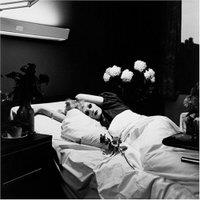
The cover. "Candy Darling On Her Deathbed", a photograph by Peter Hujar from 1974. A portrait in a hospital taken a few days before Candy Darling (the one from "Candy Says", to be clear, and also a star in a couple of Warhol films) died of leukemia. A poignant black and white that perfectly captures not only the music it contains, but I believe also Antony's state of mind. A body so difficult to accept, that death at certain moments can seem the only way out of the suffering of living.
The lyrics. That this is an album that narrates an invincible struggle with sadness seems evident to me. At the same time, there is always such a will to fight, which nonetheless instills optimism. Like the music, the lyrics are simple and direct, yet effective. The condition as a transgender is narrated by Antony without any pretense, but with a purity that involves us. "One day I'll grow up, I'll be a beautiful woman, I'll be a beautiful girl, but for today I'm a child, for today I'm a boy".
In conclusion. There are, I believe, some questions that those who have been listening to music for many years, occasionally ask themselves. The main one is whether one will still be able to be moved and touched when listening to a new album. Whether it is possible to write songs that one hasn't already heard thousands of times. Whether someone can express their art, raw and unadulterated, for what it is, without considering whether their albums will sell or their videos will be aired on MTV. Antony and the Johnsons tell us yes. And for this, we are grateful to them. Because they still make us believe.
Loading comments slowly
Summary by Bot
Antony and the Johnsons' 'I Am a Bird Now' is recognized as a modern classic, combining simple yet profound songwriting with delicate arrangements. The album’s production by Thomas Newman enhances Antony’s sublime voice, often compared to Nina Simone. Its lyrics explore transgender identity and emotional struggles with rare purity and optimism. The evocative cover art echoes themes of fragility and acceptance. Ultimately, the album reaffirms the power of honest, raw artistic expression in music.Tracklist Lyrics Videos
Antony and the Johnsons
Antony and the Johnsons is a New York-based chamber/art pop group led by ANOHNI (formerly Antony Hegarty). Renowned for intimate piano-and-strings arrangements and a singular, emotive voice, the group won the 2005 Mercury Prize for I Am a Bird Now and is celebrated for themes of identity, vulnerability, and transformation.10 Reviews
Other reviews
By sodo_caustico
Antony has a wo-n-der-ful voice, Lou Reed called it 'angelic.'
Recommended: to those who welcome anyone with open arms, without knowing their name.
By Leroy Jones
Your heart, after listening, will never be the same.
Perhaps a single word can encapsulate the essence of this album: unique.
By anitaerrabunda
This album encapsulates the story of a child, perhaps recounted by a kind of Pierrot, on a rainy night in the warmth of circus caravans.
It is one of the most moving albums I’ve heard lately.
By Mariaelena
Antony’s voice is not only inimitable but also of a painful, unparalleled beauty.
His music is a continuous pulse of life agglomerated to the despair that cries out for help.
