
 •
Rating:
•
Rating:
THE REVIEW
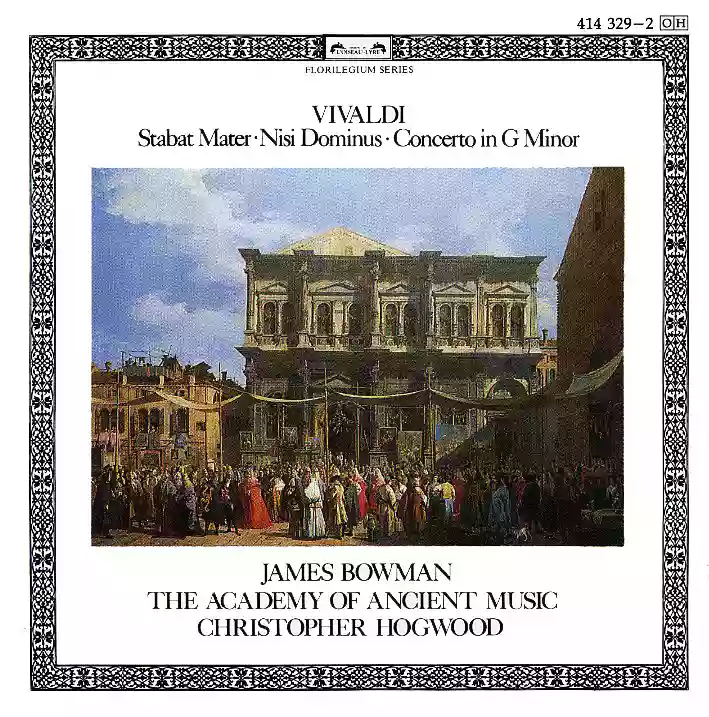
An album nothing short of sublime is this "Stabat Mater - Nisi Dominus - Concerto in G Minor" by A. Vivaldi (1678-1741) which I now present to you (Editions de L'Oiseau-Lyre, from 1976!!).
My personal approach to this album (also rare) dates back to 1993, when I listened to it "captivated" for the first time in a gothic bar inside a medieval castle near Nimes, on the French Riviera. I was literally "enchanted" by such beauty: I had never heard anything so magical and engaging.
From the very beginning I was struck by the majesty and transcendence that these pieces conveyed to the surrounding air, to the whole environment and to the people with whom they entered into "communion." I swear: even the plants seemed more lush and beautiful to me for so much joy! An album nothing short of "heavenly" that is able to convey a sense of "harmony" and "universality of spirit" like few others. The work of "this" Vivaldi, supported by the noble and "spectacular" singing of James Bowman, countertenor, and backed by the Academy of Ancient Music, conducted by Maestro Christopher Hogwood, manages to create a "unicum" of rare purity, where each instrument lightly and disenchantedly backs the gentle yet always prominent singing of this "sacred monster" of opera, with a vocal range and interpretative class above the average of the role.
The harmonic scales in counterpoint between violin and voice in the piece "Quis est homo" are splendid, but generally, it's the whole Opera that exudes delicacy and enchantment without overproduction or bombastic effects of "loaded" orchestras proving who knows what. Here, everything sounds light, impalpable, airy... you never hear more than three instruments overlapping, and above all, I repeat ad nauseam, the beauty of this androgynous voice that lightly embroiders enchanting and graceful scores like butterflies in love flying in the backlight of a spring sunset.
I'm not going to delve too much into technicalities and technical data (in my opinion marginal) also because I'm really terrible at these things. Recommended tracks: the first gloomy "Stabat Mater dolorosa" and the opening of the "4th of the Concerto in G minor", but trust me, it is all SPECTACULAR with no moments of faltering or fatigue!! I just say to get this album AT ANY COST, paying gold for it or, at most, stealing it (if necessary) or burning it from the dad of one of your friends, and I challenge anyone, I repeat ANY-ONE, to say that "it is not beautiful" or that it does not "exude poetry": I even bet my portion of expired Ciappi (that Punisher buys me with the 3-for-2 and hands me every morning... that miser!)
Truly a... Good listening (and it's not JUST a wish!). Bau Bye.
Loading comments slowly
Summary by Bot
This review praises Antonio Vivaldi's Stabat Mater album as a sublime and enchanting baroque masterpiece. The reviewer highlights the outstanding androgynous voice of countertenor James Bowman and the delicate orchestration by the Academy of Ancient Music under Christopher Hogwood's direction. It captures a sense of spiritual harmony and poetic beauty that deeply captivated the listener. Recommended tracks include 'Stabat Mater dolorosa' and the fourth movement of the Concerto in G minor. Overall, a must-have classical experience.Tracklist
01 Concerto ripieno in C major RV 114: I. Allegro (02:29)
02 Concerto ripieno in C major RV 114: II. Adagio (00:43)
03 Concerto ripieno in C major RV 114: III. Ciaccona (03:03)
04 Cantata, RV 684 "Cessate, omai cessate": I. "Cessate" (01:59)
05 Cantata, RV 684 "Cessate, omai cessate": II. "Ah ch'infelische sempre" (05:16)
06 Cantata, RV 684 "Cessate, omai cessate": III. "A voi dunque ricorro" (01:15)
07 Cantata, RV 684 "Cessate, omai cessate": IV. "Nell'orrido albergo ricetto di pene" (03:41)
08 Sonata a quatro, RV 130 "Al Santo Sepolcro": I. Largo molto (02:23)
09 Sonata a quatro, RV 130 "Al Santo Sepolcro": II. Allegro ma poco andante (02:46)
10 Introduzione al miserere "Filia Maestae Jerusalem", RV 638: I. Recitativo "Filia Maestae Jerusalem" (01:53)
11 Introduzione al miserere "Filia Maestae Jerusalem", RV 638: II. Largo. "Sileant zphyri" (06:37)
12 Introduzione al miserere "Filia Maestae Jerusalem", RV 638: III. Recitativo "Sed tenebris diffusis" (01:04)
13 Stabat Mater, RV 621: I. Stabat mater dolorosa. Largo (02:54)
14 Stabat Mater, RV 621: II. Cujus animam gementem. Adagio (01:47)
15 Stabat Mater, RV 621: III. O quam tristis. Andante (01:53)
16 Stabat Mater, RV 621: IV. Quis est homo. Largo (02:50)
17 Stabat Mater, RV 621: V. Quis non posset. Adagio (02:04)
18 Stabat Mater, RV 621: VI. Pro peccatis suae gentis. Andante (01:50)
19 Stabat Mater, RV 621: VII. Eja mater, fons amoris. Largo (02:43)
20 Stabat Mater, RV 621: VIII. Fac ut ardeat. Lento (01:38)
21 Stabat Mater, RV 621: IX. Amen. Allegro (01:07)
Antonio Vivaldi
Antonio Vivaldi (1678–1741) was a Venetian Baroque composer, virtuoso violinist, and Catholic priest. Renowned for concertos—especially Le quattro stagioni—he worked for the Ospedale della Pietà, wrote operas and sacred music, and influenced composers including J.S. Bach.07 Reviews
