
 •
Rating:
•
Rating:
THE REVIEW
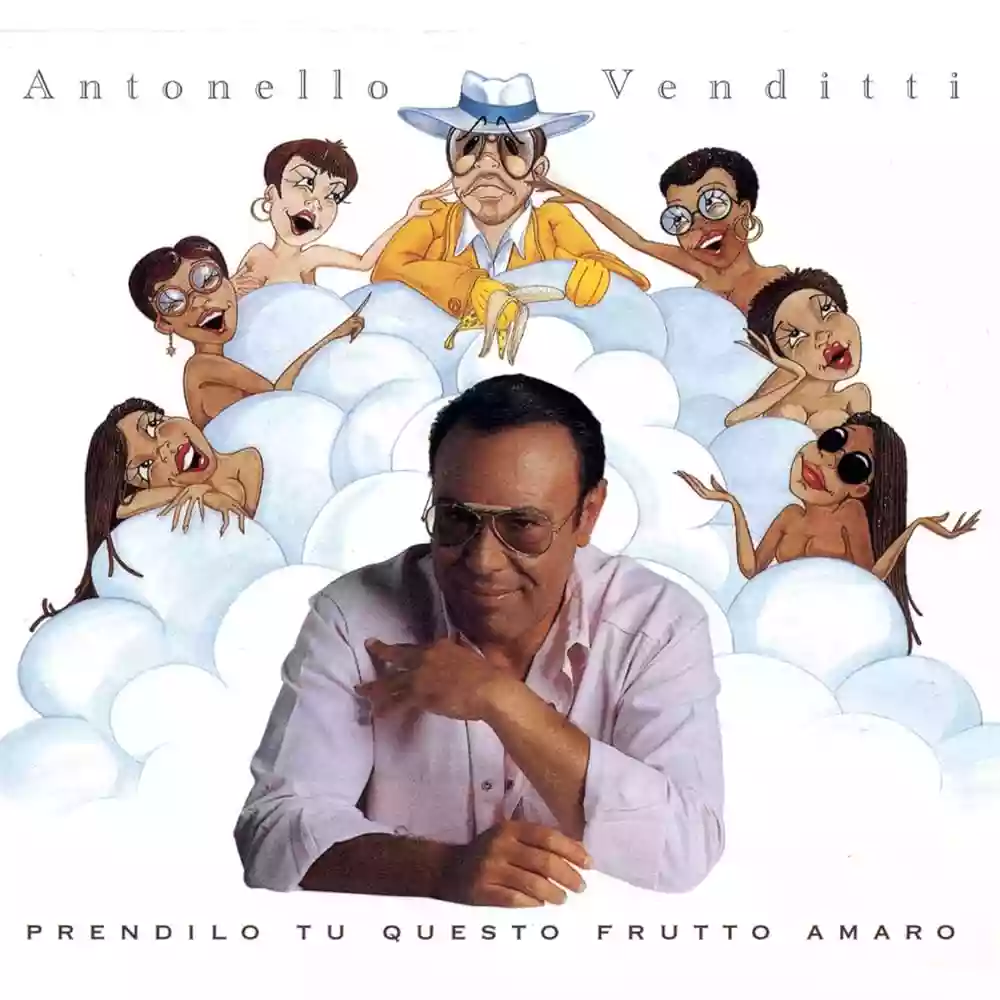
TAKE THIS BITTER FRUIT YOURSELF (1995) 2/10
“...It's a political issue/'na grande presa pe' culo...”, says Venditti, referring to the (so-called) New Republic. But here, the only real 'presa per il culo' seems to be this album, so awful you hardly want to believe it. Moreover, from this point on, our artist embarks on such a steep downward slope that it leads to unclassifiable works like “Goodbye Novecento”, 1999, or “I ragazzi del Tortuga”, 2015 (the latter he himself defines as one of his best albums—let's just move past that, it's for the best). Ugly for two main reasons: a) it's a shameless and poorly executed copy of his previous “Benvenuti in paradiso”, 1991, which at least had two halfway decent songs; b) it's the same old mush of love songs that you've already heard a thousand times over, sax at the end of every track to make everything sound more melancholic (or more mournful, take vobis) with the added arrogance of making himself a “champion” of the new popular indignation (the Second Republic worse than the First; mafia massacres; thieving politicians, which had already been told plenty well enough in a better album back in 1988).
God, actually, it must be said it doesn't even start off in a tragic way. Or rather, the opener “Ogni volta” could even be acceptable (sure, if you're going through a divorce like yours truly, better skip it), but still, it has its reason: it's a sequel to “Amici mai”, which in turn continued “Ricordati di me” (a sort of serial ante-litteram) to which Venditti is (and remains) very attached, considering it one of his best works—in fact, he calls it (with a certain annoying nonchalance) the “ultimate” love song, listen to this: “...It is the most accomplished of my songs, the least vague, and yes, in fact, it is also a farewell. For the first time I was saying goodbye to a love that now seemed over to me, spent. There was nothing left to say that I hadn't already said.” It pulled the album (also because, let's face it, it was the only listenable thing for radio among the 8 miserably disastrous tracks here included) and managed to have this atrocity end up with an honorable sixth place on the year-end chart (it outsold, here in Italy, Springsteen, Madonna and Elton John, just saying).
Venditti, who recorded the album in his own private studio (sic transit gloria mundi), has not the slightest idea (this becomes clear) of what “attire” to give the album. There's only one rule, now fixed: no more than 8 songs, each about 5 minutes, 4 per side. Period, like an accountant, like a surveyor's clerk. Beyond that, whatever happens, happens. With a pinch of social comment: “Eroi minori” tells the stories of Falcone's and Borsellino's bodyguards who died on the job and are, quite literally, called minor heroes (great intentions, very poor result); the title-track is (God help us) an Italian adaptation of “Bitter Fruit” by Little Steven to which Venditti “slaps on” such a mindless lyric that “In questo mondo di ladri” comes off as a brilliant sociological and political analysis by comparison; “Tutti all'inferno”, even more generic (no one is spared, obviously), has on drums the usual Carlo Verdone, here also giving a very brief opening monologue, this: “Pentiti, suddito, pentiti, hai fatto tanto, hai fatto pure troppo, adesso restituisci 'sto malloppo, cazzo”, and that sums it up.
Even more tragic, if possible, when it all turns to love—which, judging by his albums in recent years, ought to be his strong suit. Ought to be. “Vento selvaggio” just makes you want to give up (sorry Bennato!) and limits itself to rhymes like “mirto” and “porto” or the image of “una pioggia di stelle che ci cade giù addosso” (even Tozzi in 1995 would have been ashamed to write such a cliché!)—but at least it salvages, just a tiny bit (really, just a tiny bit) the vibe of a hot, steamy August night (in every sense). But “Parla come baci” and especially “A che gioco giochi” are two tracks that would have been unacceptable even from a rookie, never mind someone with over twenty years of career behind them. But they're not just botched songs or badly done, not even bad in the most “benign” sense of the word: they're just awful, they're annoying, they're like mosquitoes in summer and the bug spray left at home. They just piss you off, that's all. I'll also point out that it took five (yes, five) people to write “Parla come baci”.
Out of 8 tracks, 6 were released as singles, so as to stretch the album's success (which nonetheless sold nearly 900,000 copies) into early 1997. For the truly brave, there is even a version in Spanish.
Loading comments slowly
Summary by Bot
This review offers a strongly negative assessment of Antonello Venditti's album 'Prendilo tu questo frutto amaro.' The reviewer is not impressed by the album, granting it the lowest possible rating. The work is positioned within Italian music, yet fails to meet the reviewer's expectations. The commentary is brief but unequivocal in sentiment.
Antonello Venditti
Antonello Venditti (born 8 March 1949, Rome) is an Italian singer‑songwriter known for politically tinged 70s albums and hugely popular 80s hits. His catalog spans intimate piano ballads and stadium anthems, with Rome as a lifelong muse.42 Reviews
Other reviews
By rafssru
A mess of bland songs, shameless self-plagiarism, and poor imitations.
The positive exception of the record appears: 'Eroi minori,' dedicated to the boys of Falcone and Borsellino’s escort.
