 •
Rating:
•
Rating:
THE REVIEW
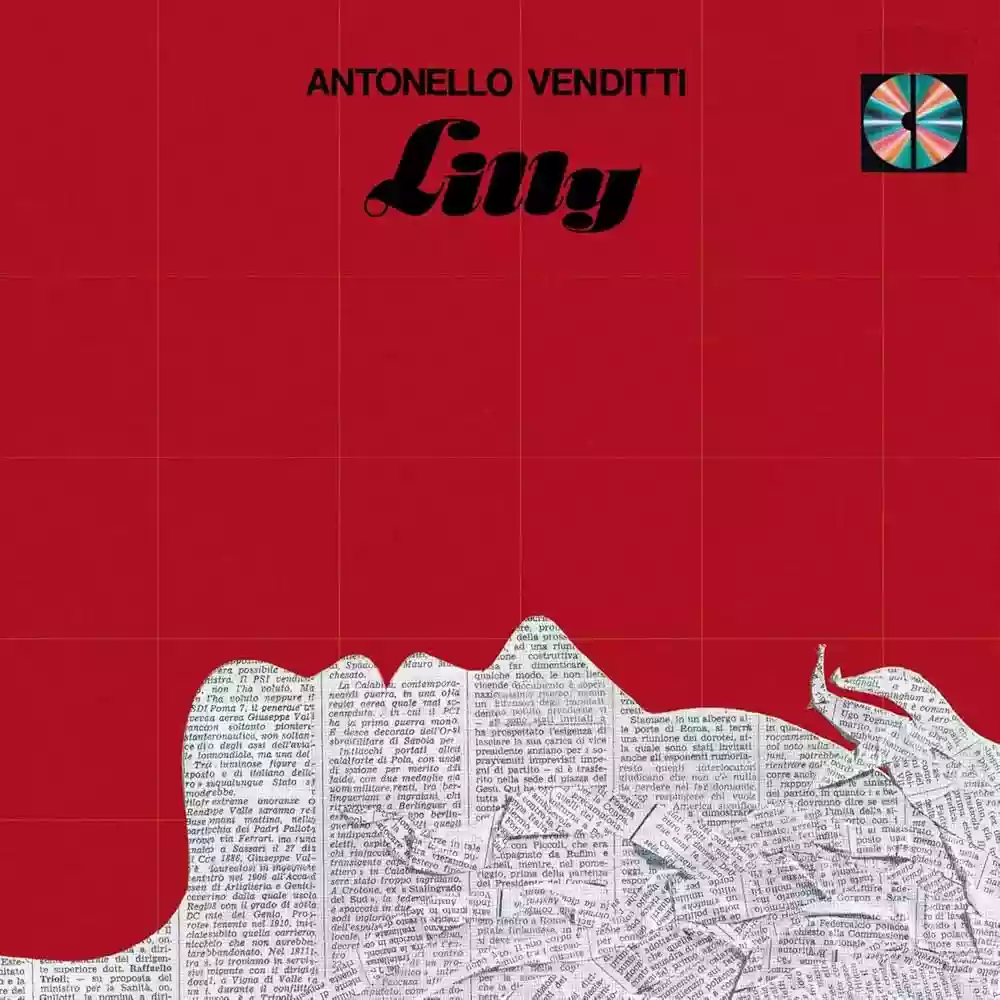
LILLY 7.5/10 (thanks to my friend L.S. for his patience)
“... There is always a lot of reticence about “Lilly” because it’s tied to a person who isn’t named Lilly, and it’s a song that I generally perform only in Milan because that’s where I made it, that’s where I felt it, and that’s where I lived it. I’ve only sung it a few other times. But, for example, I did perform it in Rebibbia in a women’s ward, a few years ago. Because I felt close to that reality. There are songs that are untouchable, and one of them is “Lilly”, which should be performed only when your conscience, your memories, don’t hurt you—when it serves a purpose...” (Antonello Venditti, from an interview with Carlo Moretti).
“Lilly” is not Venditti’s best album; the two previous ones are two notches above it (“Le cose della vita”, 1973; “Quando verrà Natale”, 1974), yet this work, released in 1975, marks the turning point in the career of the Roman singer-songwriter, who at the time was “exiled” in Milan (where he would reside until 1982). Because, except for the parenthesis of “Roma capoccia” (which topped the charts and was included on the split album with Francesco De Gregori, “Theorius Campus”, 1972), until then success had always eluded him. Instead, “Lilly”, the single, finally reached the much-coveted top of the hit parade. Not the first song to touch on the theme of drug addiction, but one of the first in Italy, it found fertile ground thanks to its remarkable musical construction, with that female name repeated almost like a “hammer” and the succession of impactful lines that follow one another in a sort of “bouncy” style, let’s say. In 1975, ironically, the best-selling album in Italy was “Rimmel” by De Gregori, but “Lilly”, which was released at the end of 1975, did exceedingly well, and the LP soared up the charts (the eleventh best-seller at year’s end) and became the basis for a theatrical show, entitled “Lilly”, which Venditti took on tour during the winter of 1975-1976. The B-side was “Compagno di scuola”: Venditti has always been one to “sniff out” the mood of the country long before his peers, and so if in the ‘70s he sensed that political songwriting would sell (often in droves), in the ‘80s he understood that in Italy it was escapism, the desire to care more for oneself than for world affairs (the famed “hedonism”), that ruled; he lowered the quality of his albums (musically and, above all, in terms of his lyrics’ writing), sold like few others (“In questo mondo di ladri”, 1988, almost reached one and a half million copies), only to then “deflate” and completely lose himself in the ‘90s. But in 1975 he could still write a song like “Compagno di scuola”: nostalgia (and bitterness) for the school struggles of ‘68 (which had been only seven years before!) described through a series of vivid images (“... tutti al bar/dove Nietzsche e Marx/si davano la mano”), a proudly featured piano, and his autobiography is served. The ending, where the drums come in, goes: “Compagno di scuola, compagno di niente/ti sei salvato dal fumo delle barricate?/Compagno di scuola, compagno per niente/ti sei salvato dal fumo delle barricate?/Compagno di scuola, compagno per niente/ti sei salvato o sei entrato in banca pure tu?”. The schoolmate, I don’t know about him, but I imagine Venditti probably bought the bank himself, afterwards. Old story.
The other essential track of the album is “Lo stambecco ferito”, in my personal opinion the most beautiful song in Venditti’s entire discography. It’s a long piano piece in which our singer-songwriter “romanticizes” the story of a certain man (a poacher, to be exact) who is determined to kill an ibex (“stambecco”—a metaphor for the businessman Felice Riva, the whip-wielding entrepreneur). The lyrics are beautiful, and I’m not joking, and, interviewed by “Ciao 2001” many years later, Venditti explained things further (with a little, perhaps needless, controversy): “... I didn’t give the poacher the time to choose […] The song is meant to spark a case of conscience, to provoke the listener, without answering the question of whether it is right to kill for political reasons. In any case, there is a difference between a true revolution and a single, useless, counterproductive act. That’s why, for example, I don’t share the attitude of the anarchist in Guccini’s ‘Locomotiva’.” The final piano “coda” sounds like Keith Jarrett, chapeau. “... I remember that at the San Siro stadium in 1992, in a stadium eager to sing, to be happy […], I sang ‘Lo stambecco ferito’. Sometimes, making 70,000 people fall silent is more important than hearing them applaud”. Apart from the passionate “L’amore non ha padroni”, the rest doesn’t measure up to the aforementioned tracks.
Loading comments slowly
Summary by Bot
The review offers a middle-of-the-road perspective on 'Lilly', Antonello Venditti's album. It acknowledges both strengths and weaknesses, providing a fair assessment. Listeners can expect a balanced take on the album's impact within Italian pop music. Overall, the album receives a moderate rating.Tracklist Lyrics Videos
Antonello Venditti
Italian singer-songwriter and pianist born in Rome in 1949. Debuted in the early 1970s, rose with Lilly (1975) and Sotto il segno dei pesci (1978), and scored major 1980s hits like Cuore and In questo mondo di ladri. Known for Rome-themed anthems and vivid social storytelling.45 Reviews
Other reviews
By mox
"Seven tracks that, among romantic or melancholic ballads and ironic or committed songs, form the best album of Venditti’s production."
"In those six minutes of listening, it felt like I was reliving the five years spent with friends... Beautiful, even today when I listen to it I get goosebumps."
By MarkRChandar
Lilly represents the most intense, painful, wrenching Italian song ever written on drugs, recounting with meticulousness and an emotion never rhetorical, the most intimate devastation of addiction.
Only 7 tracks that represent the sum of a period, a thought, a man and an artist, the highest peak that he will never be able to reach again.
By Nevadagaz
Back then, Venditti couldn’t yet know that his record would become an evergreen of Italian music for all time.
Lilly ultimately marks the dawn of a great musical season... a unique and unrepeatable season, conscious and mature.
