
 •
Rating:
•
Rating:
THE REVIEW
For devoted listeners of Virgin Radio, and more specifically of “Rock&Talk”—the segment hosted by Maurizio Faulisi (a.k.a. Dr. Feelgood) and Francesco Allegretti (following the untimely passing of the much-missed Massimo Cotto)—Antonello Piroso is “the Black Knight” (or the Franti of the Libro Cuore, as he ironically likes to call himself). The half hour devoted to his eloquent discourse—marked by storytelling and a spontaneous critique of the latest, most significant news—has, for the past eight years, enjoyed a dedicated following.
Piroso boasts forty years of an honorable career, having served as director of TgLa7 (where he set a personal record of 18 hours for a television marathon held during the 2008 general elections), as well as creator and host of radio and television programs such as “Omnibus” and “Niente di personale”. His are the monologues dedicated to the judicial ordeal of Enzo Tortora and to the massacre of Srebrenica, the latter proving, fifteen years later, to be heartbreakingly current in light of recent geopolitical developments.
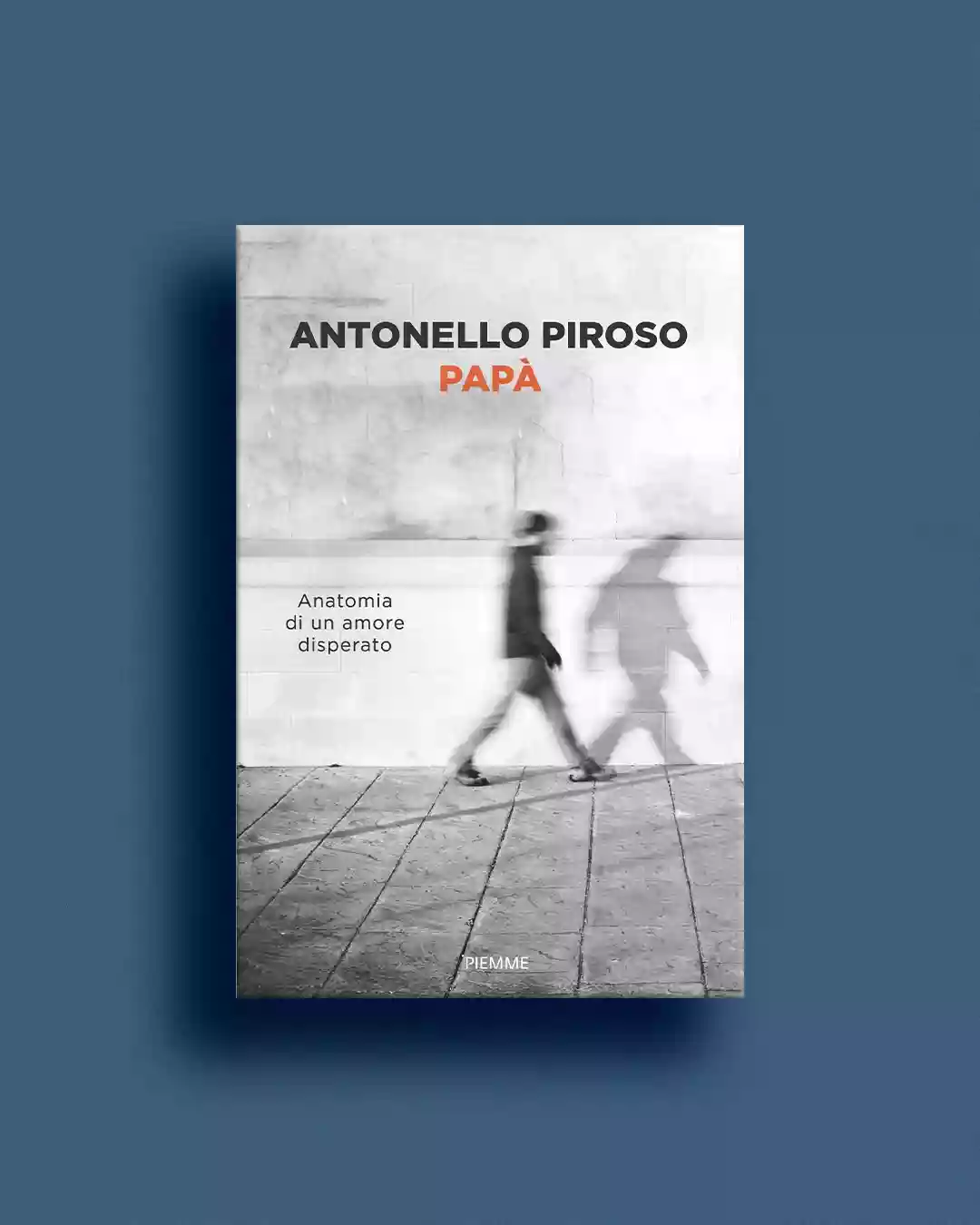
Among other honors, he received the “Premio Regia Televisiva” in 2003 and the “Flaiano” three years later. On December 7, 2025, after blowing out sixty-five candles, he announced the publication of his first book, immediate and eloquently titled: “Papà: Anatomia di un amore disperato”.
“Papà” is a confession straight from the heart, an uninhibited reflection, a kind of solitary therapy session, an uncontrolled flow of thoughts and emotions—as the author openly declares from the very start. Paragraphs are missing, even conventional punctuation is largely absent—initially bewildering the reader, who, once immersed in the story, comes to appreciate its truly unconventional and enjoyable essence.
Antonello Piroso was born in Como to a Ligurian mother and a Calabrian father. Both parents passed away in the spring of 2020, right in the midst of lockdown, just weeks apart. This is the motive, the source of pain that fuels personal reflection and feelings of guilt. Here is a love never questioned, but relived in hindsight through an overwhelming stream of consciousness. There are unforgettable memories—and also somewhat faded ones, suitably revived with the help of memory.
It’s immediately clear, even through the passages steeped in bitter irony, that these pages had been necessary for the author for quite some time. Direct dialogue first becomes a vent—of accusations and mea culpas—then an avowal of love, through the magnifying lens of memories, zoomed out when needed to weave past and present together. Little Antonello, through the adult Antonello, looks at his beloved son Romeo and his adored wife Lucia with eyes brimming with love, attributing due credit to those who deserve it for so many well-earned emotions. He recalls school desks and places them alongside the blinding light of stage spotlights or the scent of printed paper.
Nicola Piroso, an honest finance officer, is an emotionally distant father, at times even violent, and was himself a lost son, abandoned by a runaway father—a leading man of his own era. Despite his mistakes, shortcomings, and emotionally detached presence, Nicola remains a reference point for his son “Titti”; a guide, an “influencer” if we use today’s terms. That son bares his soul and admits to his own mistakes, his own careless acts, born out of bravado and a lack of humility typical of a talented and culture-hungry youth.
Piroso does not seek to set himself up as a preacher or, even less so, an educator—he merely transforms into ink what he has so painstakingly kept secret, even from himself, thus handing down to eternity and to future generations a well-deserved tribute.
A book like this is not just a personal accomplishment for its author—it is the realization of a desire and maybe, even if only in part, the achievement of inner peace. Only he who has written it can say that for sure. For the reader, there remains an irresistible urge to pick up the phone or ring the doorbell of their own parents. Because this is what Antonello Piroso wants to tell us: let us take nothing for granted, and if we are lucky enough to still have them, let’s tell our parents how much we love them and how indebted we feel to them—before time takes this opportunity from us.
Loading comments slowly
Summary by Bot
This review praises 'Papà: Anatomia di un amore disperato' as a deeply moving exploration of a father's love and the pain of loss. The reviewer highlights the author's honest and heartfelt storytelling, commending his ability to evoke strong emotions. The book is recommended for its introspective and relatable themes. Readers will find resonance in its universal family dynamics.
Antonello Piroso
Italian journalist and broadcaster, former director of TgLa7, creator/host of Omnibus and Niente di personale, and recurring voice on Virgin Radio’s Rock&Talk. Awarded the Premio Regia Televisiva (2003) and the Flaiano (2006). Debuted in print with “Papà: Anatomia di un amore disperato,” an intimate memoir sparked by the loss of his parents in 2020.00 Reviews
