
 •
Rating:
•
Rating:
THE REVIEW
Jeff Waters was born in 1966 in Canada, in Ottawa, and his personal story is undeniably tied to the moniker Annihilator, a name chosen for the group that would accompany him on his solo journey in the field of Thrash Metal. In fact, the name is merely a pass to create the aura of a new band, one of the few that would become a myth and a driving force in Canadian thrash.
Jeff is the Lonely King: he produces (almost) all his records, plays all the string instruments, sings decently, and tyrannizes his employees with care: "... just this week, we'll start rehearsing to prepare for the tour that will begin on April 30, I can't wait! In any case, Curran might need to calm down during the concerts since Annihilator's guitar parts are a damned challenge for anyone, myself included! As you may have noticed, some of our rhythms resemble actual solos..." (interview with Jeff Waters by Kronic.it on the occasion of the release of "Waking The Fury" in 2002).
From his interviews, we learn that musicians are paid to play his compositions (and pose for album photos). Only in concerts can they have their say, perhaps by organizing the stage, moving the water bottle and the drum stool, thus becoming a full-fledged band. After releasing two groundbreaking albums of innovative thrash (especially from a compositional standpoint), like "Alice In Hell" and "Never Neverland," and a decent third one, born out of haste (with three different drummers), namely "Set The World On Fire," criticized everywhere regardless (www.metalitalia.com/intervista for more information), our master experiences a downturn in the '90s, resorting to the help of Randy Black on drums until complete self-reliance with an electronic thrash album (Metallus.it) in 1996. After various family issues, he makes a semi-major comeback in 1999 with "Criteria For A Black Widow," along with original singer Randy Rampage and historic drummer Ray Hartmann. Randy's voice (with a past in punk band D.O.A.) appears improved, rough but less disdainful than usual, but the Canadian singer is ousted in the middle of the tour with Overkill in support of "Criteria For A Black Widow."
At that point, Jeff makes the boldest move of his career: instead of hiring a puppet singer to manipulate at will, he hires a gray eminence of the metal scene of the time, that Joe Comeau, former guitarist and voice of Overkill and former singer of Liege Lord. Joe Comeau is capable of singing with four different voice tones: his original one, that of Brian Johnson imitating Bon Scott, that of Rob Halford (see some excerpts of the cover "Tyrant" with Overkill), and that of Bruce Dickinson; he's also an excellent guitarist, but in Overkill he was restricted to playing few solos (the wah-wah of "Little Bit 'O Murder" from "From The Underground And Below" is good) and performing backing vocals over "Blitz's" voice (on Kronic.it there's a very interesting interview with Joe Comeau).
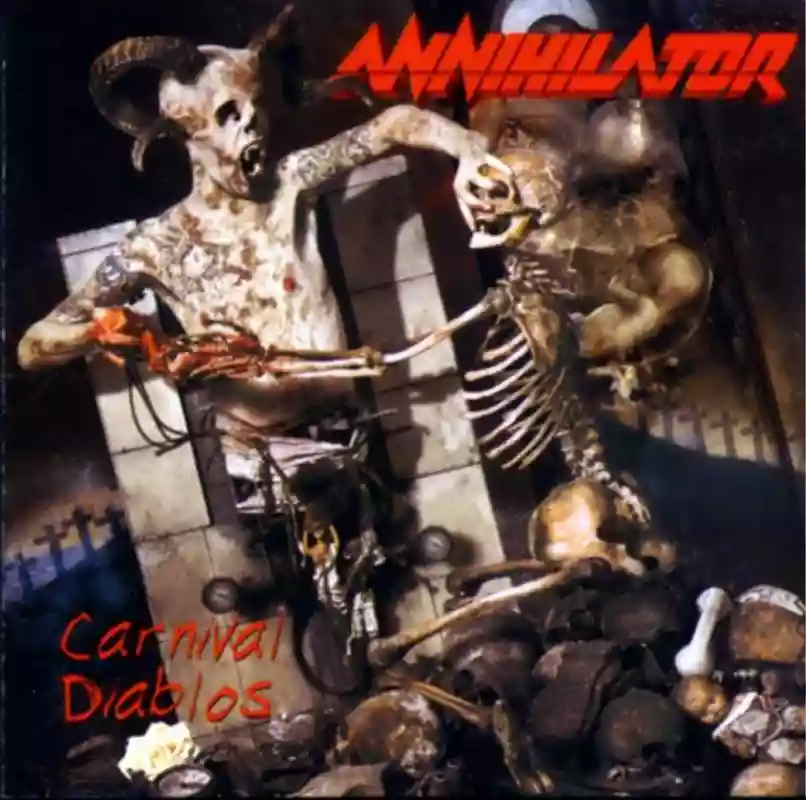
"Carnival Diablos" arrives with the days of the hooded crow in 2001 and rides the wave of "Criteria For A Black Widow," being a continuation in blazing, old-style thrashy sounds like hay dried in summer fields, except for timeless vocal parts. Even the old friend and singer Jonh Bates, who helped Jeff with the lyrics, steps aside, and Joe Comeau writes four or five along with the commander, putting the vocal seal on every episode of the album except the instrumental "Liquid Oval", a classy track, with some deviations towards "Sound Goods To Me," full of sweet, soft sounds like a hook-shaped cirrus cloud, almost similar to "Textures" by Cynic but in the melodic dimension sense, not executive or creative so to speak, where all of Jeff's guitar expertise manifests fully. The metal showcase created by Waters isn't full of power mannequins or end-of-season doom sales, but offers a singer in great form, especially in the track "Battered", a sentimental speed marathon among my all-time favorites, where Ray Hartmann, with a precise never Byzantine style, doesn't miss a beat, even adding small skirmishes that truly satisfy: listen, for example, to the cymbal crash that accompanies the melodic guitar after Jeff's screamed and irresistible solos, or the double gallop before the solo's entry. Waters uses the guitar like the "hundred-barrel guns" of the Bluecoats against the Apaches, but further surprising is Joe Comeau, with his grit, voice depth, and pronunciation so charming it amazes (see the diction of "...agony"...).
The album is a kaleidoscope of styles coated in '70s heavy powder coating, that often perplexes the listener, depriving the sound of compactness, which doesn't always appear devastating but indulges in hard rock mixtures, such as in the case of the title track that is a thoughtful melancholy watercolor, brushed by the mournful and plaintive voice of the former Liege Lord, almost reliving an old memory, a flash of searing pain that doesn't exit our mind; the magic of the guitar crosses our mental loop without forcing: we find ourselves always listening to it with transport. And so reading the text becomes of little use: in our mind, we recreate a whole new one, reinvent it with our own emotions, another way to listen to music.
In "Shallow Grave", Comeau embodies Brian Johnson parodying Bon Scott, and the song sounds like an AC/DC b-side, an excellent concert diversion, as well as "The Rush," which finds Joe Comeau dealing with Rob Halford in a solid song, less charming, with no clear synopsis, a simple compositional structure to remember. The atmospheres of the title track of the tough "Neverland" are revisited with "Insomnia", especially in the gloomy intro good for "The Ring" Japanese version, or for drifting into the sweet sea of nightly evenings, with an inspired and thoughtful Waters. And the heart-stopping one-two punch of "Epic Of War" and "Hunter Killer" arrives; in these last two songs, both Joe and Jeff fire their last shots. Therefore, in "Epic Of War" a speed rhythm reigns, highlighted by the melodic guitar and persistent double bass drum of Hartmann, emphasizing the absurdity of war: "...welcome to war, in the war garden, smell the war, taste the war..." Joe Comeau fills his lungs, warms his vocal cords for the song's second half, which takes off with Bruce Dickinson-like tones, a journey into Maiden style that brings redness to the cheeks and warm ears, overshadowing the raw sound, perhaps dated, but certainly tailored to the incandescent tongue of the former Overkill, for his assault on each line with conviction, never "carrying" the voice like a hysterical siren.
At the end of the album, Jeff Waters showcases the most violent track, "Hunter Killer", in which the main riff becomes a remake of "Bloodbath" from the previous "Criteria For A Black Widow" or "Reaction" from "Remains": but it's the malice, perfect speed, and timing of the solo that excel, like a stick of dynamite in the hands of Wile E. Coyote. For two minutes, Jeff punishes our ears with two or three crossed riffs, monotonous, almost waiting for our tension to build up, knowing full well we await the restart, the torpedo ("Operation Petticoat") happening at minute 2:02: countdown ended and in come the Slayers of the good old times, the waterfall solo of Jeff (who'd recall this procedure for the subsequent "Waking The Fury"), Joe Comeau's scraping vocal agony is heightened to the max ("die submission is the rule/you cry out but your time is through"), followed by a stratospheric Ray Hartman rolling relentlessly and roughing up the drums, while master Jeff self-celebrates with a dazzling bass passage, tortuous and baritone, heard many times this century which lets the fury drop to the hypochondriac distortion of the guitar, crying out for the tortures inflicted upon it. And the curtain falls. Yet there are twice the fast echoes of chickens, the calm, and here comes the chicken coop similar to the one my maternal grandmother had: it materializes the ironic song "Chicken And Corn," sung by an improbable Jeff-Filo Sganga, racing along and kindly closing the platter (www.youtube.com has the funny video).
An inspired and well-played album that ushers Jeff Waters-Annihilator into the new millennium and, apart from two subdued songs, remains an album to savor without being misled by the sonic stew that smells old like a rickety straw chair, because Jeff himself has repeatedly stated he prefers a fluctuating production, signed by him, over paying a renowned producer: the "Never Neverland" experience still burns him, Jeff keeps repeating in every interview, almost to convince himself. After this release, lights and shadows gather over Annihilator's future, with Joe Comeau not getting the requested space (apparently) and leaving, while Randy Black rejoins the band. The times of "Alice In Hell" will never return.
Loading comments slowly
Summary by Bot
Carnival Diablos is a strong thrash metal album that highlights Jeff Waters' guitar mastery and Joe Comeau's vocal range. The record blends classic thrash energy with hard rock elements, presenting intricate compositions and memorable performances. While production has a vintage feel, the musicianship remains impressive. The album captures a pivotal moment for Annihilator entering the new millennium.Tracklist Lyrics Videos
Annihilator
Annihilator are a Canadian thrash/technical thrash metal band strongly associated with guitarist and main songwriter Jeff Waters. Reviews emphasize their influential early albums (Alice in Hell, Never, Neverland), frequent lineup changes, stylistic experimentation, and recurring “return to form” moments in later releases.14 Reviews
