
 •
Rating:
•
Rating:
THE REVIEW
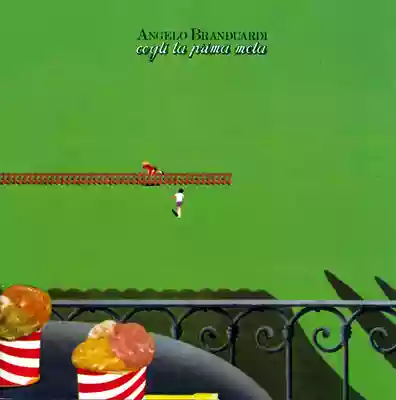
The old cardboard case shows the passage of time, yet what that green expresses in the heart remains unchanged, stronger than the years: the ice cream will not melt, and the children who jump the fence and embrace in the meadow will always remain the same.
I extract the envelope and read once again the words printed on it: "“Danzala la vita tua, ridila la tua allegria”.
Angelo Branduardi, with his poetry and his violin, is capable of opening vast horizons, both spatial and temporal: faraway epochs, the passion of timeless loves, and the sadness of seasons ending. But always in motion, and it is a constant journey because "it is in the journey that everything happens". By his side, besides excellent musicians like Maurizio Fabrizio, is his wife Luisa, always co-authoring the lyrics and acting as his muse. And this journey leads him, in 1979, to write a new page in his diary. It becomes a magnificent page, suspended between melancholy and sweetness. It begins with what is for the Minstrel (though he doesn’t much like the nickname) a true classic, that "Cogli la prima mela" that still today, with its almost gypsy-like guitar rhythm, is a real anthem to life and friendship: "Hold tight to the friend who will smile at you". It talks about love, and if "Colori" is a wonderful poem about the pain of love, "Se tu sei cielo" is instead a declaration of trust, conviction, faith, even if the future may be uphill. It also talks about the sweet half of the apple (to stay on topic), with that "Donna ti voglio cantare" where Angelo reveals the presence of the feminine universe in every element surrounding him, the true driving force of the world, in a song almost obsessive in its linearity: "Woman, woman you are stone, at times you are a cloud..." But Branduardi is not just this, otherwise, he would be as sugary as sugar in honey and that’s it.
Branduardi is a fairy tale, primarily: a tale of strange characters, like “La strega”, a girl who, driven by the gaze of a man, a sort of sorcerer, leaves her father’s garden for the secrets of magic that this man can teach her; “Il signore di Baux”, on the other hand, characterized by a slow but relentless pace, tells of life in the home of a local lord, built on stones, and it is a story of hunting and parties; musically speaking, it is one of the peaks of the album. Fairy tales are also, and above all, animal metaphors. Animals become a representation of human vices and virtues (an aspect, in truth, more present in other albums: “La pulce d’acqua” for example, with tracks like “La lepre nella luna”); the LP presents “Il gufo e il pavone”, to be honest not irresistible, perhaps a bit confused in the singing, but still enjoyable. Certainly, what has been described so far is a good album, but overall inferior to the previous one.
So why “Cogli la prima mela”? Because the last seven, eight minutes are missing... the “Ninna nanna” is missing. The title may not be promising. Yet, yet, and I am perfectly aware of the enormity I am about to say, it is the song that moves me the most, that gives me the most chills: for me, a song among the best ever, perhaps THE best ever, because it is unique. An introduction of violin, and Angelo's poignant voice introduces the first of the verses, chilling: “I put him to sleep in the cradle and entrusted him to the sea; whether he saves himself or is lost, and never returns to me.” Then it is an absurd cavalcade, narrating the story of the boy from the voices in the kitchens at the bottom of the stairs and then towards the uncertain fate that awaits him after abandonment. Each verse is accompanied by sweet and determined instrumentation, always different and always enveloping, in the tones of accordions and medieval instruments, culminating in the magnificent theme for guitar and mandolin that will precede again the "key" verse and then will spread, in a crescendo of intensity, into a melody that could continue for eternity.
"Cogli la prima mela" may not be a masterpiece, but it is a beautiful work, certainly deserving of the highest rating, and like the previous "La pulce d'acqua" it perhaps does not have that place of honor among Angelo's works (even in the recent “Platinum Collection” all the tracks extracted from it appear in the live version of the album “Camminando camminando” from '96) and in Italian music that it deserves, and it is a shame because the history of music also passes through minstrels like him.
And because I want my children (after a prog day, of course!!) to fall asleep with his tales and his lullaby.
Loading comments slowly
Summary by Bot
The review praises Angelo Branduardi's 1979 album 'Cogli La Prima Mela' for its poetic lyrics, evocative violin, and captivating blend of medieval and folk sounds. Although viewed as slightly weaker than his previous work, the album features standout tracks like the title song and an emotional lullaby finale. Branduardi's music tells timeless tales with enchanting metaphors and rich instrumentation. The album is acclaimed for its heartfelt storytelling and cultural significance in Italian music.Tracklist Lyrics Videos
Angelo Branduardi
Angelo Branduardi is an Italian singer-songwriter and multi-instrumentalist, widely described in these reviews as a minstrel-like artist whose music blends folk writing with medieval, Renaissance, classical and Celtic/ethnic influences, often led by violin and acoustic guitar.17 Reviews
