
 •
Rating:
•
Rating:
THE REVIEW
The Apocalypse, yawning...
The end of the world is happening, and for real, out there, but we, people of witty spirit, we who are elegant and refined, know that we don't have time for these trifles. We are not afraid. We are perfectly calm. Instead, we want to stay here a little longer, to enjoy those pleasures of which, if we know how to appreciate them, life is anything but stingy. To all this noise then, and the Apocalypse, or end of the world as it may be called, advancing menacingly outside our window, we respond with a blissful and mocking yawn...
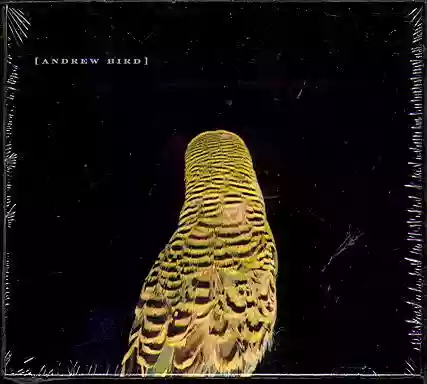
Not unlike what was just described must have been the inspiring image on which Andrew Bird developed his latest album, "Armchair Apocrypha", released in March of this year with the new (for him) label Fat Possum. Andrew Bird, multi-instrumentalist (violin, guitar, glockenspiel), born in Chicago in 1973, already a prominent figure in the American alternative scene with his previous group the Bowl of Fire, tried, in this new work, a compositional key based on relaxation, both melodic and textual. The result is greater cohesion and homogeneity among the twelve tracks that make up the album, compared to previous works, the penultimate of which, "The Mysterious Production of Eggs", was released in 2005.
The opening track, "Fiery Crash", with its catchy phrasing of electric piano, amplified guitar, and drums that start with subtle rolls to become more and more demanding, is a brilliant introduction for the whole album. The second track, "Imitosis", is a reworking of "I", from the 2003 album "Weather Systems": listenable, but those who are already familiar with the originating track may be a bit perplexed by Bird's penchant for self-citation. Already in "The Mysterious Production of Eggs", there was "Skin Is, My", a reinterpretation of "Skin", also included in "Weather Systems".
With the third track, however, Bird definitively convinces us of the high value of this album. The track is titled "Plasticities": "plasticities" in the plural, but also, perhaps, "plastic cities." The first interpretation of the term refers to the changing and multifaceted character of the melody of this piece, which is shaped and set in motion, particularly in the chorus, by the magnetic electric guitar riff and Bird's voice that darts between the lines of the staff like a dolphin in and out of the waves, modulating these verses: "we'll fight we'll / we'll fight for your music halls / and dying cities / they'll fight they'll fight / for your neural walls / and plasticities / and precious territory" (we'll fight, we'll fight for your concert halls / and for the dying cities / they'll fight, they'll fight / for your neural networks / and for the plasti-cities / and for the precious territory). The lyrics throughout the album are cultured and ironic: in the case just mentioned, for example, Bird plays with the pronunciation of "we'll fight," altered by him into "whale fight," as if to say that all the fuss to have spaces to make music, orderly cities (even if made of plastic!), and increasingly performative brains, ultimately results in nothing other than a whale fight (sic!).
The most surprising track on the album is probably "Armchairs", a construction as sumptuous as a neoclassical palace, which, however, manages to remain light and dynamic for all seven minutes of its captivating duration, during which it goes through continuous changes in melody. In other tracks, like "Heretics," the excellent work of drummer Martin Dosh stands out, who in this album is also at the keyboards, as well as co-author of some of the tracks.
Exact, meticulous mixing, done at Pachyderm Studios in Cannon Falls (Minnesota), puts every sound in the right place under Bird's singing, now assertive, now sighing and whispered, excellently supported, as in the mentioned "Fiery Crash," by the counterpoint of Haley Bonar, a very young country-pop singer from Minnesota who can already boast her own solo repertoire. Rich is the tone of guitars and electric piano and the precious insertions of the violin, the favored instrument played by Bird. The dynamic of the melodies, the warmth, and the depth of the overall sound are nonetheless credited to Dosh's Rhodes and Wurlitzer keyboards.
A separate note should be dedicated to the whistling, or whistling if you will, so beloved by Bird, and to which he has now accustomed his admirers. Bird whistles a bit everywhere on his tracks, using the lips whistle just like any other musical instrument. It can be appealing or not; sometimes, in my opinion, it seems redundant, as in "Simple X," other times it is effective, as in the intro of "Darkmatter."
A mention deserves the remarkable "Schityan Empires," in which Bird talks about obscure ancient civilizations and the horsemen of the Apocalypse, while the music "follows" the text, highlighting its pivotal points. There are two instrumentals: a refined and brief "The Supine" and another with the burden of closing this valuable work, "Yawny at the Apocalypse," where on gentle pastoral echoes, the serene and relaxed chords of Bird's violin unfold, like the awakening of a child on a fresh morning.
"Armchair Apocrypha" is a further significant work by Andrew Bird. After six studio albums, it might have seemed that his qualities as a writer of lyrics and music, as well as an extraordinary performer in his live shows, had exhausted the margin for further developments. And that, like many, he would continue to propose a tested musical formula capable of guaranteeing him the appreciation of the established audience. But no. Every now and then, impressions deceive. In the case of this album, that is certainly a pleasure.
Andrew Bird, "Armchair Apocrypha", Fat Possum, 2007
Loading comments slowly
Summary by Bot
Andrew Bird's 'Armchair Apocrypha' delivers a sophisticated blend of witty, ironic lyrics and intricate melodies. The album shows greater cohesion compared to previous works, enriched with skilled instrumentation including violin, electric guitars, and distinctive whistling. Highlights include the compelling tracks 'Fiery Crash,' 'Plasticities,' and the epic seven-minute 'Armchairs.' With meticulous production and the support of collaborators like Martin Dosh and Haley Bonar, the album stands as a significant evolution in Bird's career.Tracklist Lyrics Videos
Andrew Bird
Andrew Bird is an American singer, songwriter, and multi-instrumentalist from the Chicago area, born in 1973. Known for violin, looping, and whistling, he first came to prominence with Andrew Bird’s Bowl of Fire before a string of acclaimed solo albums.03 Reviews
