
 •
Rating:
•
Rating:
THE REVIEW
It was about time someone decided to bring wrestling to the attention of academics.
Everything and more has been said and written about the phenomenon of American wrestling shows; yet, paradoxically, no one has ever written what was necessary to write.
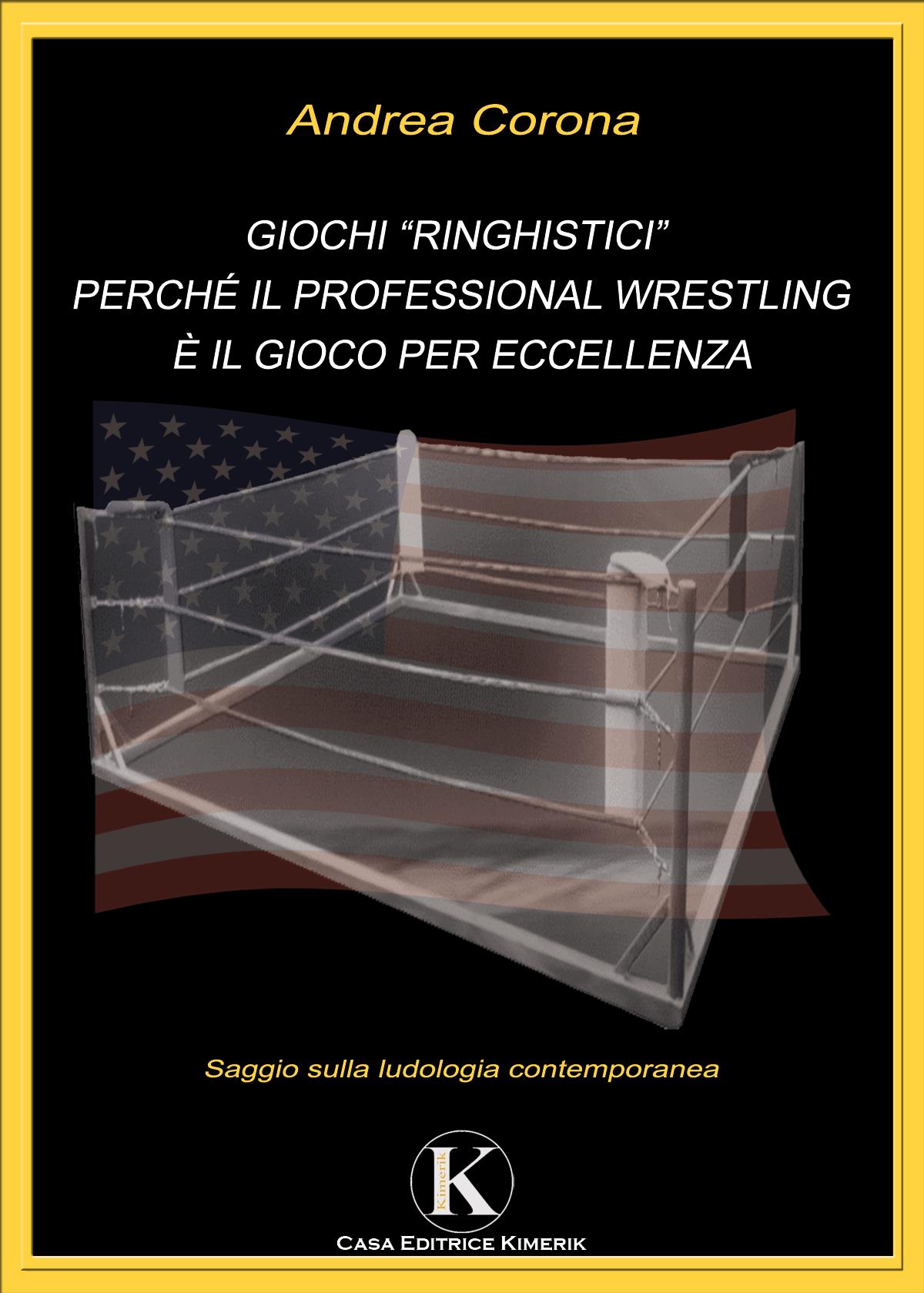
Andrea Corona, a young Neapolitan philosopher, did so, author of the book "Giochi ringhistici. Perché il professional wrestling è il gioco per eccellenza" (Kimerik 2009).
Corona explains, firstly, how wrestling is a postmodern phenomenon in which the canons of classical shows are taken up and reworked with a precise adaptation to mass culture. It is not a low-grade show where adult men fight for the sole purpose of proving who is the strongest, because this is only the mask of a discipline (or an art?) based on the mythological-ritualistic representation of Pain and Suffering.
The style of the book presents all the characteristics of a treatise on semiotics, but also on anthropology of language, sociology, pedagogy, and philosophy. Not surprisingly, the book also has a subtitle, "Essay on contemporary ludology".
As Corona himself declared, it is primarily a current affairs essay, which aims to integrate the theme of wrestling within the debate, already in vogue for some years, on the meaning of gesture in play and sport, taking up themes (dear, for example, to educators and philosophers of language) such as the infraction of the rule as a rule, the thin threshold between harmless play and dangerous play, the role of players, always on the edge, in being playmates, between being friends and enemies, accomplices and rivals.
The author tackles, with much expertise, the famous texts on play by Johan Huizinga, Roger Caillois, Eugen Fink, and Gregory Bateson.
But in addition to these texts (an essay on ludology cannot disregard these cornerstones), Corona enriches his arguments by also referring to Gilles Deleuze's extraordinary book on masochism, the schemes of the Russian fairy tale by linguist A.J. Greimas, as well as, naturally, the essay on wrestling shows by French semiotician Roland Barthes.
The central chapter, which acts as a link between philosophy and ludology, is dedicated to Wittgenstein's "language games", for whom «the meaning of words lies in their use». But, as Corona notes, meaning is not only in the use of verbal languages, but also in non-verbal ones: gestures, actions, reactions. Thus, taking an umbrella to protect oneself from the rain is different from taking an umbrella to hit someone over the head. Naturally, hitting someone against their will is different from hitting someone to gratify a masochistic desire. In short, if we want to understand wrestling (in which objects are often used for fighting), we must first preliminarily understand the anthropological context, the "community form of life," within which an interaction takes place between two or more people. Otherwise, trying to establish a unique meaning for each word, gesture, action, and reaction leads to prejudice, resulting in assigning meanings inappropriately, completely misunderstanding the real intentions of the users of the languages, as well as the subjects of the actions in general.
But in wrestling, the real intentions are always "obscure", but this, however, is an added value, because it leads the spectator to play along.
In conclusion, the meaning of the gesture in play and sport is studied by many educators, who, considering the "Enciclopaideia" project, are dealing with the topic also from a phenomenological point of view, and therefore not only from a psycho-pedagogical standpoint but also a philosophical one.
In this, "Giochi ringhistici" is an extremely fitting book, recommended for many university students... but also for many teachers.
Loading comments slowly
Summary by Bot
Andrea Corona's book offers a rich, interdisciplinary exploration of professional wrestling, framing it as a postmodern, ritualistic game beyond mere sport. The review praises the author’s integration of philosophy, anthropology, and semiotics to explain wrestling’s deeper cultural significance. It highlights Corona's discussions of language games, gesture meanings, and the blurred boundary between play and conflict. Recommended for academics, educators, and wrestling fans seeking a profound understanding of wrestling as a form of art and play.
