
 •
Rating:
•
Rating:
THE REVIEW
Meteopathic and prone to rather abrupt mood swings, I must confess that Autumn has always been a season, not only atmospheric, that stimulates in me personal drillings that occur with a certain regularity. In these often futile inner explorations, I try to bring to light things, sensations, and situations "forgotten" for a long time and dry them in the sun of my maturity (at least chronological) to find, if not a sense, at least a tangled or partial fil rouge of my personal history.
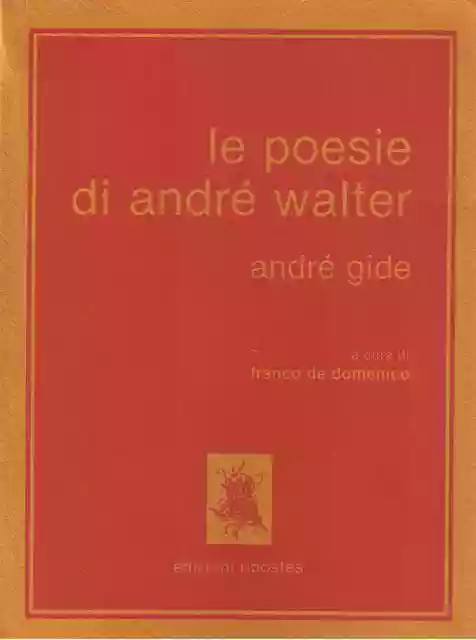
In France, in 1892 and thus in the full autumn of Symbolism, a small collection of poems by an author barely in his twenties, then semi-unknown, appeared. These compositions paired with the prose debut of the previous year, "The Notebooks of André Walter," and represented, besides a complete commercial failure, the first poetic murmurs of what would become one of the most refined and influential writers of the first half of the 20th century.
A restless and wandering personality, fervent and introspective, with a very strict Puritan education that invariably clashed with an ambiguous sexual identity that the poet himself struggled to accept for a long time, André Gide transferred into his writing the tearing and often irreconcilable conflicts he carried within himself.
All these incompatibilities, which were the constant spur of his work, are present in nuce even here in the "Poems of André Walter." Humble and bare of any intellectual frills, these twenty poems resemble dewdrops slowly carving into Gide; pages of a diary where the oppositions shadow/light, meditation/action, flesh/spirit seek to harmonize in a score that could ease the poet's pains. An Existentialism ante litteram where the likes of Sartre or Camus would later partake.
The symbols, stripped of any mystical and evocative charge, seem rather to reflect Gide's spiritual stagnation, bogged down by doubts and scruples. The colors used to paint these watercolors are those pale ones of the moon and those subdued of dying oil lamps. The beloved whom the poet confronts turns out to be a sort of double, an emanation of himself that widens the cracks in his creaking religious dogmatism.
Atonal and expressionless poems, where Gide seems almost to suffer from an excess of consciousness, and where the imperceptible oscillations of his spirit mark an inner rhythm in total submission and partial dissonance from the austere and indifferent rhythm of Nature. Personally, for stylistic elegance, immobility of setting, and reiterated solipsism, this book reminds me of the second act of Chekhov's "The Cherry Orchard," where the characters, gathered at the edge of the ancestral garden, thought aloud and, answering each other's questions, paid attention only to what they themselves were saying.
Although the mature Gide wrote works of much higher caliber than this (I think of the voracious self-seeking in "The Immoralist" or the stylistic balancing acts in "The Vatican Cellars"), in my view, rewinding the tape and finding the end of the thread is a necessary operation not only regarding ourselves but also to understand the path of certain great artists.
Loading comments slowly
Summary by Bot
This review explores André Gide's early poetry collection 'Le Poesie Di André Walter,' highlighting its introspective mood and existential undertones. It positions these poems as foundational to Gide's later refined works. The review emphasizes the poet's personal struggles and the symbolic contrasts within his writing that prefigure existentialism. While modest in style, the poems are seen as essential to understanding Gide's artistic evolution.
André Gide
André Gide (1869–1951) was a French author, novelist and essayist, awarded the Nobel Prize in Literature in 1947.02 Reviews
