
 •
Rating:
•
Rating:
THE REVIEW
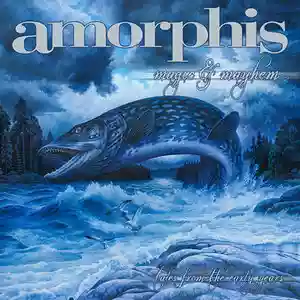
The subtitle of this work, quite simply, is "Tales From The Early Years." Therefore, this is not an album of unreleased tracks, but it is a reinterpretation in the "new style" of old glories belonging to the early albums of the Finnish group Amorphis. The reason for this maneuver, which could easily be accused of being purely commercial? The new (so to speak, given the more than five years of presence in the group) singer Tomi Joutsen, with his good warm and versatile voice, and the greater resources available to the band manage to justify such a release.
More or less in chronological order, the pieces of this "Magic & Mayhem" unfold from the most canonical melodic death of the title track and "Vulgar Necrolatry," to the much more complex and significant songs taken from the "middle" albums (Elegy primarily, perhaps the masterpiece of the early days).
The tracks are, of course, presented with greater sound quality and production, these are not simple remixes, but new performances that do not structurally differ from the originals; yet, the whole thing has the merit of not seeming contrived and overall the tracks regain a new freshness.
The metal heard in this hour of music is decidedly melodic, as per the band's tradition, namely a heavy/death that, along with a constant typically seventies aura (old-style guitar riffs, keyboards borrowed from Yes, with due proportions), consistently adds never too extreme doom slowdowns. The frontman is decidedly talented, more incisive than his predecessor, and alongside deep growls, he inserts clean voice parts, with quite a low tone.
The most successful tracks in this new guise are those endowed with more melody and references to classic rock: "Song Of The Troubled One," already immense in its original form, boasts successful arrangements and a typically progressive keyboard melodic base. It truly feels like listening to an old school prog-rock band that decided to turn up the volumes, complete with guitar wah-wahs for the joy of vintage lovers (among whom the writer counts himself). "Black Winter Day" has more of a doom flavor, with a powerful pace and guitar delights that denote both melodic taste and good technique; noteworthy is the central keyboard solo in which the specter of Yes and ELP emerges not even too subtly.
"On Rich And Poor" is a more canonical and straightforward heavy metal song, with a nice baroque riff in evidence. The album concludes with the most well-known piece, the beautiful "My Kantele", a song capable of pleasing both the harshest metaller and the romantic damsel: an exceptional chorus and successful keyboard and guitar solos lead to an exciting finale. Unless one owns the special edition, which features a pleasant but nothing more bonus track: it is the famous "Light My Fire" of Doorsian memory, proposed faithfully instrumentally, and equipped with the usual growls, misplaced here.
For those who wish to listen to the album, the advice is not to be misled by the very first tracks that do not do justice, neither in style nor in quality, to the rest of the work.
Loading comments slowly
Summary by Bot
Magic & Mayhem by Amorphis is a reinterpretation of early tracks with enhanced production and Tomi Joutsen's versatile vocals. The album balances melodic death metal with progressive and classic rock elements, adding freshness without altering the originals fundamentally. Key tracks like "Song Of The Troubled One" and "Black Winter Day" stand out for their sophisticated arrangements and musicianship. The album is highly recommended for those interested in melodic metal and progressive sounds.Tracklist Lyrics Videos
Amorphis
Amorphis is a Finnish metal band known for evolving from early death metal into a melodic death/progressive style often enriched by keyboards and folk elements, with recurring lyrical inspiration drawn from Finnish mythology and traditional poetry.23 Reviews
