
 •
Rating:
•
Rating:
THE REVIEW
Don't touch my America! If it's true that their inspiration and compositional flair began to fade quite early, to the point that most of their records might seem rather pointless, their career start was absolutely fresh and interesting. Essentially, I recommend getting their first two albums: the self-titled debut from 1971 and this "Homecoming" from the following year, while you can safely ignore the rest without missing much, just a few melodic gems here and there.
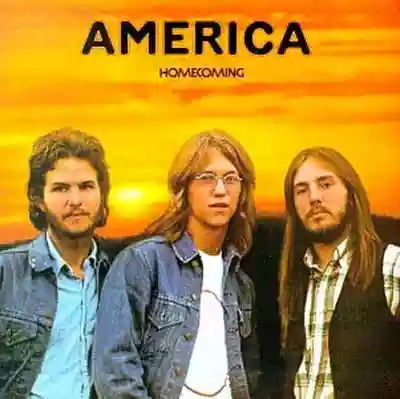
Spectacularly portrayed on the cover in front of one of those incredible orange sunsets typical of the Californian desert, the three guys (then practically in their twenties) happily manage to replicate the compositional quality and the performative freshness of their first album. The inspiration from the great Californian folk-rock groups, particularly Crosby Stills & Nash, is clear and total; it would eventually dilute over the years into a more stylistic and anonymous pop, but for now, the musical direction is undeniable: West Coast.
Their passion for Californian moods, philosophies, and music is acquired, not absorbed from within, considering Dewey Bunnell, Gerry Beckley, and Dan Peek hail from England (Bunnell was even born there, and their previous debut album was recorded in London), being all children of NATO military personnel stationed in the old continent. Perhaps that's why their elegant and accessible music lacks the depth, intensity, courage, madness, psychedelia, social consciousness, and even the additional value from various narcotics that the great San Francisco and Los Angeles bands generously spread during the late '60s.
"Homecoming" ("Returning Home") is thus the inevitable title of an album conceived after initial successes allowed the three to leave their families and settle in their homeland, to continue directly from California creating a refined, intentional, and beloved sound envelope of pure American West, as was said of limited conceptual strength but pleasantly serving itself. There are no messages, worries, searches, or animosities, just a great inclination and desire to compose and perform brilliant little songs, in total democracy among themselves: they indeed assign three songs each in terms of composition and lead vocals, plus a cover for a total of ten pieces.
As happened the year before (with the famous "A Horse With No Name"), the highlight is a song by Bunnell, rightly placed at the beginning: "Ventura Highway" owes much of its success also to Beckley, the creator of the persistent and effective acoustic guitar riff constantly doubled and harmonized by Peek with another acoustic, throughout much of the song. It's an "embellishment" of Dewey's singing and rhythmic strumming of vital importance to give the piece charm, dynamics, harmonic richness, uniqueness.
Bunnell's beautiful voice (the most interesting of the three) nevertheless achieves its best performance in the electric and intense "Cornwall Blank", a song of a much broader scope than their usual, with time changes, lysergic electric guitar solos a'la Jefferson Airplane, a tense and expressive singing worthy of the most loaded and visionary David Crosby.
Beckley is the one most connected to the land of adoption, the just-abandoned Great Britain. The piano is his favorite instrument, the Beatles a reference point as much if not more than Californian country rock. Of the three piano ballads he offers, the most effective seems "To Each His Own", with its exquisite and irresistible melody.
Dan Peek, who would leave the group a few years later reducing America to a duo for the rest of their career, contributes with the excellent "Don't Cross The River", which impeccably rolls along with its electro-acoustic resonances, rich in harmonies with Byrds-like nuances. There's maximum suggestion also in the concluding "Saturn Nights", offering a successful contrast between the softly uncertain progress of his lead voice and the splendid arrival of beautiful choral parts.
The only cover on the album pertains to a great, now-late British folk singer, proving their umbilical connection still with the English music scene. "Head & Heart" by the late John Martyn is rendered not far from the original, maintaining its soft and confidential atmosphere, with a muddy electric piano bearing a curious, total similarity to McCartney's well-known "Come Together" by the Beatles.
Don't touch my America, or at least do so after you've (re)listened to "Homecoming" and its handcrafted easy listening that remains innocent, fresh and sunny.Loading comments slowly
Summary by Bot
The review praises America's 1972 album Homecoming as a fresh and interesting follow-up to their debut. It highlights the band's West Coast folk-rock style inspired by groups like Crosby, Stills & Nash, and emphasizes key tracks such as Ventura Highway and Cornwall Blank. The album showcases strong democratic songwriting among band members and captures a sunny, innocent vibe. While their later work is seen as less inspired, Homecoming remains a melodic highlight worth revisiting.Tracklist Lyrics
America
America are a folk/soft-rock group formed in London in 1970 by Dewey Bunnell, Gerry Beckley and Dan Peek, children of U.S. military personnel stationed in the UK. They broke through with the No. 1 single A Horse with No Name and the debut album America (1971), followed by Homecoming (1972) with Ventura Highway. Mid‑70s albums produced by George Martin yielded hits like Tin Man and Sister Golden Hair. Peek left in 1977; Bunnell and Beckley have continued as a duo, recording and touring.06 Reviews
