
 •
Rating:
•
Rating:
THE REVIEW
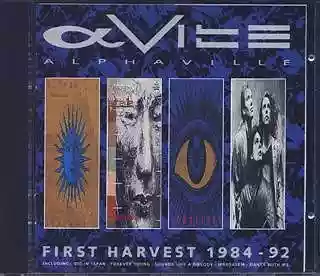
What I am reviewing and recommending to everyone today is "First Harvest", a collection of the greatest hits of Alphaville from 1984 to 1992. A perfect CD in every respect, excellent for nostalgics of synth-pop bands and very beautiful for all listeners of techno-pop music.
A melodic and sweet music, graceful and digital, futuristic as an evolution of the punk movement, but calm, sweet, and poetic in its synthesized sounds. Alphaville took their name from a future city in a Jean-Luc Godard film; the iconic song that still perfectly remembers them today is "Big in Japan", the first track of the twenty-one proposed here.
Alphaville is a group already successful with their biography typical of a happy-ending story. It all began when a group of friends consisting of Bernhard Lloyd and his girlfriend Gieselmann, Marian Gold and his girlfriend Mummert, Julia Snyder, and Ulli Sprick, a computer expert passionate about music and art, decided to form a band.
The guys did not have a significant fortune to bring the project called Nelson to life, but they had thought of joining their maximum resources together to have a starting point and moved from Berlin to Munster in Westphalia in an apartment rented from Mummert's grandmother.
The guys lived together and played in the basement, proposing their results in various local venues. In '83, the then "Forever Young" began to have various record proposals.
Thus, Alphaville was born, whose new spot-on name not only wanted to pay homage to the French director Godard but aimed to introduce the figure of the computer, which, besides being the main object of the science fiction film, is the defining element of the "new way of playing", and the computer indeed revolutionized the music world, raising a huge dust cloud of controversies.
Albums upon albums were created, success seemed never to stop, and from "Forever Young" in 1984, we reached "United" in 1996. Before the release of History in 1993, the label WEA promoted a collection of Alphaville's greatest hits, the reviewed First Harvest.
Robotic, experimental, computerized, digitally sampled sounds compose fantastic melodies like in "Sound Like A Melody" with poetic and romantic lyrics and very rhythmic yet at the same time delicate and sweet tonality due to Marian Gold's fantastic soft voice.
There are more danceable and lively tracks like the cheerful and charged "Sensations" and others where Gold's extensive and pure timbre is very remarkable, such as in "The Mysteries Of Love". Some tracks like "Lassie Come Home" are more relaxing and calm, with melancholic poetic bases and very abstract and psychedelic lyrics, while others like "Jerusalem" retain the character of melancholy, but wrapped in mystical/melodic contexts of intense atmosphere.
Some tracks are instead more lively and energetic, full of that energy that only the synth-pop current can transmit, as is the case with the beautiful Dance With Me, a pearl of '80s dance.
Don't miss the fantastic "For a Million" a song of pure playful and atmospheric electronic expressiveness, a wonderful ballad with a happy and invoking chorus.
A deeper, lower, and mysterious voice sings silently in "A Victory Of Love", with a somewhat dark and gothic base, while many experimental sounds can be heard in the beautiful "The Jest Song", cheerful, fast, and with choruses.
There is also a remixed version of Big in Japan, with an initial message that, if played backward, announces the creators of the mix.
Other tracks deserve to be listened to, like "Forever Young" from the first album that still bore the old name of the band, and "Summer in Berlin" very soft and serene.
An excellent album capable of accompanying the human mood in its thousand facets, a collection of small masterpieces of an artistic current far from commercial. Try it to believe it.
Loading comments slowly
Summary by Bot
First Harvest is a superb greatest hits collection from Alphaville, capturing their melodic, futuristic synth-pop sound from 1984 to 1992. The album features iconic tracks like "Big in Japan" and "Forever Young" and highlights the band's poetic and electronic style. It offers a rich variety of moods, from energetic dance tunes to relaxing, melancholic ballads. Recommended for fans of 80s synth-pop and techno-pop music.
Alphaville
Alphaville are a German synth-pop/new wave group formed in 1982 in Münster by Marian Gold, Bernhard Lloyd, and Frank Mertens. Named after Jean‑Luc Godard’s film, they broke through with the 1984 singles “Big in Japan,” “Sounds Like a Melody,” and the iconic “Forever Young,” and continued with albums including Afternoons in Utopia, The Breathtaking Blue, and Prostitute.04 Reviews
