
 •
Rating:
•
Rating:
THE REVIEW
Writing your very first review starting with what you ultimately consider your favorite album, all on the day of the twenty-fifth anniversary of its release. Let's do it.
Seattle, early '90s. If you've done your homework, your mind will already be traveling towards names and sounds that were protagonists of the grunge scene, which, at that precise period, was experiencing its peak of splendor. Despite some genre milestones already present in the market and the charts, there was still a reserved seat at the table of the greats for Alice in Chains who in 1992 released Dirt, the second full-length album by the band led by the Staley-Cantrell duo, a record into which they poured all their demons.
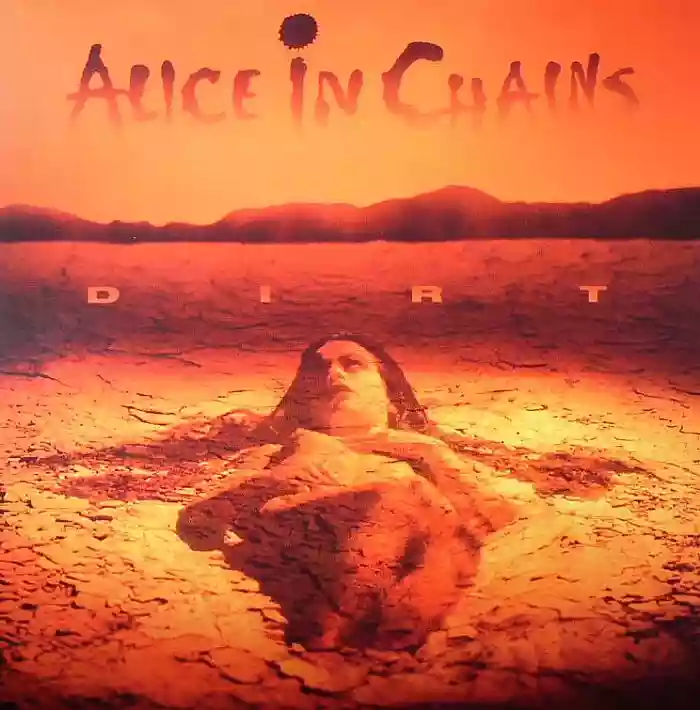
The album cover prepares the listener for the thirteen tracks to come, a journey in the desert where shades of red and orange dominate, a desolate scenario in which a female figure surrenders to the bare ground disappearing little by little, perhaps the perfect image to represent the dimension of abandonment in which the blond frontman lived, a son of drug addiction that played a very heavy role in the lyrics of the album but even more in his life, which ended prematurely ten years later.
Dirt is a platter with harsh and lysergic sounds that for about an hour forces the listener to wear the shoes of someone who, now powerless, asks for help but without receiving it; heroin abuse and the dilemmas of the soul are at the base of the decadent lyrics of this album and equally desperate are the music. Layne Staley's voice, the absolute protagonist of the work, changes register at will freely wandering among (negative) emotions suitably supported by the choruses of guitarist Jerry Cantrell who, besides effectively executing the two-voice harmonization that is the band's trademark, puts his six-string with acidic sounds at the service. Completing the package is the solid drumming of Sean Kinney, effective even in the most syncopated parts, while Mike Starr’s Spector emits grating roars down in the kingdom of low frequencies. All the ingredients are there, the album can start from here and it will be a crescendo but only in qualitative terms because in the end, at the bottom of the hole, you'll feel so small.
The show is opened by “Them Bones” with an anxious verse but with a chorus that almost seems to want to reassure the listener by reminding them what the only true destination is (gonna end up a big 'ol pile of the bones). It is followed by a defiant “Dam That River” leading into the psychedelic “Rain When I Die”, a semi-ballad with an obsessive riff telling of a tormented love (could she love me again, or will she hate me?). It’s the turn of the schizophrenic “Sickman” before reaching the touching “Rooster”, dedicated to Cantrell's father, a Vietnam veteran, a track seemingly peaceful at the start but with an explosive chorus accompanied by one of the frontman's best performances on the microphone. “Junkhead”, as the name suggests, is a journey into a junkie's mind (you can’t understand a user's mind but try with your books and degrees). The title track “Dirt” fully expresses Staley's desperation (you use your talent to dig me under and cover me with dirt) rocking the listener with its middle-eastern flavor. Back to more aggressive sounds with “Godsmack”, fast and almost amusing, and “Hate to Feel”, with a blues vein and a limping rhythm. What follows is a closing trident that alone is worth the purchase of the album, I say this with all due respect to the previous tracks. Just a few steps from the end, Dirt pulls out of its arsenal three absolute gems to conclude the journey into the abyss and conquer that seat at the aforementioned table of the greats.
“Angry Chair” captures with a paranoid intro before flowing into its chant to which a sharp pre-chorus is contrasted and everything concludes with a more heartfelt chorus. Sanity is completely abandoned between dark words (candles red I have a pair, shadows dancing everywhere, burning on the angry chair) and hypnotic sounds dirty with effects. After reason, it's time to lose even the last hopes, “Down in a Hole”, the pride of the platter, rends hearts and lacerates flesh, a two-voice ballad to admit one's defeat at the hands of drugs. I’d like to fly but my wings have been so denied, a cry I would dare to define generational, words that anyone could borrow. The final act is entrusted to “Would?”, whose opening bass line is as iconic as the initial riff of that “Smells Like Teen Spirit” that made history the previous year. A disarming and nervous track destined to become Alice in Chains' most famous song, posing that immortal final question at its close (If I would, could you?) screamed against the world. And then silence.
Ultimately, Dirt is an album as dark and dense as pitch, a suffocating sonic experience that fully represents a musical trend that in a few years would have completely disappeared. To assign a grade to a piece of history like this would be almost disrespectful, I'll simply tip my hat (once again) and play the album again from the start. I invite the reader to do the same.
Loading comments slowly
Summary by Bot
Alice in Chains' 1992 album Dirt is a seminal grunge record that explores dark themes of addiction and despair through haunting lyrics and powerful performances. The review highlights the band's musical chemistry and standout tracks, portraying the album as a deeply emotional, suffocating sonic journey. Despite its heavy subject matter, Dirt remains an essential classic of its era.Tracklist Lyrics Videos
Alice in Chains
American rock band formed in Seattle in 1987, noted for two-voice harmonies, dark lyrical themes and a signature grunge/alternative-metal sound. Fronted by Layne Staley until his death in 2002; later continued with William DuVall.37 Reviews
Other reviews
By Asjklf
Alice in Chains were more than just simple Nirvana clones, as they remain a point of reference for many bands today.
The lyrics of Dirt, supported by a sometimes claustrophobic sound, narrate Staley’s descent into the hell of drug addiction.
By Rooster
If suffering had a voice, it would not be much different from Staley’s.
The title track, however, is perhaps the piece that most unsettles the listener, it is the central moment, when Staley slowly paints the fresco of his despair.
By andrewramone
Goosebump-inducing atmospheres, emotions never felt before; dark and touching songs that leave a strong sense of melancholy.
The main theme of the album is the singer’s relationship with drugs: to directly and explicitly convey what it means to be dependent.
By Starblazer
a record that, as soon as you listen to it, conquers you and penetrates your veins with a virulence that 'Nevermind' and 'Ten' can’t even dream of.
'Down In A Hole' leaves you breathless for the perfect intertwining of Jerry’s and Layne’s voices, PURE POETRY.
By Omega Kid
Dirt moves in an almost perfect balance between metal spirit and pop fascination, where everyone has their space.
There are no minor tracks or filler in Dirt, a characteristic that would already be a minor miracle for the recording industry.
