
 •
Rating:
•
Rating:
THE REVIEW
Rough, ungraceful, rebellious, sadistic, monstrous, and at times horrifying, often bordering on bad taste: this is the portrait of the grandiose Alice Cooper in the eyes of a layperson during the glory days of rock music.
It should be remembered that this is actually the character Alice has always wanted to create, in contrast to the usual two-faced America, a blatant example of everyday life's contradictions. With the help of astounding stage performances, spiders and snakes, guillotines, hangings at the end of concerts, and that touch of the macabre that bloodied makeup around the eyes can add to an eternally angry face, Alice Cooper managed to be hated by the "respectable America" almost as much as he was loved by the youth, especially in the early '70s. The idea of using a woman's name as a moniker is also entirely revolutionary: Alice Cooper was the name of a witch who lived during the 17th century, whom Vincent Damon Furnier believes he is the reincarnation of, after receiving spiritual messages during a Ouija session. In 1974, he even had his name legally changed.
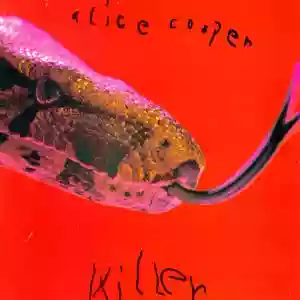
After two albums that were little appreciated by the audience and critics of the time, a window of success opened with "Love It To Death" and especially with the single "I'm Eighteen." "Killer," dated 1971 and produced by the omnipresent Bob Ezrin, is the act immediately preceding the album that would mark Alice Cooper's consecration, that is "School's Out" in 1972. "Killer" is an album today considered a classic, in which Alice Cooper continues his exploration of the dark side of life, combining solid rock with a sharp touch of satire.
The attack is entrusted to Under My Wheels, a rather mean track, with a very rock'n'roll riff featured along with horns that, starting from the solo, fill the riffs and verse. Be My Lover is a track whose guitar part has now become a cliché in the rock field. The ending and the slowed reprise are beautiful. The great masterpiece of this album is undoubtedly Halo Of Flies: the hypnotic intro, which develops into themes with different rhythms, and then the chilling guitar that marks the true beginning of the piece, on which the great Alice sings in splendid form. The part dominated by bassist Dennis Dunaway is frightening, with a backdrop of strings soon replaced by Neal Smith's relentless drumming, up to the dazzling finale. Desperado is another classic, where Alice croaks like a raven, dedicated to Jim Morrison, who died in that same year. Again, strings are arranged by Bob Ezrin.
You Drive Me Nervous is another typical Alice Cooper style track, on the wave of Under My Wheels. The riff of Yeah Yeah Yeah is stunning, a very cheerful song in which the harmonica stands out, giving an American touch to the piece. The song Dead Babies caused great controversy at the time, obviously misunderstood by the American public who cried scandal, even though it's actually a song against child abuse. The progression is slow, the atmosphere is dark, but the message is still positive and fully agreeable. Finally, another great masterpiece is Killer, the title-track, with obsessively dark guitar riffs, Alice Cooper's voice raging in every corner, and then heartbreaking screams over cadenced rhythms, a sort of funeral march made of keyboards and drums with Alice Cooper reciting a sort of sermon, leaving us with a strange and unpleasant final sound.
"Killer" is therefore an album very evocative, mixing macabre humor with teenage fears, a rock approach that tends towards the hard with orchestral touches scattered here and there, more melodic vocals with the powerful yet never unpleasant croaking of the artist. An already very mature album, the result of a good musical blend, the child of a cohesive formation and whose leader was soon destined to become a legend.
Loading comments slowly
Summary by Bot
Alice Cooper's 1971 album Killer is a seminal work blending hard rock with macabre humor and orchestral touches. Produced by Bob Ezrin, it features powerful tracks like Halo of Flies and Dead Babies. The album showcases Alice's rebellious persona, solidifying his place as a rock legend in the early '70s.Tracklist Lyrics Videos
Alice Cooper
Alice Cooper is the stage name of Vincent Damon Furnier (born February 4, 1948), an American singer-songwriter known for pioneering shock rock and theatrical stage shows.34 Reviews
Other reviews
By JeffChow
"Killer," one of the most fascinating albums by Alice Cooper and, consequently, one of the classic rock albums of the ’70s.
"Dead Babies," the story of a girl who died after accidentally ingesting aspirin, ignored by her own parents.
