
 •
Rating:
•
Rating:
THE REVIEW
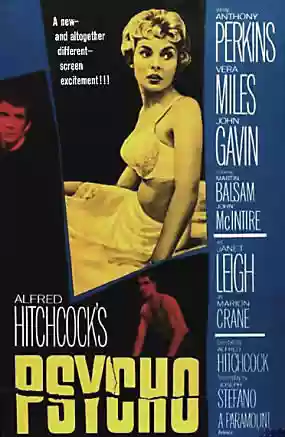
"A quintessential psychoanalytic film and a movie that lightheartedly breaks many taboos (first and foremost, the age-old "that Medea must not die on stage"), a film both admired and aloof as the highest expression of cinema based on its voyeuristic power, and a film with famed scenes [...] Drawn to his own power of "directing the audience," [...] Hitchcock creates an unusually gothic atmosphere for himself [...] and a skillful dissonance in narrative structure (the cruel transgression of killing off the star in the first part alone makes what follows distressing [...]). Above all, he leaves no room for identification with anyone, wallowing in the mystery of a remorseless maniac who kills disguised in his murdered and stuffed mother's clothes. Only a pure film of glacial force?" (Gianni Volpi, "I Mille Film", Baldini & Castoldi, 984 pp.)
Hitchcock came from two very different films, both undisputed masterpieces: the commercial flop of "Vertigo" (partly attacked even by some American critics) and the success of "North by Northwest". Producers pushed for the English director to continue making spy movies, or at most classic whodunits, which the public loved and which were sure to bring further triumphs. Yet Hitchcock seemed restless, and at barely 60 was no longer willing to tolerate the whims of producers or similar. His secretary, Peggy Robertson, passed onto her employer, in 1959, a book (after reading a positive review in a magazine), namely Robert Bloch's "Psycho", based on the crimes of Ed Gein, known as the "Butcher of Plainfield," one of the most ferocious serial killers ever to appear in the US and "almost" a neighbor of Bloch himself (they were separated by 64 km). Hitchcock liked the book and proposed the idea to Paramount, which immediately refused. The idea seemed daring, the film could turn into something excessively cruel (and therefore off-putting for an audience used to less violent shocks) and, above all, the budget seemed enormous. Hitchcock, who at the time was working steadily on his famous show Alfred Hitchcock Presents (one of the first directors to see the medium's potential), counter-offered proposing to use the technicians, equipment, and soundstages (with a few rare exceptions) from the television show. At that point, Paramount agreed, without knowing the film would become Hitchcock’s greatest commercial success and one of the most "gigantic" of all time, but rather predicting a flop which would nevertheless entail manageable economic loss.
"Psycho" is, above all, a masterpiece of storytelling and technique, a cat-and-mouse game that Hitchcock "organizes" with the viewer, providing conflicting interpretive cues so as to continually throw them off balance. It opens with a famous tracking shot which moves from the scorching asphalt of Phoenix straight into a seedy motel room, continually broken up by an alternation of horizontality and verticality (the verticality of the house vs the horizontality of the motel; the window blinds and the bed headboards), perpetually divided between highs and lows (the roads the protagonist travels until she, unwittingly, reaches Norman Bates's motel, and the rain that falls heavily on objects and people), hammered by a brutal soundtrack by Bernard Herrmann and an ever-present sense of anxiety and amazement that keeps the tension sky-high, even in the second part despite the protagonist’s disappearance. The famous shower scene (a true masterpiece of camera movement and editing, which took 7 days to film) is now studied in every film school: to be memorized is the very slow sequence which starts from an extreme close-up of the corpse’s eye and ends on the full shot of the body lying on the floor (which, technically, contains something from the Russian experimental cinema of the so-called Cineocchio).
With a truly fascinating sense of décore: Norman Bates’s motel is inspired by an Edward Hopper painting from 1925. And it is a delightful mix of whodunit, thriller, and horror overtones. Certainly, the psychological sketching of Marion Crane (the protagonist, played convincingly by Janet Leigh) seems perhaps less sharp compared to that of Norman Bates/Anthony Perkins (poor Perkins, over time, would be sucked into this role and eventually create his own version in 1986's "Psycho III"). The mentally dissociated psychopath, lover of taxidermy (who in fact stuffs his mother, mummifying her in the basement), is a textbook clinical case like few seen onscreen, and the excess of brutality (nowadays far less impactful) was one of the main criticisms raised by the specialized press at the time, but it was also one of the reasons for its huge public success (with some trivia: it was the first film in cinema history to show a toilet, a detail that was scandalous at the time; the "premature" death of the protagonist convinced Hitchcock to place notices at the entrance of every theater in the world warning "no one admitted after the film starts").
Everyone has copied it, or tried to; some even remade it ("Psycho", 1998, by Gus Van Sant), there have been films recounting its troubled production ("Hitchcock", 2012, by Sacha Gervasi), and TV series derived from it (in 1987, "Bates Motel", and a longer one produced from 2013 to 2017), essays and treatises of all kinds have been written about it. And critics weren’t always kind when, in 1960, they saw a film so revolutionary and, to them, disgraceful: "A stain in an honorable career" (Bosley Crowther, "New York Times"); "No search for humanity in the characters, nor for dramatic truth [...] only the futile, academic, and often irritating play of intelligence carried to the extreme, and unfortunately supported by the most academic and worn-out conventions" (Nino Ghelli, "Rivista del Cinematografo"); "[...] and if the camera, under Hitchcock’s direction, here and there tends to overemphasize some points of the story, well, it can be forgiven" (Gene Arneel, "Variety"). It was much loved by the Cahiers du Cinema with Truffaut at the helm. With a budget of $806,947, it grossed 32 million.
In 2020, a delicious Blu-Ray edition called "uncut" was released, restoring some original details of the work never before available (and thus never seen in home-video, but only in cinemas in 1960): Bates's bloody hands after moving Crane's corpse; a greater number of stab wounds in the detective's murder, making the scene even more gruesome if possible. With three sequels ("Psycho II", 1983, by Richard Franklin; "Psycho III", 1986, by Anthony Perkins; "Psycho IV", 1990, by Mick Garris). In editing, much of the famous psychiatrist’s final monologue explaining to the police and others Norman Bates's origin of madness was removed (a longer sequence, about 5 minutes more, was shot in the original). It had 4 Oscar nominations but came away empty-handed. On this point, no surprise (that year "The Apartment" by Billy Wilder triumphed, another masterpiece).
Loading comments slowly
Summary by Bot
The review praises Alfred Hitchcock's Psycho as a groundbreaking film in psychological horror. It highlights Hitchcock's mastery of suspense and lasting impact on cinema. The reviewer considers it a must-see for fans of the genre and classic movies alike. Psycho is noted for its innovative storytelling and unforgettable atmosphere.
Alfred Hitchcock
Alfred Hitchcock (1899–1980) was a British film director and producer, widely regarded as one of cinema’s most influential auteurs, famous for shaping modern suspense filmmaking and for his frequent on-screen cameos.20 Reviews
Other reviews
By Bubi
The shower scene is undoubtedly one of the most renowned in cinema, seen by all on television, as the very symbol of the film.
One cannot think of Psycho without recalling Norman Bates, without Anthony Perkins coming to mind.
By let there be rock
The infamous shower scene took 7 days of work and 72 camera positions to film.
Psycho is a film about psychology, about dual personality, and a great thriller that keeps the viewer glued to the screen until the end.
