
 •
Rating:
•
Rating:
THE REVIEW
The new hope of European horror: Alexandre Aja. Director of the excellent High Tension, which allowed him to make his way to Hollywood with the remake of The Hills Have Eyes, Aja offers us another remake this time of a semi-unknown Japanese horror: Into the Mirror.
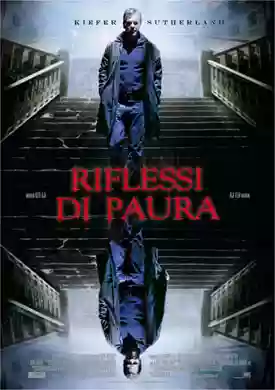
Ben Carson, played by a good Kiefer Sutherland, after mistakenly killing someone and subsequently turning to alcoholism, is left by his wife. A year later, he finds work as a night guard in an abandoned warehouse. The building, previously destroyed by an arson, saw twenty-nine people die inside. In this place, Ben's odyssey will begin, amidst disconcerting visions, strange presences, and his continuous existential problems.
Mirrors plays on mirrors. The mirror as a terrifying object, the means through which fear is dispensed. A continuous play of reflections and reflective surfaces, continuous references to the symbolic object of this film. Mirrors that Ben encounters have the ability to reflect unsettling images and seem to manipulate reality.
After a heart-pounding start, the film slowly loses its strength due to some unconvincing dialogues, while every time it returns to the abandoned warehouse, Aja demonstrates his great talent in recreating dark and ephemeral atmospheres. And it is precisely in these moments that one witnesses the director's skill in creating scenes aimed at scaring the spectator. The film nevertheless lives on an alternating rhythm: chilling scenes (unforgettable the bathtub death one) and silly dialogues that undermine what is otherwise a very good film.
As has happened before, excellent choice of location by Aja. In this case, the film was shot in an old building in Bucharest. Moreover, the same film was produced by a Romanian film company.
The biggest flaw of the French director's horror is certainly the dialogues: some embarrassing, others barely functional to the story being told. Absolutely disconcerting is the one where Ben is called by his wife, and one hears him being apologized for not believing that mirrors could kill. To rescue the film's fortunes comes Aja's undisputed directorial talent, which in the last twenty minutes, with a great idea, and an unexpected ending, raises the fortunes of the film.
Aja tried to represent the mirror as something that no longer reflects the man but rather his fears, his anguish. The same anguish that makes the protagonist much more vulnerable than he is. The director succeeded halfway in this intent, but he still made an attractive film, with excellent photography and great scenes masterfully directed. To do this, he slightly distanced himself from splatter to turn towards a more classic horror style, succeeding quite well. All this work is heavily marred, however, by a weak and silly script that makes this third work by Aja much more banal and grotesque than it actually is.
Loading comments slowly
Summary by Bot
Alexandre Aja’s Mirrors is a visually striking horror film that effectively uses dark, eerie atmospheres and strong directorial skills. Despite its chilling scenes and great locations, the film suffers from weak dialogue and a flawed script. The story explores mirrors as a source of fear and reflects the protagonist’s inner anguish. The final act redeems the film somewhat with an unexpected ending but overall, it is marred by its banal and silly writing.
Alexandre Aja
French film director known for visceral horror films. Director of Haute Tension (2003) and the 2006 remake of The Hills Have Eyes; noted for tense atmosphere, striking cinematography and graphic violence.02 Reviews
