
 •
Rating:
•
Rating:
THE REVIEW
We call them "bricks," "whoppers," "big clunkers." Sometimes, much more prosaically, "a pain in the ass" or "a big nuisance."
They are the endless books, the ones you don't remember when you started and by now you begin to doubt you'll ever finish.
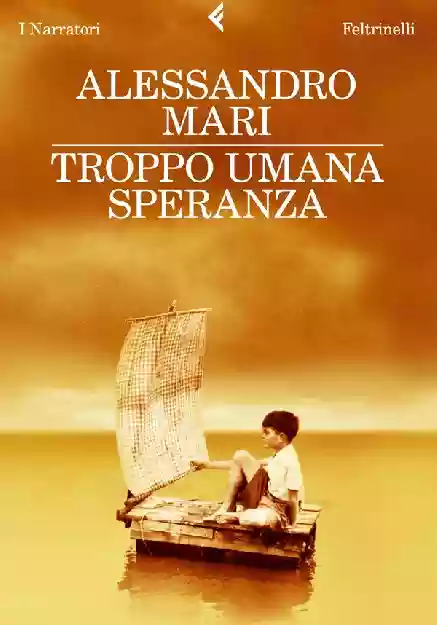
"Troppa umana speranza," the debut novel by young Alessandro Mari, is a brick. Not that it's particularly long or "difficult." It's just that I feel like I've been stuck on page 400 for about 5 years.
Obviously, I don't have the courage to give up, to leave it to its fate and let it remain unfinished. And so I take it with me everywhere: to the bathroom while I poop, to the kitchen while I make ragù, on the metro while I ride up and down.
I started reading it because the author is from my area and because some events in the novel are set in Sacconago, a small village in the province of Varese that I know well.
The expectations were strong.
It's painful to admit, but the disappointment was just as strong.
Let's be clear: not everything is to be discarded. Because even though it requires a (good) amount of patience, in the end the book captivates and manages to create a sincere empathy between the reader and (not all) the characters. This happens especially with Colombino: a classic case of the "village idiot" with a pure heart and noble soul, who decides to embark on a mad pilgrimage with his trusty donkey Astolfo to Rome to seek an audience with the Pope. But also with Leda, a young girl imprisoned in a convent by the will of a cruel uncle, who is recruited as a spy by a strange secret organization.
The real problem, if anything, arises when the author chases after historical novel ambitions and mixes the lives of the protagonists with the events of the Italian Risorgimento. Because that's when the novel just can't keep the reader attached: the historical facts are not sufficiently linked with the characters' stories and leave the impression of being "artificial."
As if that weren't enough, Mari often and gladly dallies in a hybrid prose, which mixes very modern speech and dated vocabulary, and indulges in descriptions often entirely unnecessary, most of the time boring, that just make you want to skip lines upon lines in the hope that eventually something will happen.
More or less every chapter follows the same narrative pattern: first, a snapshot of the situation the character is in at present, then a long flashback of the events that led them to that condition. Which wouldn't even be bad, but in the long run, it becomes cloying, predictable. Sometimes even irritating.
I don't know. It's as if the author, too caught up in showing the world how good he can be at writing, had lost sight of what should be the main goal of a novel: to tell a story.
Loading comments slowly
Summary by Bot
Alessandro Mari's debut novel Troppo Umana Speranza is a demanding read often described as a 'brick.' While it struggles to effectively merge historical events with characters’ lives, some characters like Colombino and Leda evoke genuine empathy. The prose is a hybrid of modern and dated expressions, paired with overly long descriptions that can test patience. Despite its flaws, the novel occasionally captivates and showcases Mari's writing ambition.
