 •
Rating:
•
Rating:
THE REVIEW
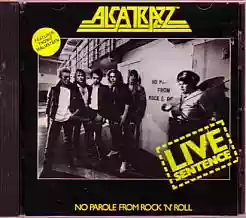
Except for his debut with Steeler, Alcatrazz represents the first true beginning of the Swedish axeman in the rock music scene: in 1983, "No parole from Rock'N'Roll" was released and the following year this live album was published, featuring some of the best songs from the Japanese tour.
Alongside the very young Malmsteen, we find a highly charismatic singer, already well-known to the public for having played under the reign of His Majesty Ritchie Blackmore in Rainbow. I'm talking about Graham Bonnet and a band that is extremely technical and refined. In this live performance, you can admire a Malmsteen who is absolutely different from the current one. It may seem paradoxical for those who consider him today an eccentric and verbose virtuoso of the six strings, but here the guitar is absolutely in service of the songs, always mature, incisive, never cloying.
A considerable amount of attention is given by the Swede to the arrangements and the rhythm section, but the perspective is different: within this band, there is a notable balance among the parts to which Yngwie himself adapts, showing, contrary to today, that he can express a great and unreachable classical virtuosity without necessarily distorting the songs with redundant and baroque solos. There are many musically relevant and significant episodes, although "Night Games" and "Kree Nakoorie" represent, in my opinion, the highest expression of the perfect harmony between sung and instrumental parts, while the solo track "Evil Eye" (which will later appear on "Rising Force") is absolutely overwhelming, where Malmsteen reaches a stellar technical-compositional perfection, surpassing clearly the rather unhappy version present in G3 with Vai and Satriani.
Finally noteworthy are two covers by the great Ritchie Blackmore, "Since you've been gone" and "All night long", played with absolute reverence and inspiration. During these years, his influence on Malmsteen is decisive, especially in the search for melody and a musical journey that sees the fusion between a rock and a classical foundation. This is an album I recommend to everyone. For those who love Malmsteen, it represents a milestone, for those who hate him and there are many, it's an opportunity to say that at least at the beginning of his career, he was truly great. Certainly, it is singular to note how his has been a trajectory inversely proportional to that of other great musicians, "unreachable" at the start of his career (as defined by Steve Vai himself who will replace him in Alcatrazz) and so repetitive and verbose (except for some episodes) after more than 40 years.
Loading comments slowly
Summary by Bot
The review praises the 1984 live album Live Sentence by Alcatrazz featuring Yngwie Malmsteen and Graham Bonnet. It highlights Malmsteen's technical skill in a balanced band setting, contrasting his early style with later work. Standout tracks and respectful covers of Ritchie Blackmore songs are noted. The album is recommended as essential for both fans and critics of Malmsteen alike.Tracklist Lyrics
Alcatrazz
Alcatrazz is an American hard rock/heavy metal band formed in Los Angeles in 1983 by vocalist Graham Bonnet. The debut featured Yngwie Malmsteen (No Parole From Rock 'N' Roll), followed by Steve Vai on Disturbing the Peace and Danny Johnson on Dangerous Games. The group is known for Bonnet’s powerhouse vocals, high-caliber guitar work, and a blend of hard rock with neoclassical flair.02 Reviews
