
 •
Rating:
•
Rating:
THE REVIEW
Alberto Cavaliere is back!/
After decades during which nothing more of him /
had been published again until now./
He’s back, and in great style indeed,
with verses as dazzling as ever,
which had appeared only in Avanti! before.
Alberto Cavaliere (1897-1967) — anyone who starts reading him never wants to stop, but always craves more of his rhymes. The published books collecting his works are certainly not few: La Chimica in versi, La Storia Romana in versi, La Storia di Milano in sesta rima, Due Lombardi alla prima crociata, Satire politiche, La parola a Alberto Cavaliere, Radiocronache rimate, E... vennero i Beat, etc. (and for brevity I will omit others here), yet, as the passionate enthusiast soon discovers, there also exists a (frighteningly large) body of compositions never published in book form, remaining out of reach for ordinary people who cannot chase down the archives, leafing through old newspapers hoping to spot the familiar name (or the pseudonyms he used, such as Il Cavaliere Errante or G. O. Venale) at the end of a piece.
I speak of all those rhymes written for magazines and newspapers (not to mention those read on the radio, on the Gazzettino Padano from 1950 onward) with his characteristic ironic flair and the mastery he demonstrated in the books that made him famous.
But almost eighty years later, part of these rhymes is finally being offered once again to the general public, who get to read them as if for the first time since, as said, they had never been reprinted and collected together after their appearance in the papers.
The volume
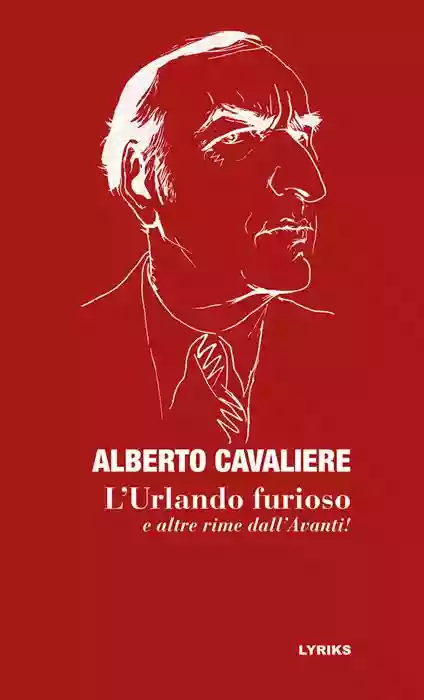
L’Urlando furioso e altre rime dall’Avanti!
(compositions never before published in book form, here for the first time gathered and organized by theme and year of publication, with an introduction and copious historical, metrical and literary notes on the texts, edited by Gerimio Aderi); Lyriks, 2026.
This collection presents, with footnotes and introductory remarks indispensable to fully appreciate them in their historical as well as poetic dimension, 33 of these rhymes. Their length ranges from a few to many pages, so that these 33 compositions make up a good-sized book of 220 pages.
What does Cavaliere narrate here in flawless metre? /
Just to give you a taste, /
we can say he delights in versifying /
the stories of sport: cycling, football, /
politics, daily events and news.../
practically everything he turns into poetry!
Indeed, in his hands anything could become rhyme; for example, Gino Bartali’s victory, already thirty-five years old, at the Tour de France in 1948:
Midway upon the journey of our life
we all perceive the shadow of the dusk,
and feel it creeping in each muscle,
that laziness inviting us to rest.
Naturally, this harsh law applies
to the anonymous, humble multitude,
it applies to me, to you, but not to Gino,
armed with his crossed badge.
(from: L'ambasciatore non è arrivato)
The defeat, recounted in twinned ten-syllable stanzas, Manzoni style, of Bartali and Coppi at the Tour de France of 1951, won by Hugo Koblet:
No longer gathered around the radio, trembling,
every day at five o'clock sharp
will the mocked crowds gather,
bound by the same single thought,
nor will they anxiously hear from Ferretti anymore
the announcement of a stage victory
won by the weakest of the lot,
whose name is nothing but foreign;
(from: Elegia del Tour)
He even recounts the matches of the national football team in verse, and always in rhyme launches appeals to subscribe to the newspaper Avanti!
Stopped in front of the newsstand,
eyes turning to three hundred newspapers
that daily are ready to spread
fake and trivial news,
he swore: "Never again from now on
will I not be a reader of the Avanti!:
among all newspapers, it is the best
and to Avanti! I will subscribe."
And again, he versifies the events of contemporary politics, newly (it was 1947) freed from the tyranny of Fascism, in various compositions — among them his famous narrative sestinas, ending with a witty punchline:
Emigrazione
It is announced that the clerical party
in the southern regions intends
to build its election campaign
on the promises of emigration.
Nonetheless, the reports confirm
that the votes will emigrate... to the left.
The compositions, as you can see, are organized into sections which the editor of the volume, Gerimio Aderi, summarizes in homage to Cavaliere’s style:
Rime politiche, / rime sportive, / sempre fantastiche, / sbalorditive; / con lo pseudonimo / di G. O. Venale, / rime a carattere / promozionale / e miscellanee, / dopo l’Urlando / furioso, il pubblico / vi andrà trovando. / Non basta! Tròvaci, / chi il libro acquista, / chiose: ogni lirica / qui n’è provvista. / Ragione esistere / non può di sorta / per non qui e subito / metterle in sporta. / Non versi liberi / fiacchi: son vere / rime, le or edite, / di Cavaliere.
Before all these sections, though, the book opens with one of the 33 pieces that is worth 15; indeed, it consists of XV cantos, each with eight stanzas in ottava rima. This piece gives the collection its name, and is titled, in fact: L'Urlando furioso.
But then, what is L’Urlando — furioso? Well, a poem/
that displays, as always, — his supreme virtuoso skill/
and lists Fascism’s — key events,/
with hendecasyllablic verse, — and stanzas in ottava;/
it recounts how — Benito Mussolini rose/
and then, how far — he would eventually fall;/
from Piazza San Sepolcro — to that Piazzale/
Loreto where his mortal frame — was finally hung up high;/
and in the epilogue — on those infamous facts/
the author even mentions — Togliatti’s amnesty!
And it is precisely the story of Benito Mussolini (as well as many other protagonists of the First and Second World Wars up to the armistice) that Alberto Cavaliere traces here, beginning even earlier, from 1912, when the future Duce was still director of Avanti!. A satirical history, for satire was ever his muse, even in times when prudence would have advised against mocking the fascist regime.
The model for the poem is clear: Ariosto’s Orlando Furioso; in fact, here is the first ottava:
The arms, the chiefs, and the mighty commanders,
Discourtesies, and bold feats I sing,
To refresh the memory of all those gentlemen
Who, enflamed by nostalgic longing,
Go sighing for new dictators,
After the model of him who boasted
Of destroying Italy in a mere instant
Yet took thirty years or little less.
Reading it, thanks to Cavaliere’s technical skill — he writes perfectly flowing hendecasyllables (and, in general, the more smoothly the line flows, the greater the poet’s craft in creating it) — is delightful in itself, but on top of that, adding even more pleasure along the way, one repeatedly encounters pearls of irony, as in canto III, stanza VIII, verse 1, where he mentions Mussolini wounded during an exercise, and says:
He came back bandaged (not yet fascist),
There are also references to the personalities and catchphrases most famous at the time and later become proverbial, like those of Gabriele D’Annunzio and Marinetti:
“Arm the prow and sail towards the world”
Gabriël kept shouting endlessly,
And Marinetti, with superb daring,
Thus proclaimed: “March on and do not rot!”
(Canto I, stanza VI, vv. 5-8)
by Olindo Guerrini (so fitting for our times):
And to all the uncertain and bewildered crowds
He shouts the maxim: “Let us arm... and you depart!”
(Canto III, stanza IV, vv. 7-8)
He also cites many other poets, such as Carlo Alberto Bosi (Addio, mia bella addio) and Giovanni Visconti Venosta (Il prode Anselmo o il lamento del crociato)
One day, Benito: “I’ll go too,”
He said, “of Cecco Beppe and Guglielmo
I will make mincemeat!” And, though quite reluctant,
He took up his rifle, helmet donned,
Said to Rachele: “Addio, mia bella addio!”.
But unfortunately, while brave Anselmo
Never returns — the days roll by —
He came home instead, proving slyer than him.
(Canto III, stanza VII)
And there’d be so much else to remark, but I'll leave it to the interested reader to discover for themselves. Surely, one laughs, but reading it today, it seems almost prophetic with the current winds of war. Germany’s rearmament before the Great War can’t help but remind us of today’s, and we know how it ended then. Rationing, runaway inflation, the black market... all described by the author, and we feel they could return. In short, this is a highly relevant text, still vibrant and alive, still speaking to us as it must have done back then, in 1947, when it was serialized in the Socialist Party’s newspaper.
And, coming to the end, as Lippi said in the Malmantile racquistato, I can only say:
Let the leaf be narrow, the road wide,
you tell your side, as I have told mine.
Loading comments slowly
Summary by Bot
This review analyzes Alberto Cavaliere's collection, focusing on its satirical tone and literary relevance. The reviewer offers a balanced perspective, noting both strengths and weaknesses. Readers gain insights into the book’s themes and style, as well as its historical context. The rating reflects appreciation, though some reservations remain.
Alberto Cavaliere
Alberto Cavaliere (1897–1967) was an Italian poet and satirist known for turning science, politics and daily news into meticulously crafted verse. He published widely in Avanti!, read rhymed chronicles on the Gazzettino Padano from 1950 onward, and wrote in classical forms such as ottava rima and hendecasyllables. He also used the pseudonyms Il Cavaliere Errante and G. O. Venale.02 Reviews
