
 •
Rating:
•
Rating:
THE REVIEW
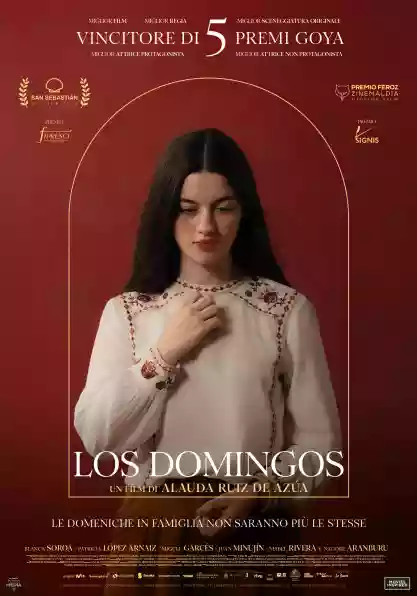
The other night, as I went to the cinema (specifically, a two-screen theater) near my house, I made a choice that was, in a certain sense, demanding. Let me explain: there were two films being shown, namely "Michael" (a biopic dedicated to Michael Jackson) and "Los Domingos." Given my aversion to one of the major exponents of the plasticky pop music that was all the rage in the '80s, I opted for the aforementioned Spanish film. I had already read up on the plot and so I knew it would be a challenging piece—and this was quickly confirmed.
Set in Bilbao (Basque Country, Spain), the film introduces us to a unique female character. This is Ainara, a seventeen-year-old who studies successfully and is approaching her final high school exams. A girl like many others, already with a few flings with her peers. During a parish outing, she visits a convent of cloistered nuns, and the experience touches her deeply—so much so that she reveals to her family her intention to become a nun. Such a statement leaves all the family members astonished. Meanwhile, the father, widowed for several years, is deeply absorbed in running a restaurant for which he had to take out a loan; he’s also seeking emotional comfort with another woman and bearing the weight of his two younger daughters besides Ainara. Equally shocked by Ainara’s intent are her grandmother and her aunt Maite, a more secular-minded woman unsatisfied with her own love life.
In short, within such a modern and tangled family framework, a minor declaring an unexpected mystical vocation is about the last thing one would expect. And this, even though all the aforementioned characters regularly attend Sunday Mass, an established routine that is more formal than truly heartfelt. I’ll let you imagine the disorientation of these adults, who would expect a young woman, once she has passed her exams, to choose perhaps a university course that would lead her into civil and working life. But to hear from Ainara herself that she feels a spiritual calling, to leave worldly life and enter a cloistered religious order—well, that’s not something you come across every day.
It must be said that Ainara’s father, as detached as he may be, understands that to categorically refuse her wish would be unwise. So, despite the many reservations voiced by Aunt Maite, he allows Ainara to spend a trial period of a few weeks in the convent. Here, life follows a steady rhythm dictated by the rule of "ora et labora," and the nuns feel an inner peace, going so far as to compare God to a kind of husband who tests you, making it pointless to feel deprived (such as missing certain comforts of lay life), because in the monastic state, one both loves and is loved by God. It is, therefore, far from easy, but Ainara perseveres, convinced because she feels God’s call in her heart.
If the outcome is ultimately inevitable—Ainara won’t change her mind, and none of her family will persuade her to at least wait until she’s of age—all the questions raised remain after watching this film, directed with a sure hand by a Spanish director little known in Italy but extremely sharp in portraying such an unprecedented story.
In any case, there’s no reservation about the choice of believing or not believing in God, since it remains, "in interiore homine." Perhaps, faith can be a strong reason to live daily life with intensity, engaging in volunteer work, as many young people and adults do. For Ainara, however, this may not be enough; what she senses is the underlying greyness of her family environment, wrapped up in everyday compromises and limitations that make you lose sight of the bigger themes of existence, such as the meaning of being here and now.
The need for absoluteness felt by Ainara (typical for someone in life’s springtime) leads her toward another dimension where everything is ordered in honor of God. Certainly, it is a path less and less taken, and it is no accident that the crisis of vocations in the Catholic Church is a real fact. It didn’t surprise me, in the film, that the convent’s mother superior had no objections to Ainara being so young when entering the cloister, where the feeling of solitude before God can be real.
In essence, "Los Domingos" is a work that stirs doubts in the soul, as I felt from my secular and skeptical point of view. The director’s mature touch is clear—she tackles a complex topic like faith in God, taken to its extreme consequences, without overdoing it and remaining as objective as possible. Equally remarkable is the performance of the debuting Blanca Soroa, who easily slips into the role of Ainara, making her a character sparing with words but endowed with such strength and inner faith as to inspire awe. Nothing can sway her, and watching her, one can truly think that the prophecy "God is dead," pronounced some time ago by a famous German philosopher, does not apply to those who are pure of heart and unafraid of being irrational.
Loading comments slowly
Summary by Bot
The review highly praises 'Los Domingos', directed by Alauda Ruiz de Azúa, giving it a perfect score. It highlights the film's emotional depth and captivating narrative. The reviewer is moved by its storytelling and direction. The film stands out in contemporary Spanish cinema. A must-watch for fans of heartfelt dramas.
Alauda Ruiz de Azua
Alauda Ruiz de Azúa is a Spanish film director and screenwriter known for character-focused storytelling. Her acclaimed debut feature Cinco lobitos (Lullaby) won multiple Goya Awards, and she directed the Netflix romantic comedy Eres tú.01 Reviews
