
 •
Rating:
•
Rating:
THE REVIEW
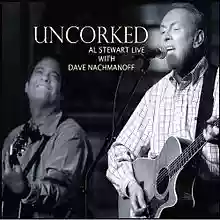
It is difficult if not impossible to harbor doubts about Al Stewart, a singer-songwriter and musician of intelligence, compositional depth, and sublime melodic taste, perhaps one of the most undeservedly underrated artists in history. Yet, besides the obvious curiosity, there is still a bit of uncertainty about the final outcome of an album like "Uncorked", a live record from 2009, the latest release to date by the great Scottish storyteller who opts for the classic unplugged formula: just two guitars, his and Dave Nachmanoff's, an American guitarist and songwriter who has been a faithful companion since the second half of the '70s. Indeed, although Al Stewart fundamentally started as an acoustic artist, he has evolved throughout his career to express a wide range of sounds and styles that have inevitably left a distinctive mark on his songs. Going through the tracklist, I especially think of "News From Spain" with its twilight organ solo, the orchestral restless magnificence of "Bed-Sitter Images", the Latin-tinged grit of "Running Man", the scenic flirtation with the new wave of "Last Days Of The Century", and the elegant and impeccable arrangements of "Midas Shadow" and "Palace Of Versailles", and it almost seems natural to wonder if this basic dimension can truly do justice to such unique tracks.
Among the reinterpretations, Al and Dave present a couple of unreleased tracks, a simple and enjoyable diversion like "Princess Olivia", a delightful tune based on a reimagining of the famous "Ode to Joy" melody, and especially a ballad in the most classic and crystalline Stewart style: "Coldest Winter". The theme it addresses, the invasion of Russia by King Charles XII of Sweden, relentlessly defeated by the so-called General Winter like Napoleon and Hitler after him, immediately and inevitably draws a comparison with "Roads To Moscow", although there are very few other analogies; "Coldest Winter" is a simpler, calmer song that does not aim to evoke the drama and historical significance of the moment but rather to recall a distant past with a tinge of sweetness and melancholy.
As for the rest, the proposed selection is undoubtedly peculiar; unfortunately there's no hint of Stewart's production from 1993 onwards, even though it could have provided countless opportunities for great reinterpretations, and on the other hand, there aren't even those two songs that everyone would expect to find, dispelling any doubts about potential nostalgia operations and/or slightly increasing the commercial appeal of the product. "Uncorked" is not an acoustic best-of but a very careful and considered selection, covering almost all of Al Stewart's artistic milestones from 1967 to 1988, successfully uniting them in a common language, the most essential and traditional musical language that exists.
The live dimension also allows for the appreciation of a characteristic of AS that obviously remains hidden in his studio production: you discover an excellent communicator, capable of creating the right empathy with the audience thanks to his affable and ironic attitude, and this makes the show even more interesting and enjoyable, excellently structured, opening with a medley that combines "Last Days Of The Century" with the vigorous "Constantinople", ensuring an incisive overture and immediately appreciating the fascinating interplays between the two guitars, the instrumental beauty inherent, and the raison d'être of "Uncorked". Bringing back "Bed-Sitter Images" is both a risky and necessary choice, considering what this wonderful song originally represents: the pursuit of happiness, balance, a place in the world, particularly the restlessness and the crucial significance of such a pursuit; "You know I can't go back until I either win or crack", and what was a declaration of intent in 1967 now becomes the perfect closure of a circle, a more serene and mature interpretation in which time inevitably mitigates the moment’s spleen, turning it into a beautiful and glorious memory. Another highly impactful episode is certainly "Warren Harding", which, with the same brilliance and irony as in 1973, recalls the rapid rise and fall of the libertine, gambling, pro-business president, while the profound simplification to which "Palace Of Versailles" is subjected elevates it to a much more songwriter-focused dimension, concentrating solely on the message and not on the magnificence of the arrangement, a message that is the same as "Midas Shadow" expressed on a different level: a sense of imperfection, incompleteness, and restlessness that inexorably makes its way among appearances and proclamations. "Life In Dark Water" adds to the narrative the indecipherability and intrinsic allure of an unresolved mystery, "Running Man" the tension of fleeing from an ineluctable fate, and "Carol" the bitterness of a misunderstood life, burned out between drugs and easy pleasures.
Remaining are "News From Spain", freed from the confines of a limited album like "Orange", twilight, painful but tremendously captivating in its flow of images and thoughts, which does not suffer at all from the absence of the organ originally played by Rick Wakeman, and finally, "Old Admirals", humorously placed as the show's closing act: Al Stewart acknowledges that he belongs to another era, sidelined by a world that seems no longer to need a figure so hard to pin down to pre-set coordinates and apparently "out of touch" with a modernity often superficial and facade-based, but he does not trouble himself with it at all. A serene, quiet, and silent "farewell" will be the just reward after a life spent pursuing his own goals without ever worrying about having to please everyone or speak in a more accessible and compelling language for the masses, but rather foreign to his own inclinations.
Loading comments slowly
Summary by Bot
This review praises Al Stewart’s live album Uncorked for its intimate acoustic setting and thoughtful song selection spanning his career from 1967 to 1988. Stewart's ability to reinterpret his complex, historically-influenced songs with minimalist guitar arrangements alongside Dave Nachmanoff is highlighted. The album showcases Stewart’s communicative warmth and artistic depth, offering a fresh take on his legacy without resorting to nostalgia or commercial gimmicks.Tracklist Lyrics
Al Stewart
Al Stewart (born 1945) is a Scottish singer-songwriter known for folk-rock and literate, history-infused storytelling. He broke through commercially in the mid-1970s, notably with the album and title track “Year of the Cat.”20 Reviews
