
 •
Rating:
•
Rating:
THE REVIEW
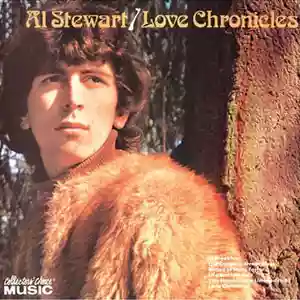
The British answer to Bob Dylan: this label was hastily slapped on a young and debuting Donovan, and history has broadly demonstrated its total and misleading falsehood, but there was another Scottish songwriter who intentionally sought this moniker, without achieving particularly significant results in terms of image and notoriety, trying with conviction to reach an objective that was anything but easy, without fully succeeding, yet producing an excellent album. Al Stewart, two years after the marvelous debut dated 1967, changed musical direction almost completely; completely abandoning the lavish orchestrations of "Bedsitter Images," an album never to be replicated, he enlisted Fairport Convention as a supporting band: Simon Nicol and Richard Thompson on guitars, Ashley Hutchings on bass, and Martin Lamble on drums. The result is more sober songs, with an acoustic framework and supporting bluesy electric guitars, in order to further highlight lyrics that are sometimes "torrential" and full of life, reflections, metaphors, images, and experiences; not that this component was absent from "Bedsitter Images," but in this second album, it is particularly accentuated.
"Love Chronicles" is an excellent album, but not on the level of the debut nor of many subsequent albums of Stewart’s production; let's say that with a bit more experience and, forgive the somewhat inappropriate term, humility, it could have been much more beautiful than it already is. The opening is simply magnificent, one of the expressive peaks of the Glasgow songwriter: if "Bedsitter Images" referred the listener to a black-and-white England, "In Brooklyn" perfectly evokes the intensity, the atmosphere, the ferment of the great metropolis with all its life and colorful humanity that populates it: a perfect and engaging melody for a splendid musical snapshot, the brightest and most brilliant example of the new stylistic course undertaken by Stewart. Despite this happy episode, the album generally settles on more introspective and autumnal coordinates, focusing more on reflection than impact, which is why it requires a few thorough listens and careful understanding of the lyrics to be fully appreciated; for this reason, a good song like "You Should Have Listened To Al", which follows the uptempo folk-blues rock style of "In Brooklyn" without its depth, seems slightly out of context. The backbone of "Love Chronicles" rests on three major pillars like the moving "Old Compton Street Blues", an intense and melancholic ballad of a distinctly singer-songwriter mold that delicately narrates the life of a street woman, the seemingly ordinary characters on the edge of the abyss evoked in the leaden blues of "Life And Life Only", concluded by an incisive guitar solo, and a fascinating "The Ballad Of Mary Foster", a long entirely acoustic folk narrative divided into two distinct acts: the first, livelier and supported by tribal percussion, describes the life of an ordinary family in the English countryside, amidst prospects and great hopes, the second, slow and sorrowful, instead highlights the defeats, the bitterness, dreams, and desires that wither in the grayness of an ordinary daily life that becomes oppressive and lifeless.
Paradoxically, the real Achilles' heel, the step too far, the greatest structural weakness of this album is precisely its purported strong piece, what was supposed to be almost the raison d'être of the whole record, namely the concluding, torrential title track, 18 exact minutes: with such a duration, it's logical that the listener expects something truly strong in terms of charisma, personality, and ideas, and "Love Chronicles" is not a "Sad-Eyed Lady Of The Lowlands," a "The End," nor an "Alice's Restaurant Massacree" to afford such an exacting temporal extension. Some might be interested in the presence of Jimmy Page on guitar; an irrelevant detail, there could have been anyone else and the result would not have changed: the song is an autobiographical account of Stewart's love life, with references already present in "Long Way Down From Stephanie" and "Swiss Cottage Manouvres" from the previous album, with a rather linear structure in its elegant and sober folk-blues, what is missing is personality, it doesn't bore, it simply flows by without great jolts throughout its length. Not a failure, but certainly a shot in the dark, an experiment that indeed will never be attempted again by Stewart, not even in the most flourishing years of his artistic maturity, simply such a song was not entirely within his range, and this ends up influencing the final outcome of an admirable album of great lyrical depth, which opens an interlocutory phase in Al Stewart's artistic journey, a period of searching for a personal style that will extend for another two albums.
Nevertheless, "Love Chronicles" remains a remarkable episode in this great artist's discography, the most pessimistic and introspective point, but for a first approach to his music, I find much more suitable and representative the subsequent "Zero She Flies," "Past, Present And Future," and the trilogy "Year Of The Cat"-"Time Passages"-"24 Carrots."
Loading comments slowly
Summary by Bot
Al Stewart's Love Chronicles marks a notable shift from his debut album, featuring Fairport Convention as backing musicians and focusing on acoustic, introspective folk songs. The album highlights Stewart’s lyrical prowess, with tracks like "In Brooklyn" and "Old Compton Street Blues" standing out. Despite its overall excellence, the lengthy title track is seen as a less successful experiment. Love Chronicles represents an important but transitional moment in Stewart’s evolving career.Tracklist Lyrics
Al Stewart
Al Stewart (born 1945) is a Scottish singer-songwriter known for folk-rock and literate, history-infused storytelling. He broke through commercially in the mid-1970s, notably with the album and title track “Year of the Cat.”20 Reviews
