
 •
Rating:
•
Rating:
THE REVIEW
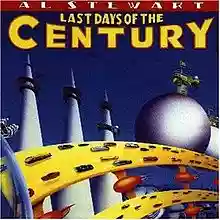
Never judge a book by its cover, said someone, but in the case of "Last Days Of The Century", the eleventh album by Al Stewart dated 1988, the artwork is highly revealing about the content and value of the work: are you familiar with the covers of "Year Of The Cat" and "Time Passages"? Two small works of art for two wonderful records, but LDOTC gets a pseudo-futuristic sketch with flashy colors, flat, unattractive, and decidedly unoriginal, adjectives that can easily be used to describe the album in question. If nothing else, compared to the equally unsuccessful "Russians & Americans" four years earlier, here there is a greater stylistic cohesion, unfortunately favoring electronically infused sounds that at best have little to do with Al Stewart's style, resulting in a clumsy and ineffective record, a classic "wishful thinking" work.
The peak of this album is that when Al Stewart remembers to be the wonderful artist he is, there is no competition: "Fields Of France", a beautiful and evocative piano line, the fairytale and melancholic sound of a flute and lyrics that make you fly with your imagination, back to the myth of the great pioneering aviation aces who dueled in aerial battles in the Great War, now a distant and faded memory. This is Al Stewart, a simple, elegant, communicative artist, who knows how to give dreams and emotions with his gentle and soothing voice and his innate taste for melody; unfortunately, however, of this Al Stewart, except for this episode, there are very few traces in "Last Days Of The Century". The opening, marked by a beautiful title track, seems to promise great things, a return to the rock glories of "24 Carrots" with a touch more of new wave: a compelling and engaging rhythm and an anthemic refrain for great stages well-supported by female choirs, but unfortunately, it's almost a flash in the pan. To understand the "hidden evil" of this album, the most significant example is "Red Toupèe": the usual squeaky keyboards present in about a hundred '80s radio hits flatten what could have been a fun and well-executed folk-pop episode, though the worst comes with the boring and banal contrived rockabilly of "License To Steal", and the '80s mediocrity of "Bad Reputation" with the usual basses and keyboards and the usual, pleonastic guitar phrasing; not shining for originality and freshness even the final "Antarctica", although endowed with a fairly catchy melodic line, that fades into an instrumental with a highly catchy and evocative title, "Ghostly Horses On The Plain", but an arpeggio accompanied by sound effects is certainly not enough to create any particular atmosphere, thus closing the album with the same impressions of incompleteness and approximation that accompany it throughout its duration.
Nevertheless, "Last Days Of The Century" is enriched by some well-crafted episodes that save it from failure, allowing it to reach the threshold of a hard-earned but full adequacy: "Josephine Baker", an elegant and convincing folk song, free from the electronic heaviness that burdens the rest of the album and the refined smoky and reverberating swing of "Real And Unreal"; even "King Of Portugal" and "Where Are They Now" can be considered as good episodes with appealing atmospheres that try to reinterpret in a modern key (for those times) the classic style of Al Stewart. Compared to the makeshift "Russians & Americans", this 1988 Al Stewart offers a structurally better album with many pleasant moments, but decisively too sycophantic and lost in chasing the stylistic trend of the moment; with "Last Days Of The Century" closes a non-prolific decade to forget for the Glasgow singer-songwriter, which the '90s will return to his natural dimension, resized but redirected on the right path, ready for a slow but steady rebirth.
Loading comments slowly
Summary by Bot
Al Stewart's 1988 album 'Last Days of the Century' shows a mixture of electronic influences that detract from his usual folk style. While the album lacks originality and fails to capture the charm of his earlier works, standout tracks like 'Fields of France' and 'Josephine Baker' offer glimpses of his true artistry. The record reflects a challenging decade for Stewart, balancing pleasant moments with notable stylistic missteps.Tracklist Lyrics
Al Stewart
Al Stewart (born 1945) is a Scottish singer-songwriter known for folk-rock and literate, history-infused storytelling. He broke through commercially in the mid-1970s, notably with the album and title track “Year of the Cat.”20 Reviews
