
 •
Rating:
•
Rating:
THE REVIEW
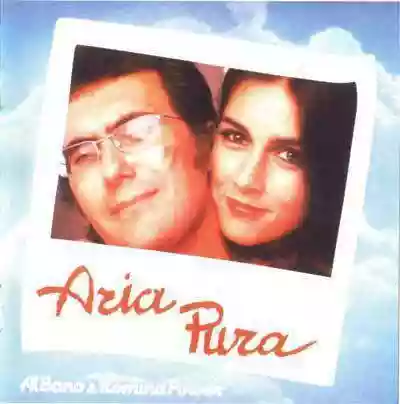
Al Bano & Romina Power - "Aria pura" (1979)
How many of us, my 15 readers, at least on one Baglioni-esque Saturday afternoon, haven't felt like these two Peynet sweethearts walking hand in hand through villas, without thinking of sneaking away for a more Aristotelian love? But where is the line between bad taste and involuntary absurdity?
Al Bano - Romina. The couple, the quintessential Italian artistic union. The detractors (among them also those envious of the couple's success) define them as comedians, false lovers dripping with Perugina kisses from every pore. In fact, they have lasted quite some time since that July 26, 1970. How many, on that occasion, said they would never last.Too down-to-earth him, too sophisticated her. I don't know why, but the couple from Cellino Sammarco has a certain sinister yet universal charm thanks to their use of Italian, English, German, and Spanish. And this album fully demonstrates it: released entirely in Spanish under the title Momentos, given that the sentimental melting pot ranges from the Spanish of Agua De Fuente to the American of tracks like Heart Games, Who? and, cherry on the cake, a Romina disguised as an unlikely disco queen in the track U.S. America, a danceable rendition of her old 1974 song, Con un paio di blue jeans. In this track, you can glimpse the unexpressed potential of our Rominuccia, what she could have become if she hadn't fallen into the Albano tacky-trip. Of this album, it is obvious that Romina's moments are preferable to the nauseating, old, and progeric gargles of the working-class hero Al Bano. Romina, because of the pugliese buffoon, burned a career. She debuted in cinema at 13 and participated in as many as 14 films in four years, including some erotic roles (as in Justine, or the Misfortunes of Virtue by Jesús Franco). She had the chance to engage with the lively art scene in Rome, London, and Los Angeles and for a certain period regularly took LSD! Which did her harm, because she didn't understand who Albano was. Let's just try to imagine what it meant for the beautiful Romina to sacrifice everything to be a farmer with her husband...
All that's left for me is to throw another dart at the poster of Albano and Romina, trying to hit him, of course, as Jerry Calà did in the film vado a vivere da solo. Why him, Romina, why? I met her once in Trastevere, avia dela Scala; tanned, still beautiful, she even seemed happy.
Loading comments slowly
Summary by Bot
This review critically examines Al Bano & Romina Power’s 1979 album Aria Pura, emphasizing the mixed artistic qualities and the overshadowing of Romina’s talent by Albano’s presence. It highlights Romina’s diverse background, linguistic versatility, and unrealized potential, contrasting it with an unfavorable view of Albano. The album is seen as a sentimental but flawed product, with particular praise for Romina’s moments and a dismissive tone towards Albano’s contributions.Tracklist Lyrics
Al Bano & Romina Power
Al Bano & Romina Power are an Italian pop duo formed by singer Albano Carrisi and American-born actress/singer Romina Power. Active mainly between 1975–1999 and reunited for concerts from 2013, they scored European hits such as Felicità, Ci sarà (winner of Sanremo 1984), Sharazan and Sempre sempre, and represented Italy at Eurovision in 1976 and 1985.02 Reviews
