
 •
Rating:
•
Rating:
THE REVIEW
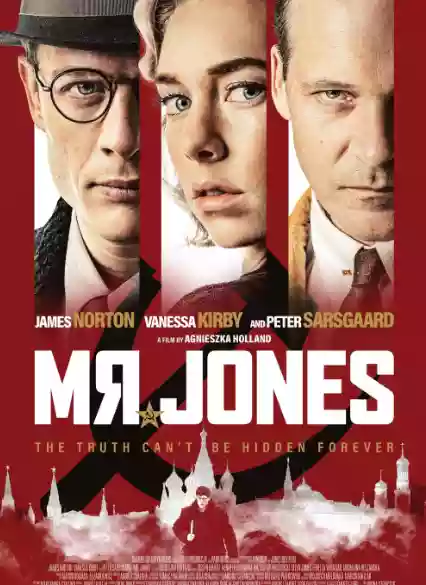
Mr. Jones is already a rather uninspired original title, further trivialized in the anemic Italian version, "L’ombra di Stalin." The title fails to do justice to the explosive, urgent, and tragic historical material it deals with, unfortunately succeeding in the difficult task of making it narratively disjointed.
The story, heavily fictionalized, follows Welshman Gareth Jones, a rising star in British journalism after he interviewed Hitler in 1933, just as he came to power and was already somewhat unsettling. Driven by ambition, recklessness, and a rare remnant of professional ethics, Jones decides to investigate the increasingly persistent rumors of a devastating famine in Ukraine, carefully concealed by Soviet propaganda.
Arriving in Moscow under the official pretext of wanting to interview Stalin, he finds himself immediately immersed in a system of surveillance, censorship, and lies, where the truth is treated with the same hospitality reserved for dissidents. Here he meets Walter Duranty, Pulitzer Prize-winning journalist and world champion of reverse moral climbing: brilliant, corrupt, and perfectly willing to sacrifice reality on the altar of his own privileges. Duranty is perhaps the film’s most disturbing symbol, the embodiment of journalism prostituted to power, elegantly rotten like caviar left out in the sun.
Jones eventually manages to elude the authorities and reach Ukraine, where he is confronted by the horror of the Holodomor: villages frozen in hunger, abandoned bodies, children reduced to specters. Here the film truly hits home, stripping away superfluous flourishes and emphasis. The muted colors, the almost utter silence, the absence of musical embellishment, all convey a devastation that needs no rhetoric. This is the beating heart of the work, the moment when the narration finally drops its posturing and reveals something authentically savage.
It’s a shame that instead of trusting the power of this material, the director then chooses to sabotage her own work by dispersing it in a fragmented and often clumsy narrative structure.
The film’s three major themes would have deserved much more discipline:
- the Holodomor and Stalinist responsibility
- the betrayal of journalistic ethics
- Western complicity in tolerating the horror for political convenience
Instead, Mr. Jones feels like a hastily packed suitcase, stuffed with good intentions and badly closed.
The insertion of George Orwell as a narrative frame, suggesting his inspiration for Animal Farm, appears artificial and didactic. Rather than an effective narrative choice, it comes off as a flashing neon arrow reading: “Attention, viewer, this is important!” A pity, because the true story already possessed enough power and didn’t need such almost schoolbook literary crutches.
And then there’s Duranty and the infamous Moscow orgy scene: a good seven minutes of bourgeois decadence straight out of a catalogue of clichés about elite vice. Rather than delving deeper into the character, the segment seems to indulge in a sort of aesthetic of vice that merely slows down the pace, as if someone shoved The Great Gatsby into a gulag.
The result is a schizophrenic film: powerful when it observes human tragedy, irritating and unfocused when it tries to become, at the same time, a political manifesto, a journalistic thriller, and a literary parable.
Finally, the Italian dubbing carries out the usual massacre of linguistic nuances: Welsh, Russian, Ukrainian, and English characters all speak with the same neutral diction typical of generic TV drama, flattening accents, cultural tensions, and authenticity. The linguistic inflections are, however, appreciable in the original version.
In conclusion, Mr. Jones is an important, necessary, even courageous film, but artistically unresolved. When it shows historical horror, it truly strikes hard. When it tries to simultaneously become a political thriller, a moral indictment, and a literary parable, it buckles under the weight of its own ambitions.
It remains a film worth watching, especially for its historical testimony, but also a partially realized opportunity: a historical denunciation trapped within a screenplay that badly needed more rigor and a few lessons in the art of restraint.
----------------------------------------------
Available on RaiPlay
Loading comments slowly
Summary by Bot
The review covers Agnieszka Holland's film 'Mr. Jones', examining its strengths and limitations as a historical drama. Focus is placed on its depiction of journalistic integrity during a dark historical period. The reviewer assigns a mid-range rating, noting both compelling moments and notable shortcomings. Themes of truth, propaganda, and historical tragedy are explored. Overall, it’s described as engaging but not without flaws.
Agnieszka Holland
Agnieszka Holland is a Polish film director and screenwriter known for politically and historically engaged dramas, including Europa Europa, In Darkness, and Mr. Jones.02 Reviews
