
 •
Rating:
•
Rating:
THE REVIEW
Japan, for more than a century now, has absorbed any kind of influence from the Western part of the world, yet still manages to preserve its own traditions.
The After Dinner group consciously represents the complexity and allure of the land of the rising sun.
Born in Osaka by the will of composer and singer Haco, the After Dinner project was meant to be a musical laboratory open to any kind of sound experience.
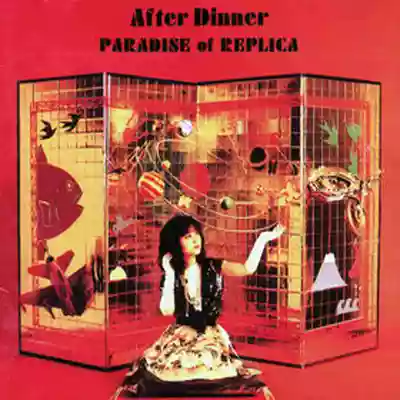
"Paradise of Replica" (released in 1989) features the participation of 16 musicians from the most diverse musical environments, who, through the use of a plethora of instruments, contribute in just under half an hour to creating an avant-garde and floating album.
The strong instrumental and vocal dissonance and the heavy use of countertempo clash forcefully with the typical sounds of traditional Japanese music, the succinctness of the compositions reminiscent of the lopsided sound of a kokyû, punctuated by a diligent Kakko: "Paradise of Replica" succeeds in the not-so-easy task of being accessible even to those not particularly accustomed to this breakdown of times. It's extremely fun to try to identify the sounds that inspired After Dinner: one immediately notices a typical approach of "Rock in opposition," also considering the high number of instruments used. Another evident element is the "art rock" cabaret style of Slapp Happy; Haco's vocal tones can only remind one of Dagmar Krause's. The list could be particularly long depending on each listener's sensitivities.
As often happens, those who create also have the right to destroy: the laboratory closes at Haco's own will, who decides to focus on a solo career, increasing her prestige internationally by taking part in multiple projects.
"Paradise of Replica" is a collection of images for an ear (as someone once said). The perfect ukiyo-e of the late twentieth century.
Asai Ryoi wrote in 1662: "Living moment by moment, turning entirely to the moon, the snow, the cherry blossoms, and the red leaves of the maples, singing songs, drinking sake, consoling ourselves by forgetting reality, not worrying about the misery in front of us, not being discouraged, being like a hollowed-out gourd that floats along with the river current: this, I call ukiyo".
Loading comments slowly
Summary by Bot
After Dinner’s 1989 album Paradise of Replica is an avant-garde musical laboratory blending traditional Japanese sounds with diverse experimental influences. Led by composer Haco, it features 16 musicians and a wide array of instruments producing floating, dissonant, yet accessible soundscapes. The album juxtaposes Japanese musical traditions with Rock in Opposition and art rock styles. Despite its complexity, it remains enjoyable and evocative, capturing a modern ukiyo-e spirit.Tracklist Videos
03 Kitchen Life I (02:07)
04 Motorcycle (01:19)
05 Kitchen Life II (01:23)
07 Dancing Twins (00:59)
08 KA-NO-PU-SU-NO-HA-KO (07:54)
10 Akai Kutsu no Ningyo (Red-Shoed Mermaid) / Pascal Plantinga (07:53)
11 Paradaisu (Imada Kuufuku) / Terre Thaemlitz (10:08)
12 A/B-ing the Bird / Skist (06:35)
13 Reflector / Joshua McKay (05:40)
After Dinner
After Dinner is a Japanese experimental/avant-pop group from Osaka led by vocalist-composer Haco. Active mainly in the 1980s, they are best known for Paradise Of Replica (1989), a concise, instrument-rich album released via the international experimental network associated with Recommended Records. The group dissolved in the early 1990s as Haco pursued a solo career.01 Reviews
