
 •
Rating:
•
Rating:
THE REVIEW
Sometimes it happens. And, when it happens, it's funny.
It's funny to think that the Scottish Aereogramme, known to the public for being among the godfathers - and founders - of the so-called post-rock movement, decide to disband after ten years of honorable career, just at a time when the entire structure of post-rock is beginning to show the first cracks and falter due to a lack of ideas. And all of this is also a bit strange, because Aereogramme cannot be simply categorized as "post-rock": it means everything, and it means nothing. And, nowadays, this nomenclature may not be as pleasing as it once was.
In ten years, Aereogramme have done pretty much as they pleased. In their songs, in their albums, they have fused together progressive rock -the true and proper foundational pillar of their sound- with orchestral pop rock, with dense and ethereal ambient atmospheres, with sudden bursts of hard rock or even more extreme and intense genres (just think of the split done with Isis, one of the early creatures, in the New Millennium, of the hardcore/sludge metal scene). Despite the first consequence of this miscellany being a lack of visibility under the spotlight, the four from Glasgow managed to appeal to a bit of everyone - if by "everyone" we mean the small group that fills the ranks of alternative music-.
It seemed inconceivable to think about a breakup of the band. Not after that ivory gem "A Story In White" (2001), which represented their explosive debut, nor with the sophisticated strings and electrolytic play of the following "Sleep And Release," two years later. Not to mention the aforementioned split with Isis, "In The Fishtank 14," which more than any other helped project them into the imagination of good music enthusiasts and, above all, fervent supporters of "contamination."
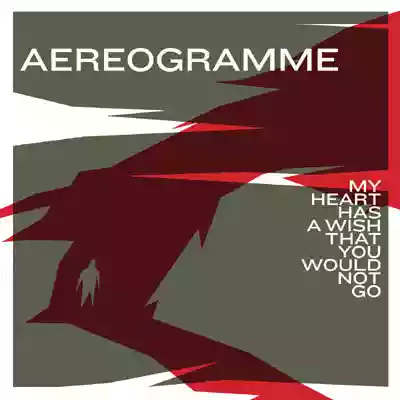
And yet, it is so. In the spring of 2007, they bid farewell to the crowds with a final album, with a poetically long title ("My Heart Has A Wish That You Would Not Go"), announcing their imminent separation at the end of their respective promotional tour. But this separation has a bittersweet aftertaste. The farewell album turns out to be, in fact, a partial response to the dilemma posed at the start of the review. If it's true that post-rock, as we understand it, reveals to the world the first compositional apneas, it is also true that Aereogramme are no exception and, in part, lack oxygen along with the entire genre. In simpler words, the threads of the piece imply what the terrible disease was, creeping among the Scots, to such an extent that it prevented any further artistic growth. Predictability.
And it's a real shame: the opener "Conscious Life For Coma Boy" faithfully represents the best of what has been heard in progressive rock of the New Millennium, Mogwai permitting. The brilliant contrast between the distorted and resounding guitars of the beginning, and the piano and incorporeal voices of the refrain, seems to be the best possible calling card, a real kick in the stomach - painless, of course - to all the critics of "new rock," some more, some less. And yet, after a rocket start, the album gradually loses steam.
Predictability, as we said. A word that, in fact, does not enter into the skeleton of "Conscious Life For Coma Boy" but which, unfortunately, encompasses much of the subsequent tracks. Already from the following "Barriers," it is clear that something has changed: the melancholic voice of Craig B, supported by a truly substantial string ensemble, works really well: but it's the total duration that shouts scandal. A five-minute ballad is really hard to endure in its entirety, especially if the rhythms do not accelerate and remain peaceful and sleepy from start to finish. The main problem with the following tracks is that there is no sign of aggression, not even a sound imprint that is at least presumable, with the intricate prog machinery completely dissolved. All that remains is the orchestral melody, which can be fine for three, four tracks, but becomes really excessive for eight. For heaven's sake, nothing to say, the symphonies that emanate from the cd, although far too baroque, are more than appreciable: pompousness, after all, always has a certain charm. Thus, one can fully appreciate the delightful acoustic arpeggio opening "Exits," or even the cut'n'paste hints that appear in the timid "Finding A Light," as well as the very delicate, concluding "You're Always Welcome," dominated by a harmonious interplay of voice and piano, and the dark wave that permeates, with its oppressive shadow, the prophetic "Nightmares." But what is really missing, in the best cases, is a certain compositional freshness, or a winning idea that can drive a piece from start to finish. Everything melts and mixes among itself, without being clearly distinct, as was the case in previous works. The song that perhaps escapes the rule, and is capable of keeping its honor high, is "Trenches," a sort of genetic cross between Enya's somnolence, Mogwai's mastery, Eluvium's fairytale atmospheres, and the noble and choral accelerations of Sigur Rós.
It hurts the heart a bit to listen to "My Heart Has A Wish That You Would Not Go." It's a bit like saying goodbye to a dear friend, the one who marked your days, without however not feeling a sense of relief. It's like having known them pure and honest, and abandoning them brazen and false. Here, perhaps this is the true origin of the "illness" of Aereogramme: having yielded to a small offer of popularity, and with it a broader success and, surely, also MTV. Teenage syrup, the harshest might think on a superficial listen, and perhaps they aren't entirely wrong. One thing is certain: the cd can be listened to with pleasure, in its bland smoothness, neither praise nor blame. And that might be enough for someone. But from a band that in ten years has always proven to know how to renew itself, with creations each time astonishing, one expected something more and, above all, something qualitatively different.
Loading comments slowly
Summary by Bot
Aereogramme’s farewell album reflects the band’s rich fusion of progressive and orchestral rock while revealing signs of creative fatigue. Though the opening track shines with energy and compositional prowess, much of the album leans towards predictability and mellow orchestration. Fans may appreciate the smooth melodies, but the album lacks the past freshness that defined the band’s legacy. This release serves both as a closing chapter and a bittersweet goodbye to one of post-rock’s unique voices.
Aereogramme
Aereogramme were a Scottish band from Glasgow active from 1998 to 2007, blending post-rock, progressive rock, orchestral and ambient elements. Key releases include A Story in White (2001), Sleep and Release (2003), Seclusion (mini-album), and a collaboration with Isis for In the Fishtank 14, before the farewell album My Heart Has a Wish That You Would Not Go (2007).05 Reviews
