
 •
Rating:
•
Rating:
THE REVIEW
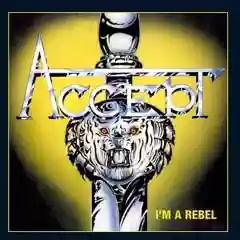
The Accept, Hard'N'Heavy musicians from Solingen, Germany, caught the (more or less) global spotlight in the wake of the Scorpions and were immediately credited as the perfect hybrid between AC/DC and Judas Priest starting with the classic LP "Breaker," both in sonic and vocal intensity terms. It took them three albums to forge their classic "Fistful Of Steel," with a touch of moderate Speed; this second "I'm A Rebel" from 1980, with the cover printed in various versions, in some cases with a sword and lion changing shape and color. However, the bombshell is just around the corner: on the back cover, the five Accept members are dressed like ambiguous nightclub and dancing frequenters, sufficiently made up, with pink scarves, dangling chains, and colorful shirts, even captured in descending order of height. Udo Dirkschneider, Wolf Hoffman, Jorg Fischer, Peter Baltes, and Stefan Kauffman seem as if they've emerged from a Munich nightclub investigated by Inspector Derrick (episode "La preghiera della sera," I'd say) rather than from an old shabby garage, with vintage guitars (Flying V) but steeped in experience and metallic sweat, with the demo tape in their pocket and beer pouring out of every pore of their skin.
Recently interviewed, singer Udo still considers the band's first two albums as the least successful (www.metalitalia.com), essential for the march towards a more powerful sound. Compared to their debut, this album is a step back in terms of Accept-music: eight tracks instead of ten as in the previous one. Among these eight is an unusual cover, the title track, composed by one George "Alexander" Young, who is none other than the brother of Angus and Malcolm Young of AC/DC, and their producer along with Henry Vanda until the live "If You Want Blood..." from 1978. George had written the piece in the Scott era, around 1977, but even after recording it, the Australian band didn't include it in any album; Accept dusted it off, and it's fair to say that the piece is sparse but catchy, with an easily graspable riff (perhaps camouflaged in "You've Got Another Thing Coming" by Judas Priest?) and the stadium chorus that rides throughout the song with a more edgy sound than the debut. A bold choice since it would have been easier to perhaps propose "Riff Raff" or "Rock'N'Roll Damnation," just to name two killer tracks from the Scottish origin kangaroos.
In "Save Us", a bass appears in the style of "Discogatto" in tune with the dance chaos of the era, but the song is not despicable, with Udo's raw voice standing out and a lively guitar solo, distorted at the end. A small glimpse of "Dance Hall Days" yet cloudy, as if to reveal that the wall dividing the dance hall from the stage is very thin. Two slow ballads: "No Time To Lose" and "The King" are sung by bassist Peter Baltes; certainly decent and canonical but they steal space from more fierce tracks, reiterating the Scorpions model with sharp tracks mixed with others simmered and pondered. Strangely, the inclusion of drummer Stefan Kauffman in place of Frank Friedrich results in a decrease in execution speed, there's no "Free Me Now," for example, as in the debut, although the drummer will redeem himself with "Breaker." "Thunder & Lightning" is the strongest track on the album along with "China Lady", invigorated by good '70s riffs and Udo's voice oscillating between Bon Scott and Brian Johnson. In the case of "China Lady", it seems impossible that such an effective riff hasn't already been invented. Also in "I Want Be No Hero", there is a déjà-vu whistling guitar, a filler equipped with another disco bass that grants the piece a pass to discos. It's 1980, and Judas Priest is producing "British Steel" while AC/DC are "Back In Black": Accept is like Don Abbondio in the castle of the Unnamed. "Do It" is again admiration for AC/DC, self-indulgent rhythm, and a good solo.
For those who appreciate later Accept, this album is little more than an appetizer, not fully capturing the guitar talent of Wolf Hoffman but revealing the potential of Udo Dirkschneider. An immature and still transitional album, certainly not as essential as the subsequent "Breaker" and "Restless And Wild" for a great honest, energetic, and often forgotten band.
Loading comments slowly
Summary by Bot
Accept's 1980 album 'I'm A Rebel' reflects a transitional phase for the band, marked by a mix of raw energy and fledgling songwriting. It reveals Udo Dirkschneider's emerging vocal power but lacks the full maturity of later works. The album borrows heavily from AC/DC and Judas Priest influences and contains a notable cover track by George Young. While not as essential as subsequent albums, it offers insight into Accept's development.
Accept
Accept is a German heavy metal band associated with the classic Teutonic heavy metal sound, widely linked in the reviews to vocalist Udo Dirkschneider and guitarist Wolf Hoffmann, and later to singer Mark Tornillo.20 Reviews
