
 •
Rating:
•
Rating:
THE REVIEW
It is said that changes are never a good thing. For my part, I somewhat agree. One must always consider the perspective from which a change is carried out. If it is done to try to give a new image, then so be it. But if it is done with the intention of being a placeholder, where one can cover an evident situation of difficulty to make it seem to the eyes of people like everything is under control, then one begins to sink into wrongness.
In the music realm, countless changes have occurred, some good, others awful. Let's take two bands that even the stones know, Iron Maiden and Judas Priest. The former, with Dickinson entering in place of Di Anno, was able to make that quality leap from those first two albums that depicted them simply as a heavy metal band strongly linked to punk sounds, and which saw in Air Red Siren that essential change that led them to worldwide fame. The latter, with the arrival of Owens, suffered the total hatred of fans towards the latter, who strongly wanted Rob Halford's return to the English group. A change made by the Priest that is also strongly tied to the reasons of the fans, having in some way become attached to Halford, and categorically renouncing anyone who was put in his place.
In Accept, more or less the same thing happened. With Udo's departure in 1986 due to internal disagreements with guitarist Wolf Hoffmann and bassist Peter Baltes regarding musical changes leaning towards AOR, the Wuppertal elf decided to leave the band after the tour for the promotion of "Russian Roulette". Now, the decisions that Hoffmann and company had before them were essentially two: either leave everything after the true historical figure of Accept had gone, or attempt a change. They chose, as we know, the latter, hiring singer David Reece, a singer who before joining the German group was part of lesser-known bands like U.S. Metallers and Sacred Child. The difference between Reece's style and Udo's is evident and significant. If the latter became famous especially for his vitriolic, grating, and annoying voice for some, Reece had warmer and softer tones that partly recalled a certain David Lee Roth.
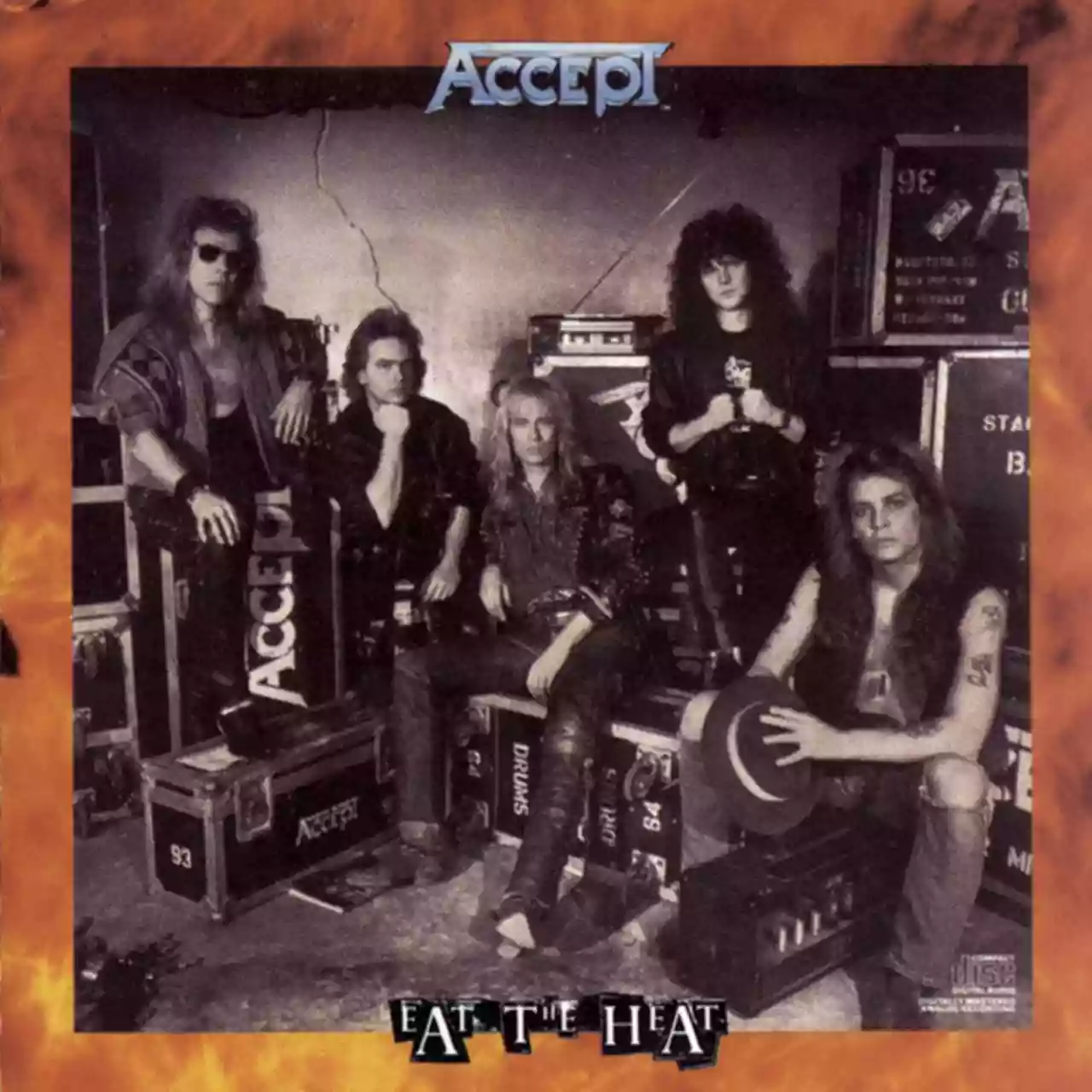
In 1989, "Eat The Heat" was released, an album that sharply divided the opinions of the German group's fans. Accompanied by a rather anonymous cover, both in the American and European versions, depicting the band posing behind a stage, the CD is full of excellent moments, alternating with others that are not awful but extremely banal. Let's start with the positive notes, pieces like "Generation Clash" (which will later be presented on the "Death Row" album) and "X-T-C" definitely have an impact, supported both by an excellent bass, in the former, and good riffing in the latter. Fast songs in full Accept style like "Hellhammer" manage to earn this song the title of hit of the album, and mention the excellent work of Reece behind the microphone, with a tone that grows more and more, reaching the refrain, the same goes for "Stand 4 What U R". And now let's move on to the drawbacks. "Break The Ice", despite succeeding in its intent, musically feels like already heard, and the ballads "Love Sensation" and "Mistreated" definitely do not raise the rating. Ballads? In Accept? Seriously? Special mention goes to "D-Train", which with its pounding progression, and relentless use of the double kick, literally breaks the listener's eardrums, and even Hoffmann, with his continuous, non-stop riffing, stands out as the main protagonist.
Giving a final judgment on "Eat The Heat" is difficult, both because it is a very, very difficult album to assimilate, and because it is difficult to place it in the history of a band like Accept, who made Udo a cornerstone. As already said, the album is full of highs and lows, more highs to tell the truth, and passion seems not to have been lacking in its making. For this, the real score would be 3 and a half stars, but trying to be as objective as possible, I give it 3 stars. Who knows that this album, with other careful listens, might surprise me further.
No Udo, no Accept? Possible. But I would never say never...
Loading comments slowly
Summary by Bot
Accept's 1989 album Eat the Heat marked a controversial change with David Reece replacing Udo Dirkschneider as lead vocalist. The album features strong moments like "Generation Clash" and "Hellhammer," but also weaker ballads that divided fans. Despite its mixed reception, the album shows passion and experimentation, earning an overall 3-star rating and leaving room for re-evaluation.Tracklist Lyrics
Accept
Accept is a German heavy metal band associated with the classic Teutonic heavy metal sound, widely linked in the reviews to vocalist Udo Dirkschneider and guitarist Wolf Hoffmann, and later to singer Mark Tornillo.20 Reviews
