
 •
Rating:
•
Rating:
THE REVIEW
Reviewing "The lexicon of love" by ABC is a bit like commenting on "Journey to the Center of the Earth" by Jules Verne. Both are works that initiate a completely new artistic genre, yet they are the result of contamination from multiple external genres. So what can "Journey to the Center of the Earth" by ABC, a new run for the old that cannot be older, at the core of something known only on the surface but totally unknown beneath the crust, be associated with? The oldest and most ungovernable sentiment that supports humanity, yet with a small shift, the latter collapses. I am talking about LOVE, the romanticism that permeates the debut album of an apparently humble British band, which from one day to the next finds itself leading (though not for long) the colorful and heavily disguised carriage of musical Neoromanticism, better known as "New romantic". This will bring fortune to groups like "Visage", "Spandau Ballet", "Culture Club", "Duran Duran" and ABC themselves, and will brand, defining attitudes and boundaries, the musical reality of the early eighties, one of the most homogeneous periods in the history of music.
It was no coincidence that in the same year (1982), in one fell swoop, the four gospels of "New romantic" were released: "Avalon" (Roxy Music), "True" (Spandau Ballet), "Rio" (Duran Duran), "The lexicon of love" (ABC). Probably, indeed surely, those who most inspired the sound and especially the look of Neoromantic bands were David Bowie, Roxy Music and, albeit to a lesser extent, Brian Eno. However, it is still unclear what exactly eighties Neoromanticism consists of. It is not about a specific sound; rather, it is a blend of multiple different genres, nevertheless having as a common thread a catchy and "easy" melody, punk-new wave attitude, extensive use of electronic instrumentation, and danceable rhythm. Overarching all this, the true revolution of the "New romantic" does not lie in the sound, but in the visual, exterior aspect. A sort of thinly veiled hedonism distinguishes every respectable Neoromantic piece, and "The lexicon of love", if you will, can be considered on a sentimental level an album of sublimation of the concept of sentiment, but which upon merely hearing the word does not hesitate for a moment to declare itself a fervent disciple of the most carnal and wild eros, a sort of Platonic eros in continuous change. In conclusion with the "New romantic", it was indisputably the final vector that brought the Pop genre into the homes of the Earth's inhabitants and defined its standards, which still endure today, despite Neoromanticism officially dying by the end of '85, losing the color, vibrancy, and pomposity that distinguished it, relentlessly commercializing. Today, surrounded by silly songs full of serious and ridiculous lyrics, a little healthy and casual romanticism would be welcome again. And now to us.
The album kicks off with "Show me", with an orchestral intro that anticipates an explosion of pumped sounds more precise than a surgeon, which in four minutes describes the anatomy of the entire album, ambitious and, if anything, effective in the analysis of the lexicon of love, the center of the "humanity" planet it rests upon. And after a spine-tingling intro, it officially starts with "Poison arrow", the band's first commercial success and, in my opinion, one of the best moments of the album and the "new romantic", this song is a real "poison arrow", scratching the ego and spirit of the previously innocent listener without hesitation. The rhythm picks up with "Many happy returns", a fast and lethal synth-atmosphere track that brings the album's aesthetic side to its peak, taking sensual and defined forms like never before, all products of façade imagination. "Tears are not enough" is literally and conceptually the immediate continuation of the previous track and reintroduces the same gloomy atmosphere and the same pressing rhythm, now even stronger and faster. It is the peak, the highest tower of the album. In fact, with the next song, "Valentine's day", the rhythms remain fast but the pathos drops, nevertheless maintaining part of the atmosphere of "Many happy returns" and part of another, which anticipates the eternally present one in the next track, mistakenly chosen by many as the symbol of ABC's music and inexplicably the most successful one. I am talking about "The look of love", complete with a very plastic and colorful video. The only thing I say about it is that "The look of love" sounds false and insincere at several points, but I admit that commercially speaking it was one of the album's strength points. And with this, after six fundamental tracks that passed faster than a train, the first act and the true soul of "The lexicon of love" conclude.
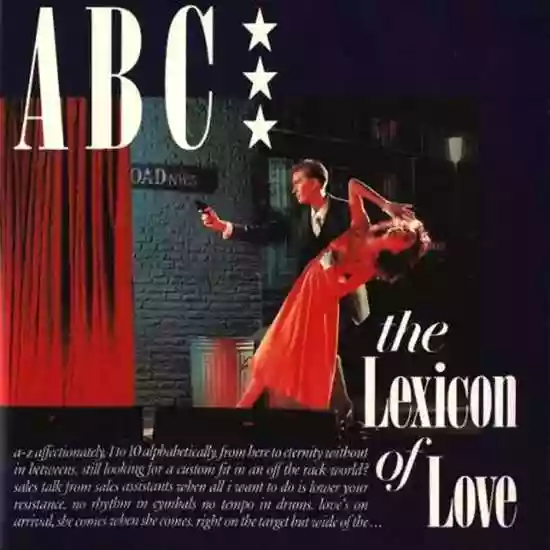
The rest is the side dish and dessert. We move through "Date stamp", a fast dark passage of the band (still excellent), the pure sentiment of "All of my heart", heralding a change of direction, a second dark moment full of atmosphere like "4ever 2gether", an unnecessary "The look of love" part 4 (who knows where the "part 2" and "part 3" have gone?) and the end that passes through the beginning, "Theme from Mantrap", a slow version in 6/8 of "Poison arrow". So goes "The lexicon of love", an excellent demonstration of competencies that has challenged artists and audiences by conducting a journey, in some ways, against the current towards the purest and most faithful definition of "LOVE", resulting in advocating that chivalric and noble love nowadays much derided and increasingly a target of satire. Much can also be understood by looking at the CD cover itself (back then, LP).
In conclusion, "The lexicon of love" is a low blow to the excessive materialism and political commitment present in today's music, a complete and classy work, which is an absolute must-have in the collection of any true music lover.
Loading comments slowly
Summary by Bot
ABC's The Lexicon Of Love is a seminal New Romantic album that blends diverse genres with themes of love and romanticism. It delivers a polished, synth-driven pop sound with standout tracks like "Poison Arrow" and "The Look of Love." The album combines emotional depth and musical innovation, standing as a classic of early 80s music and a critique of modern materialism in music.Tracklist Lyrics Videos
ABC
ABC are a British pop/new wave group formed in Sheffield in 1980, fronted by vocalist Martin Fry. They broke through with The Lexicon of Love (1982), produced by Trevor Horn, spawning hits like Poison Arrow, The Look of Love, and All of My Heart. Subsequent albums include Beauty Stab (1983), How to Be a... Zillionaire! (1985), Alphabet City (1987), Up (1989), Abracadabra (1991), Skyscraping (1997), Traffic (2008), and The Lexicon of Love II (2016).04 Reviews
Other reviews
By Bruinen
ABC’s debut is one of the most perfect pop albums of the 80s.
The Lexicon of Love is a dazzling mix of romance, heartbreak, and sophistication.
