
 •
Rating:
•
Rating:
THE REVIEW
Sometimes the fortune of an album is to be in the right hands at the right time. This is perhaps the case with Pezzali and company. Surely if I had come across it a few years earlier, I would have ignored it, still too engrossed in collecting Cristina D'Avena's entire works. A few years later, I would have dismissed it with grimaces of disgust and retching as a chubby and not at all sexy Britney Spears. Instead... I had just the right age, the age that, always and by his own admission, was his target. Elementary school dancing to "Hanno ucciso l'uomo ragno" at afternoon parties, middle school with "Nord sud ovest est" and afternoons watching "Non è la Rai", the transition to high school with "La donna il sogno e il grande incubo" and the most beautiful years of first friends and first crushes with "La dura legge del gol".
When I was still dismissing Vasco as too rebellious for a child like I was, it was precisely Pezzali with his clean face, his untainted life, and truly genuine lyrics peppered with just the right amount of swear words who was the bard of the daily life of kids juggling exams, video games, soccer, and gossip. Never mind that the bard was dangerously approaching 30 with an onset of balding and a severe Peter Pan syndrome...
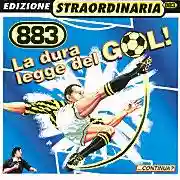
"La dura legge del gol" is the last under the banner of 883, after which Max himself understood that it no longer made sense to brand a formation that changed every 6 months with the same name and declared its end, continuing under his name from the next "Grazie mille" (excluding the first of a long series of best-ofs). He abandons the comic style that amused kids with those colorful comic-book covers, but does not completely renounce the themes that brought him to the top of the charts. Always cool, soccer, and bar, in short, but the vibe becomes slightly more bitter. Is Pezzali starting to feel that adolescence is ending? Are the falling hair venting his brain, bringing some neurons into maturity? Listening to "La regola dell'amico" (a legendary summer hit) perhaps you wouldn't say so, but in tracks like "Se tornerai" and the titular track, you start to feel the difference. I'm not talking about music (it's always the same unsettling flatness), but about lyrics that talk about friends dead from drugs (an ideal sequel to "Cumuli", who remembers it in "Nord Sud Ovest Est"?) and, above all, about memories, those with a capital M that make you choke up and feel the inexorable weight of the years you have... and even "Nessun rimpianto" tells you that loves are not always those of "6 1 mito", the ones who give it to you right away, to put it plainly... even if in the end, the optimism of "Andrà tutto bene" triumphs, for the inevitable happy ending.
It would have been better if good Pezzali had stopped here, no longer repeating himself, wearing us down with all-too-similar anthologies, without wanting at all costs to force us to live in a continuous flashback made of "Bella vera", roaring Harleys, and pumping juke-boxes. That he no longer has anything to say has been known for a long time, that he seeks in the past a way to relaunch himself in a scene that seems to have moved on is just as evident, so why do it, one might ask? By now he is a mature man, married, long past his glory days, then why persist? His earnings would allow him a peaceful life of comfort, but no, he's still here with his baseball cap and leather jacket that struggles to fasten at the front, still with his stories of coolness, soccer, and bar. Like his beloved Inter, making a big effort thinking about the glories of a brilliant past that was... I feel a bit sorry for him when he joins Costanzo's conga lines, then I think of all those teenagers (and even younger ones) who listen to him as we "grown-ups" listen to Duran or Queen thinking, like us, how cool it would have been to be there then to be living witnesses of the golden years... now that only a misty memory remains. And I smile with tenderness.
Loading comments slowly
Summary by Bot
The review explores 883's album 'La dura legge del gol' as a nostalgic soundtrack of youth marking the transition from carefree adolescence to mature reflection. Max Pezzali’s lyrics shift from playful to slightly bitter themes, touching on friendship, love, memories, and growing up. Despite critique of musical repetition and forced past reliving, there's fondness for the innocence and nostalgia it evokes. The album is seen as a closing chapter for 883 before Pezzali's solo career.Tracklist Lyrics Videos
883
883 were an Italian pop/pop-rock project initially formed as a duo by Max Pezzali and Mauro Repetto, breaking through in the early 1990s and becoming a major youth-culture phenomenon in Italy. Reviews repeatedly highlight their everyday, youth-focused storytelling and the later shift after Repetto’s departure, with reception ranging from affectionate nostalgia to harsh criticism of repetition and commercial decline.21 Reviews
Other reviews
By tristano
Max just doesn’t succeed in elevating the lyrics or the sound as hoped.
Our Max has made a clear choice: unwavering loyalty to the fifteen-year-olds who brought him success.
