
 •
Rating:
•
Rating:
THE REVIEW
Intrigued by the sales numbers and intrigued by the stage name that somehow predisposed me to a comparison with our own Piotta (companion of many battles in the old days), I procured "Get Rich Or Die Trying" and began the search for as much material as possible.
In the case of a new artist for me, this last operation usually takes me two chunks of day after work for gathering and the weekend cutouts for material analysis (strictly accompanied by the album on repeat). This time, however, I was significantly eased by the accurate and sophisticated promotional machine set up by Mida Dr. Dre and his entourage, the same one that serves the most publicized and "appreciated" rapper of the moment, Eminem (without a doubt the one who returns the most profits to his record label).
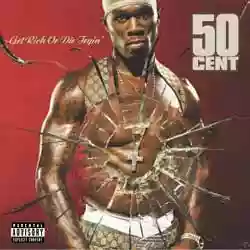
Without dwelling on the criminal events that certify the persona 50 Cent, aka Curtis Jackson, as a real tough guy perfectly inserted into the fabric of metropolitan underworlds, this guy who gets portrayed on the cover with an unsociable air fits perfectly into the role of Eminem's nemesis, with Dr. Dre's clear intent of mending the rift from that buying segment of his audience who even refuse the concept of a rapper being white.
Beyond considerations on other themes, we're faced with a good album: a deep voice that exudes "blackness" from every pore, overlaps and doubles of vocal tracks that denote mastery of rap technique, our friend (I wouldn't argue with him) never strays from that chanting and modulation at the end of the rhymes, Dr. Dre's trademark, which leaves a perfect balance or "matching" between the lyrics and the sounds.
Personally, I find this to be the strong point of the album: the production of sounds, from the selection of samples to their cut-and-sew, passing through the search for the best amplitudes in which to insert them (a tough job), then a commendable care of the beat speed.
In the end, the product, in its genre, results even refined.
Summarizing, Stars yes: 1) technical value/performance; 2) sales consensus/success/presence in the circuit; Stars no: 1) originality/ability to influence subsequent works/resilience over time; 2) subjective appreciation. I'm left only with the star I usually attribute for the artistic value of the work... days have passed and I still haven't decided: for that part of the parameter close to technical value, yes we are there, for the other, close to originality, no: the album interprets the format, it doesn't participate in its evolution, it adds nothing to what will come.
I try to rotate the problem, I try to approach it as a piece to hang and I see a print. One of those commercial prints that, with the glass frame, contribute so well to furnishing an apartment. But what is the message that the core of the album transmits to us? I decide to solve the problem by tracing back from its roots, and go retro to the heart of rap: the text. In less than 30 seconds I go to the official site for the translation of "in da club" (beautiful) and, among others, read: "...Look baby, I've got some ecstasy pills if you're into that... ...People heard I've affiliated with Dre, now they want to show me respect... 50 Cent loses the star and I lose another sliver of enthusiasm for American society.
Personal notation: Eminem's voice in this album (track 3), so important for pushing the commercial wave, reminded me of the taste of cheese on seafood spaghetti...
Loading comments slowly
Summary by Bot
This review acknowledges 50 Cent's Get Rich Or Die Tryin as a technically proficient and commercially successful album with strong production and expert rap delivery. However, it criticizes the album for lacking originality and long-term influence in the hip-hop genre. The critical view extends to some lyrical content, reflecting a certain disenchantment. Overall, the album is seen as a polished but conventional commercial product.Tracklist Lyrics Videos
50 Cent
50 Cent (Curtis James Jackson III) is an American rapper, actor, and entrepreneur from South Jamaica, Queens. Mentored by Eminem and Dr. Dre, he broke through in 2003 with the multi‑platinum album Get Rich or Die Tryin', powered by hits like In da Club, 21 Questions, and P.I.M.P. He co-founded G-Unit and has remained active across music and business.04 Reviews
