
 •
Rating:
•
Rating:
THE REVIEW
10cc is an English art-pop-rock band that formed as a quartet in 1972, reinvented itself in 1976 as a duo + other accompanying musicians, and essentially dispersed in 1983, although there were occasional, sporadic revivals. Their golden period, both commercially and creatively, is between the release of their third studio album "The Original Soundtrack" (1975) and the sixth, "Bloody Tourists"(1978).
In the middle, right after this fourth career album dated 1976, the fateful split is set between the more "song-oriented" half of the group, represented by bassist Graham Gouldman and lead guitarist Eric Stewart, and the other half more dedicated to experimentation and avant-garde, made up of guitarist and keyboardist Lol Creme and drummer Kevin Godley.
"How Dare You!" is the album where the band delves into strangeness and extravagance with more conviction, with special effects and studio alchemies, highlighting the genius and creative vision of the Creme/Godley duo, whose tendency towards multimedia and tout court art will be better realized in their later, celebrated, and influential career as video-makers.
This does not preclude a light yet skillful pop taste, inevitably Beatles-like (it's no coincidence that Stewart would later collaborate on some works with his idol McCartney), which is abundantly present even in this extravagant album, giving accessibility and lightness to much of the music. In short, 10cc, in its original and "classic" formation, worked fully on two levels: the light and accessible and the more noble and peculiar, definable as surreal, ironic, Dadaist, transgressive (but without overdoing it, with a very British composure).
An instrumental episode opens and titles ("How Dare You") the album, full of percussion and electronic sounds, a creativity exercise for the gifted Godley with a helping hand from his friend (since childhood) Creme on synthesizers. They are credited as authors, but at one point Stewart sneaks in with an unexpected hard rock guitar solo that showcases all his skill.
"Lazy Ways" is sung (lazily, as the title implies) by Stewart and doesn’t deserve particular praise, yet it shows the great quality and care in the arrangements, both light and complex at the same time, one of the group's most remarkable features.
"I Wanna Rule The World" mocks human delusions of grandiosity and is a true triumph of deep and high-pitched voices, achieved by respectively speeding up and slowing down the tapes during recording, over a continuously changing rhythm that culminates in a roaring, delirious speech: very close to Frank Zappa’s most irreverent things, albeit not as fierce. Creme is the author and main singer.
"I’m Mandy Fly Me" is inspired by an airline commercial. Released at its time as a single, it is structured as a five-minute mini-suite, full of melodic appeal yet with complete changes of rhythm and atmosphere. Listening to its first thirty seconds, before Stewart's relaxed and sunny singing arrives, you can understand several things about Radiohead’s "Ok Computer" period.
In "Iceberg" the band dives into a lavishly jazzy vocal arrangement, in the manner of Manhattan Transfer, sending the four voices up and down a wide tonal range while the rhythm section, as always, doesn't rest for a moment. Yet the standout timbre is Gouldman's.
"Art for Art’s Sake" is my favorite: a rock much more compact than the rest of the album, enhanced by a great guitar riff and an irresistible chorus. The usual Zappa-like inserts with crazy tapes and the masterful "cinematic" use of synthesizers complete the piece. Stewart shines in singing as well as with a nasally, but pointed guitar solo. It is one of those tracks consistently featured in their concert setlists.
"Rock’n’Roll Lullaby" showcases the special voice of Kevin Godley, a timbre from another era, rococo and with something of an old 78 rpm record, the ones played on gramophones. "Headroom" is another strongly "descriptive" pastiche, once again very jazzy in its rhythmic and swirling singing, primarily the domain of its main author Lol Creme.
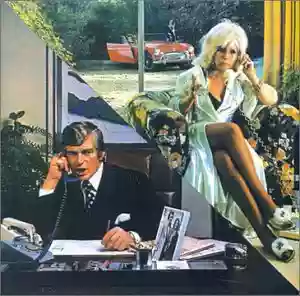
Grand finale with "Don’t Hang Up", the career masterpiece of drummer Kevin Godley. The best voice of this quartet (or at least the most surprising, with its retro flourishes and its sharp sweetness) here creates a small, authentic Musical. The story is about a He who calls a She (the ring of an old British phone opens the piece), he bores her with all his love and his concerns as she doesn't consider him, describes dreams and desires to share with her, pleads her "Don’t Hang Up"...
But in the end she hangs up!... and the track ends with the characteristic interrupted line sound of the British telephone company: irony and romance at an ultimate level in this delightful song/picture, a true movie little over six minutes long, with images left to the listener's imagination. The entire peculiarity of 10cc is well represented in this final passage of this terminal album of their most imaginative and histrionic period. Successful and well-executed works will follow, but almost entirely lightweight pop, albeit occasionally ironic and mischievous and experimental. The band will settle into a classy easy-listening yet increasingly less effective, "daring" less and less, the opposite of this substantial album.
Loading comments slowly
Summary by Bot
This review explores 10cc's 1976 album 'How Dare You!', highlighting its blend of experimental art-pop and accessible melodies. It reflects on the band's division into song-focused and avant-garde halves and praises their creative studio work. Key tracks like 'Art for Art's Sake' and 'Don't Hang Up' showcase their musical ingenuity. The album marked a peak of innovation before the band's shift to a lighter pop style.
10cc
10cc are an English art-pop/rock group formed in 1972 by Graham Gouldman, Eric Stewart, Kevin Godley and Lol Creme. All four members wrote, sang and played multiple instruments, blending Beatles/Beach Boys melodicism with Zappa-esque wit and studio experimentation. Their mid‑70s run produced hits like I’m Not in Love and Dreadlock Holiday; Godley & Creme left in 1976, while Stewart & Gouldman continued under the 10cc name.09 Reviews
