
 •
Rating:
•
Rating:
THE REVIEW
“Good morning, African Americans, any news?”
It’s December 1968 and Berry Gordy, the boss of Motown, pokes his head into the offices asking for updates on sales which, in his shrewd manager’s mind (nomen omen), he quickly translates into hard cash destined for his bank account to be spent on the upcoming Christmas festivities.
“Boss, this time I think you were wrong, Marvin’s Grapevine is literally crushing the version by Gladys Knight & The Pips. What’s more, they called from England and over there people are going wild too …”
Even if the dialogue is a product of my imagination, it’s certain that Gordy was quite happy to be proven wrong: since August 1966, when “I Heard It Through the Grapevine” was first recorded by the “Miracles,” he had blocked its release. A few months later, when Whitfield played Marvin Gaye’s version for him, he rejected it again, saying the song “wasn’t a hit” and that it “sucked.” In reply, Whitfield recorded yet another adaptation of the song with a completely different, more upbeat arrangement, stripped of the trademark organ riff, with “Gladys Knight & the Pips.” Released in September 1967, it became Motown’s biggest hit … up to that point, until October 1968, when Gordy finally allowed the release of Gaye’s version, which opens with the famous organ riff, dark and menacing, hinting at the despair inflicted by a lover’s betrayal and the shock of learning about it from others rather than hearing the truth directly from your partner (N.B. the English expression “I heard it through the grapevine” can be rendered in Italian as “l’ho sentito dire in giro”). This is also the first time Marvin sings in a much higher vocal register than usual, occasionally reaching falsetto, with a radical effect: it’s as if he had finally decided to open the cage where all those proverbial “inner demons” had been sedated until that moment.
But, let’s proceed in order: at the end of 1967, Marvin Gaye had released only one solo single in 18 months: “Your Unchanging Love,” in addition to the duet with Kim Weston, “It Takes Two,” and the duets with Tammi Terrell, “Ain’t No Mountain High Enough” and “Your Precious Love,” even though he had been in the studio recording an album since the first months of 1967.
Besides, Gordy’s project for Marvin had been clear from the start: to turn Gaye into an entertainer like Nat King Cole, and, until then, it had worked wonderfully; thanks to the excellent songwriting of Holland-Dozier-Holland, he had become the king of doo-wop, a genre focused on innocent love, joy, and melancholy, where the backing vocals and melodic lines often replace the instrumental accompaniment. Not only that. Recognizing Gaye’s natural talent for singing love songs, Gordy then always paired him with Motown female singers: Martha Reeves, Mary Wells, Kim Weston, Diana Ross, but above all, Tammi Terrell. The chemistry between Terri and Marvin was outstanding; the late Sixties were the golden age of duets and theirs was able to deliver high-quality music.
But “The Times They Are A-Changin’” warns the Bard of Duluth. The sixties, begun in the naïveté of the previous decade, would end marked by the blow of a harsher reality already revealed with the death of J.F. Kennedy in 1963 and that of M.L. King in 1967. Less than a year before the moon landing, Marvin had every reason to want a change of direction. What’s more, during a performance with Tammi at Hampden-Sydney College in October 1967, Terrell collapsed from exhaustion in Gaye’s arms. Terrell was later diagnosed with a brain tumor that sealed her fate, ended in Philadelphia on March 16, 1970. Chaos outside, chaos within: Gaye’s marriage to Anna Gordy (Berry’s sister and fifteen years his senior …) was turbulent, as were his personal rifts with his father-in-law, which had begun to create tension in his relationship with the label.
After all, the history of music, especially modern music, is made up of artists who play, compose and produce the music, and those who try to spread and promote it by starting labels or record companies; probably, Marvin Gaye’s career wouldn’t have been the same without Berry Gordy’s intervention: Marvin Gaye/Berry Gordy is perhaps the most emblematic of the relationships that have embodied the essence of soul music; that is, the clash-meeting between the pure spirituality of gospel and the commercial drive of the music industry. And if Gaye was able, in the ‘70s, to change themes and style completely, it was only because his great successes of the ‘60s had made him rich and famous, and therefore able to have total control over his own releases.
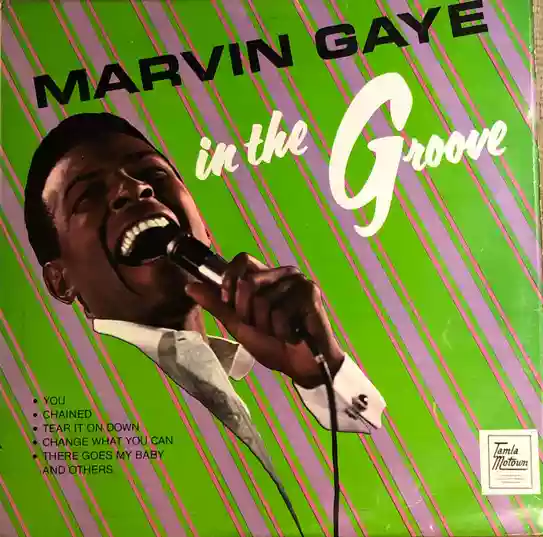
But we are not yet at the revolution of “What’s Going On” (the epoch-making album that rewrote the rules of soul music), and “In the Groove” (later re-issued as “I Heard It Through the Grapevine”) is a transitional album that nonetheless marks Marvin Gaye’s turning point towards a more mature and soul sound, deeply tied to the huge success of its (promoted) title track. Even when Gaye learned about its exceptional chart performance, he reacted coldly due to his depressed state; later, he told a biographer that he believed the song’s success was undeserved!
The album boasts the production of Norman Whitfield, Ashford & Simpson, and Frank Wilson and, moving away from the rigid Holland-Dozier-Holland formula, is characterized for the most part by a fierce groove that projects it towards a sound and themes that are more mature—a fact that is clear when listening to the three singles taken from the album, in addition to the title track, “You” and “Chained.” Although “You” doesn’t have a chorus as memorable as Grapevine, it is nonetheless treated the same way: frantic bass, tense strings, harpsichords, and flutes create a dizzying symphonic effect. The other single mostly follows the same approach, although here the powerful horn arrangement dominates the rest. In fact, it’s the very discontinuity between these tracks—in which we can also partly include “Loving You Is Sweeter Than Ever,” more for its sound than its lyrics—and those closer to Gaye’s earlier output (“Some Kind of Wonderful,” “Change What You Can,” “Every Now And Then,” and “There Goes My Baby”) that marks the album’s real limitation, with the second side, in particular, containing many soft covers that feel outdated compared to the new direction. And it’s undeniable that these changes coincided with many wider transformations in the overall sound of Black Music on the verge between the ‘60s and ‘70s: a magnificent era before Disco Music came along and swept everything away.
As an album, In The Groove suffers mostly from inconsistency: still, if the old-school tracks may seem misplaced alongside the startling innovations, there’s nothing wrong when the best moments are fantastic and the less successful ones aren’t enough to drag them down. After all, here we can listen to a new, improved Marvin Gaye, so what’s the problem if the old Marvin hasn’t entirely gone away yet?
Side A
- You - Jeffrey Bowen, Jack Coga (Goga), Ivy Jo Hunter
- Tear It on Down - Nickolas Ashford, Valerie Simpson
- Chained - Frank Wilson
- I Heard It Through the Grapevine - Barrett Strong, Norman Whitfield
- At Last (I Found a Love) - Marvin Gaye, Anna Gordy Gaye, Elgie Stove
- Some Kind of Wonderful - Gerry Goffin, Carole King
Side B
- Loving You Is Sweeter Than Ever - Ivy Jo Hunter, Stevie Wonder
- Change What You Can - Marvin Gaye, Anna Gordy Gaye, Elgie Stover
- It's Love I Need - Stephen Bowden, Ivy Jo Hunter
- Every Now And Then - Eddie Holland, Frank Wilson
- You're What's Happening (In The World Today) - George Gordy, Robert Gordy, Allen Story
- There Goes My Baby - Benjamin Nelson, Lover Patterson, George Treadwell
Loading comments slowly
Summary by Bot
The review explores Marvin Gaye's acclaimed album 'In The Groove', noting its standout tracks and timeless appeal. The reviewer praises Gaye's vocal mastery and the album's soulful production. Special mention is given to iconic hits like 'I Heard It Through the Grapevine'. The album is appreciated as a pivotal work in Gaye's career and in the Motown catalog.Tracklist
01 You (02:35)
02 Tear It On Down (02:54)
03 Chained (02:36)
04 I Heard It Through The Grapevine (02:59)
05 At Last (I Found A Love) (02:36)
06 Some Kind Of Wonderful (02:18)
07 Loving You Is Sweeter Than Ever (02:44)
08 Change What You Can (02:38)
09 It's Love You Need (02:54)
10 Every Now And Then (02:58)
11 You're What's Happening (In The World Today) (02:20)
12 There Goes My Baby (02:23)
Marvin Gaye
Marvin Gaye (1939–1984) was an American singer, songwriter, and producer who helped shape the Motown sound before redefining soul with the landmark album What’s Going On. He later explored sensual R&B with Let’s Get It On and I Want You, and crafted the candid divorce opus Here, My Dear. He died in 1984 in Los Angeles after being shot by his father.06 Reviews
